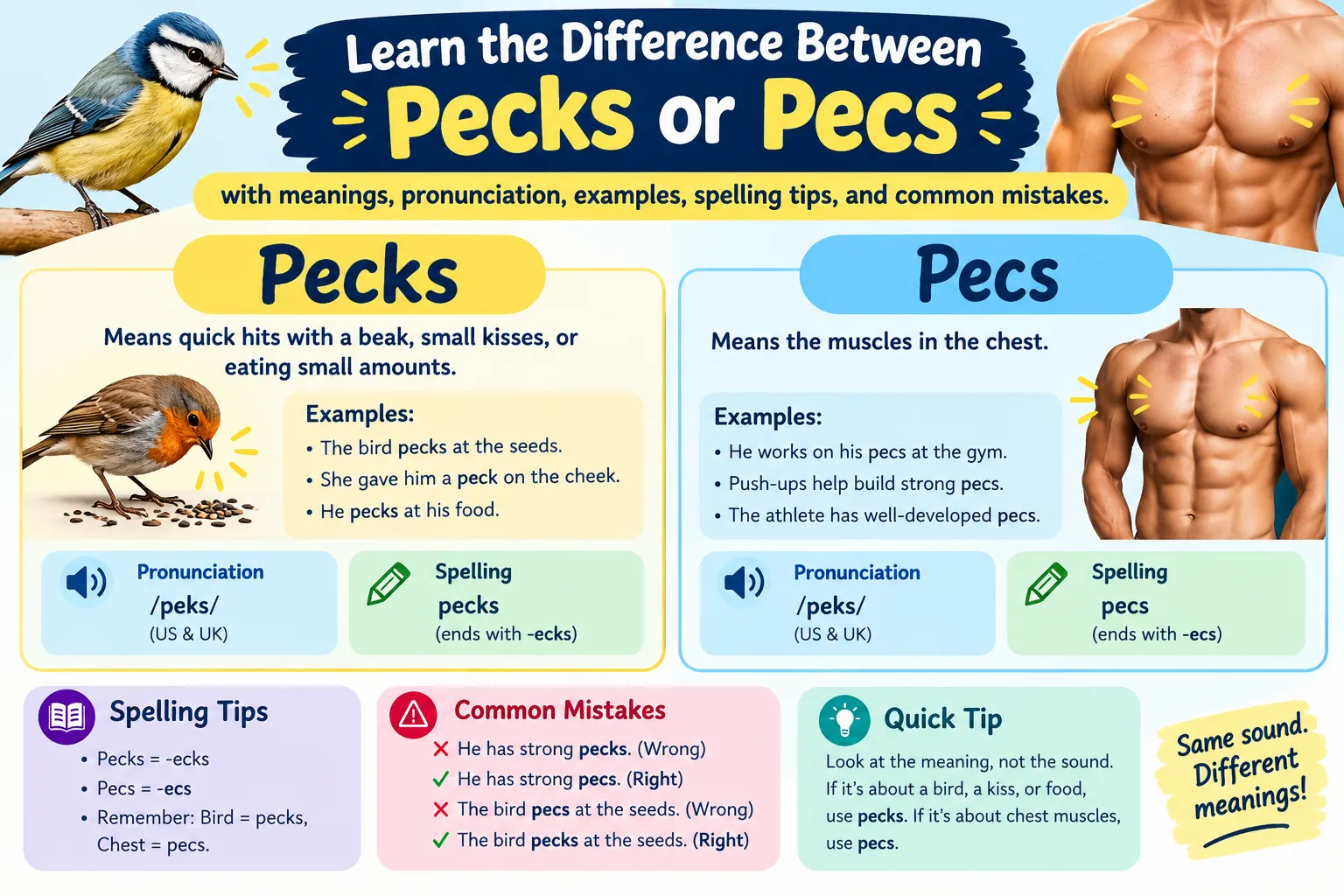
Pecks means quick bird hits, small kisses, or the action of pecking. Pecs means the muscles in your chest.
Imagine you are watching a bird in your garden. It pecks at seeds on the ground. Later, you go to the gym and see someone doing push-ups to build their chest muscles. You may hear a trainer talk about their pecs.
Both words sound the same, but they have different meanings and spellings. This can make them hard to tell apart when you hear them in a talk, video, or song.
People often search for pecks or pecs because they want to know which word is right. The answer depends on what they mean. If they are talking about birds, quick kisses, or small hits, pecks may be the right choice. If they are talking about chest muscles, they should use pecs.
In this guide, you will learn the meaning, spelling, sound, and use of both words. You will also see simple examples to help you choose the right word every time.
Pronunciation of Pecks and Pecs
Both words have the same sound in common US and UK English.
| Word | US pronunciation | UK pronunciation |
| Pecks | /peks/ | /peks/ |
| Pecs | /peks/ | /peks/ |
Say both words aloud. They sound alike, like the word checks without the first sound.
The meaning comes from the sentence, not the sound.
Example: “The bird pecks at the seeds” is about a bird. “He trains his pecs” is about chest muscles.
Difference Between Pecks and Pecs
The main difference is their meaning. Pecks is linked to pecking, while pecs is a short name for chest muscles.
Here are 10 easy ways to tell them apart.
1. Meaning
Pecks: Quick hits made with a bird’s beak, or quick kisses.
Pecs: The muscles in the chest.
Examples:
- The hen pecks at the corn.
- He works on his pecs at the gym.
2. Use with birds
Pecks: Can describe what a bird does with its beak.
Pecs: Does not mean a bird’s action.
Examples:
- The bird pecks at a piece of bread.
- The bird pecks at the seeds.
3. Use in fitness
Pecks: Does not usually refer to chest muscles.
Pecs: Means chest muscles, often in talk about exercise.
Examples:
- He trains his pecs twice a week.
- Push-ups can help work the chest muscles.
4. Use for kisses
Pecks: Can mean quick, light kisses.
Pecs: Does not mean kisses.
Examples:
- Grandma gives the child two pecks on the cheek.
- He gave his mother a quick peck on the cheek.
5. Part of speech
Pecks: Can be a verb or a plural noun.
Pecs: Is a plural noun in common use.
Examples:
- The chicken pecks at the ground. (Verb)
- He has strong pecs. (Noun)
6. Spelling
Pecks: Starts with p and ends with -ecks.
Pecs: Starts with p and ends with -ecs.
Examples:
- The bird pecks at the food.
- The coach helps him train his pecs.
7. Meaning in a story
Pecks: May describe a bird or a quick kiss.
Pecs: May describe a person’s chest muscles.
Examples:
- The little bird pecks at the window.
- The hero has broad pecs.
8. Use in a gym
Pecks: Is not the usual word for chest workouts.
Pecs: Is common in casual gym talk.
Examples:
- The trainer planned a workout for his pecs.
- She asked which moves work the chest muscles.
9. Use in daily talk
Pecks: Often comes up when people talk about birds or kisses.
Pecs: Often comes up when people talk about fitness or body shape.
Examples:
- The pigeons take small pecks at the crumbs.
- My brother wants to build his pecs.
10. How to choose the right word
Pecks: Use it for pecking actions, quick kisses, or more than one peck.
Pecs: Use it when you mean chest muscles.
Examples:
- The hen pecks at the ground.
- He trains his pecs after work.
Nature and Behaviour of Pecks and Pecs
How pecks are used
Pecks is linked to the word peck. A bird can peck at food or tap something with its beak. A person can also give someone a quick peck on the cheek.
The word can describe an action or a small, quick kiss.
Examples:
- The robin pecks at a worm.
- Dad gives me a peck before work.
The word pecks can also mean more than one peck.
What pecs are
Pecs is the short, informal name for the pectoral muscles. These muscles are in the chest. They help move the arms and shoulders.
People often use the word when talking about gym work, sports, or body fitness.
Examples:
- He does push-ups to work his pecs.
- The coach showed the class a chest exercise.
Why People Get Confused About Pecks and Pecs
People mix up these words because they sound alike. When we speak, we cannot see how a word is spelled.
For example, someone might say, “He trains his pecs.” A listener who does not know the word may write pecks instead.
The same problem can happen with a sentence about a bird. A person may hear “The bird pecks at the food” and write pecs by mistake.
The best way to avoid this error is to look at the meaning.
Ask yourself:
- Is the sentence about a bird, a quick kiss, or pecking? Use pecks if it fits.
- Is the sentence about chest muscles? Use pecs.
The words are homophones. This means they sound the same but have different meanings and spellings.
You May Also Like https://orchoice.com/hypothesis-or-hypotheses/
Comparison Table
| Feature | Pecks | Pecs |
| Main meaning | Bird hits, quick kisses, or pecking actions | Chest muscles |
| Part of speech | Verb or plural noun | Plural noun |
| Common setting | Birds, food, kisses | Gym, sports, fitness |
| Example | The bird pecks at the seed. | He trains his pecs. |
| Pronunciation | /peks/ | /peks/ |
| Same sound? | Yes | Yes |
| Spelling | Contains -ecks | Contains -ecs |
| Formal or informal? | Depends on use | Informal |
| Easy clue | Think of a bird’s beak | Think of chest muscles |
The Origin of Pecks and Pecs
Where does pecks come from?
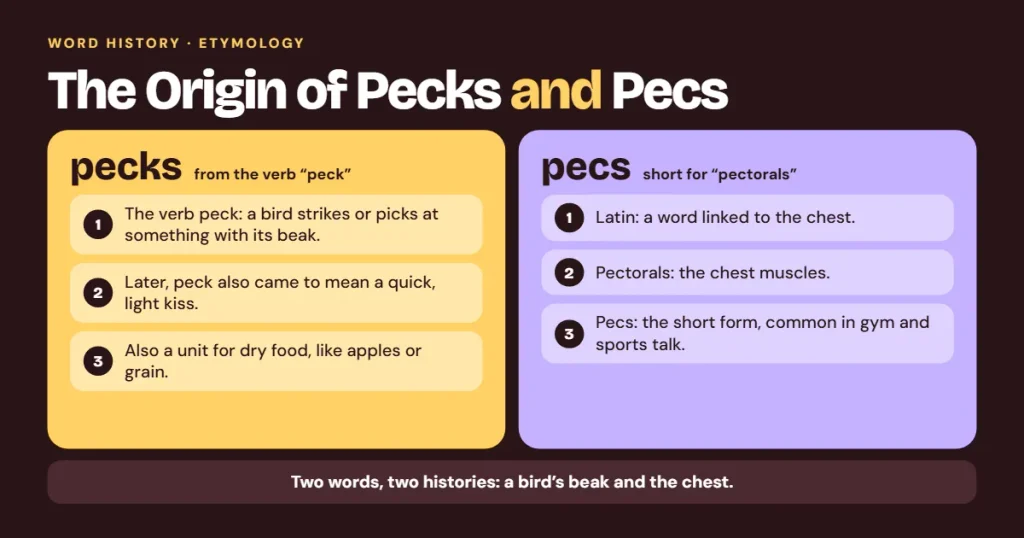
Pecks comes from the verb peck. English has used this word for many centuries to describe a bird striking or picking at something with its beak. Over time, peck also came to mean a quick kiss.
For example, “She gave him a peck on the cheek” means she gave him a short, light kiss.
The word peck can also name a unit used to measure dry food, such as apples or grain. In that sense, pecks is the plural form.
Where does pecs come from?
Pecs is a short form of pectorals, which means chest muscles. The word pectoral comes from Latin and is linked to the word for the chest.
The short form pecs became common in fitness and bodybuilding talk. It is now often used in gyms, sports stories, and everyday talk about exercise.
So, the two words have different histories. Pecks comes from a word linked to a bird’s beak. Pecs comes from a word linked to the chest.
British vs. American English
The main difference between pecks and pecs is the same in British and American English.
| Use | British English | American English |
| A bird’s action | The bird pecks at the food. | The bird pecks at the food. |
| A quick kiss | She gave him a peck on the cheek. | She gave him a peck on the cheek. |
| Chest muscles | He trains his pecs. | He trains his pecs. |
| Pronunciation | Both sound like /peks/. | Both sound like /peks/. |
There is no special US or UK spelling rule that changes one word into the other. The meaning is what matters.
In formal writing, pectoral muscles is clearer than pecs. In casual talk about exercise, pecs is common in both countries.
Which One Should You Use?
Choose the word that matches your meaning.
Use pecks when you talk about a bird picking at food, a quick kiss, or more than one peck.
Examples:
- The hen pecks at the corn.
- She gave her baby two pecks on the cheek.
Use pecs when you talk about the chest muscles.
Examples:
- He wants to build his pecs.
- The coach showed us how to work our pecs.
For readers around the world, the same rule works. If the topic is a bird or a kiss, pecks may be right. If the topic is chest muscles, use pecs.
Whether you are writing for school, use the full term pectoral muscles when you need a more formal style.
Common Mistakes
Here are some common errors and how to fix them.
Mistake 1: Using pecs for a bird
Incorrect: The chicken pecs at the seeds.
Correct: The chicken pecks at the seeds.
Why? The sentence is about what a chicken does with its beak.
Mistake 2: Using pecks for chest muscles
Incorrect: He works on his pecks at the gym.
Correct: He works on his pecs at the gym.
Why? The sentence is about chest muscles.
Mistake 3: Using pecs to mean kisses
Incorrect: She gave her dad two pecs on the cheek.
Correct: She gave her dad two pecks on the cheek.
Why? A quick kiss can be called a peck.
Mistake 4: Thinking the words sound different
The words pecks and pecs sound the same in common US and UK English. You cannot always choose the spelling by listening alone.
Mistake 5: Forgetting the meaning of the sentence
Always read the full sentence. The words around pecks or pecs can help you choose the right one.
Everyday Usage Examples
Here are examples of how you might see these words in daily life.
In emails
Pecks:
“Please keep the bird’s food bowl full. It pecks at the seeds each morning.”
Pecs:
“The gym coach has added chest exercises to my plan so I can work my pecs.”
In a formal email, you may want to write chest muscles instead of pecs.
On social media
Pecks:
“My little bird pecks at every seed in the bowl!”
Pecs:
“Chest day is done. Time to rest my pecs!”
In news stories
Pecks:
“A group of birds pecks at food left in the park.”
Pecs:
“The athlete has returned to training after a chest muscle injury.”
A news report may use pectoral muscle or chest muscle to make the meaning clear.
In formal writing
Pecks:
“The bird pecks at the seeds to pick up food.”
Pecs:
“The pectoral muscles help move the arms and shoulders.”
In formal work, it is often better to use clear words rather than slang.
Usage Trends
Both words are used today, but they appear in different settings.
Pecks is useful when people talk about birds, quick kisses, or repeated small hits. It may appear in stories about animals, nature, or family life.
Pecs is common in gym talk, fitness videos, sports news, and posts about exercise. It is a short and easy word for chest muscles.
The use of pecs is linked to fitness talk, while pecks has a wider range of meanings. There is no single spelling that replaces the other. Each word has its own job.
When writing online, use the word that fits the topic. This helps readers understand your message and helps search engines connect your page with the right meaning.
Metaphors and Similes
A metaphor compares one thing to another without using like or as. A simile makes a comparison using like or as.
Neither pecks nor pecs has one fixed metaphorical meaning. But both can appear in creative writing.
Examples with pecks
- Metaphor: “His words were pecks at her patience.” This means his words bothered her again and again.
- Simile: “The bird moved like a tiny machine, pecking at each seed.” This compares the bird’s repeated action to a machine.
Examples with pecs
- Metaphor: “His pecs were shields across his chest.” This describes strong chest muscles in a creative way.
- Simile: “His chest muscles stood out like two hills.” This gives the reader a picture of his chest.
These are creative examples, not fixed meanings of the words.
Connotative Meaning
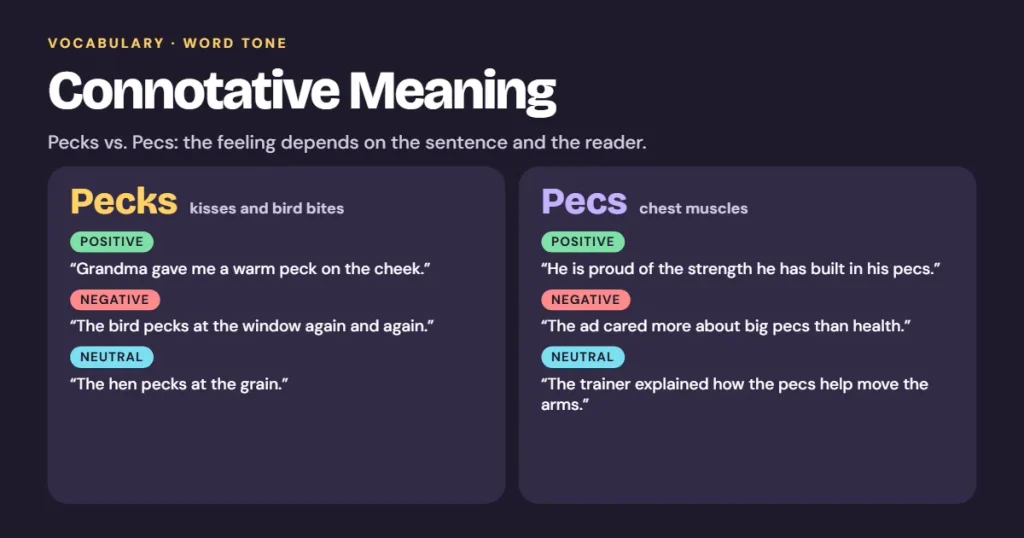
A word’s connotation is the feeling or idea it may bring to mind. The feeling can be positive, negative, or neutral.
Pecks
Positive: A peck can suggest a sweet, loving kiss.
Example: “Grandma gave me a warm peck on the cheek.”
Negative: Pecking can suggest repeated small attacks or annoying hits.
Example: “The bird pecks at the window again and again.”
Neutral: The word can simply describe a bird’s action.
Example: “The hen pecks at the grain.”
Pecs
Positive: The word may suggest strength, fitness, or hard work.
Example: “He is proud of the strength he has built in his pecs.”
Negative: In some settings, talk about pecs may focus too much on looks or body shape.
Example: “The ad cared more about big pecs than health.”
Neutral: The word can simply name chest muscles.
Example: “The trainer explained how the pecs help move the arms.”
The feeling depends on the sentence and the person who reads it.
Idioms and Proverbs
There is no common, well-known English proverb that depends on the spelling difference between pecks and pecs. Still, peck appears in some useful phrases.
A peck on the cheek
This means a quick, light kiss.
Example: “She gave her son a peck on the cheek before school.”
Peck at your food
This means to eat only small amounts, often without much interest.
Example: “He was worried, so he only pecked at his lunch.”
Pecking order
A pecking order is the order of rank or power in a group. The phrase comes from the way birds may peck at one another to show rank.
Example: “The new worker soon learned the pecking order in the office.”
Pecs
Pecs does not have a common idiom of its own. It is usually a plain, informal name for chest muscles.
Example: “He does push-ups to work his pecs.”
Literature and Movies
The words can appear in stories, films, and other forms of writing, but they are not often the main subject of a famous book or movie.
Literature
The phrase “pecking order” can be used in stories about school, work, families, or groups of animals. It helps show who has the most power and who follows others.
For example, a story about a school team may show a pecking order when one student leads the group and others follow.
The old children’s rhyme “Peter Piper” is also known for its repeated p sounds: “Peter Piper picked a peck of pickled peppers.” It is a traditional tongue twister, and its exact first publication date is uncertain.
Movies
The word peck may appear in a family film when one character gives another a quick kiss, or in an animal film when a bird pecks at food. Pecs may appear in a sports or fitness film when people talk about chest muscles.
One well-known film title that includes a similar-looking word is To Kill a Mockingbird (1962, United States), starring Gregory Peck. Here, Peck is the actor’s surname, not the word pecks or the fitness term pecs.
This is a useful reminder: words that look or sound alike do not always have the same meaning.
Why This Difference Matters
Using the right word helps you share your ideas clearly.
If you write “The bird pecs at the food,” a reader may stop and wonder what you mean. If you write “He trains his pecks,” the reader may think you mean bird actions or kisses instead of chest muscles.
The correct spelling avoids this confusion.
This difference also matters for students, teachers, writers, and people who post online. Good spelling helps readers trust your writing. It also helps people find the right information when they search online.
The key is simple: think about the meaning before you write the word.
Usefulness in Daily Life
You may see pecks and pecs in many places.
- At home: A bird pecks at food in its bowl.
- With family: A person gives a quick peck on the cheek.
- At the gym: A trainer talks about working the pecs.
- At school: A student learns how birds use their beaks.
- Online: A fitness post may mention chest exercises and pecs.
- At work: A writer may choose pectoral muscles for a formal report.
Situational Preference
Use pecks when the sentence is about a bird picking at food, a quick kiss, or repeated small hits. For example, “The hen pecks at the grain” and “She gave him a peck on the cheek” are correct. Use pecs when the sentence is about chest muscles, especially in gym or sports talk. For example, “He trains his pecs every week.” In school or formal writing, chest muscles or pectoral muscles may be clearer than pecs. In US and UK English, the main rule is the same. Think about the meaning, then choose the spelling that fits.
Possible Queries
1. What is the difference between pecks and pecs?
Pecks can mean bird hits, quick kisses, or the act of pecking. Pecs means chest muscles.
2. Do pecks and pecs sound the same?
Yes. In common US and UK English, both are pronounced /peks/.
3. Is pecs short for pectoral muscles?
Yes. Pecs is an informal short form of pectorals, which means chest muscles.
4. Can pecks mean kisses?
Yes. A peck can mean a quick, light kiss, often on the cheek.
5. Which word should I use at the gym?
Use pecs when talking about chest muscles. For example, “This exercise works your pecs.”
6. Is pecks a verb or a noun?
It can be both. In “The bird pecks at the seeds,” it is a verb. In “She gave him two pecks,” it is a plural noun meaning quick kisses.
7. Are the spellings different in British and American English?
No. The main spellings and meanings are the same in both varieties of English.
Conclusion
The difference between pecks and pecs is easy to learn. The words sound the same, but they have different meanings. Use pecks when talking about a bird hitting something with its beak or giving a quick kiss. For example, “The bird pecks at the seeds” and “She gave her dad a peck on the cheek” are both correct. Use pecs when talking about the muscles in the chest. For example, “He works on his pecs at the gym” is correct. In formal writing, you can use chest muscles or pectoral muscles instead. This rule applies to both British and American English. If you are unsure, read the sentence and ask yourself whether it is about a bird, a kiss, or chest muscles. With a little practice, you can use both words correctly in schoolwork, emails, social media posts, and everyday conversations.

I’m Samia Jamshaid, an English language specialist, SEO specialist, digital publisher, and researcher. I create clear, accurate, and well-researched content on English grammar, vocabulary, word meanings, and language comparisons, helping readers understand and use English with confidence.



1 thought on “Pecks or Pecs: What Is the Difference?2026”