Do you sometimes confuse quit, quite, and quiet? You are not alone. These three English words look almost the same, but they have different meanings. Using the wrong word can change the meaning of your sentence.
The easiest way to remember them is to focus on what you want to say. Use quit when you mean to stop doing something or leave a job. Utilize quite when you want to show how much, how far, or to what degree something is true. Use quiet when you mean little noise, silence, or peace.
Look at these examples:
- I want to quit smoking.
- The test was quite easy.
- Please be quiet in the library.
Each word has a different job in the sentence. Quit is usually a verb, quite is an adverb, and quiet is most often an adjective. Their sounds are also different. Quit and quite have one syllable each, while quiet usually has two.
In this guide, you will learn their meanings, pronunciations, spelling patterns, grammar rules, and common mistakes. You will also find a comparison table, easy memory tips, daily examples, and a short quiz to test your knowledge.
1. What Does Quit Mean?
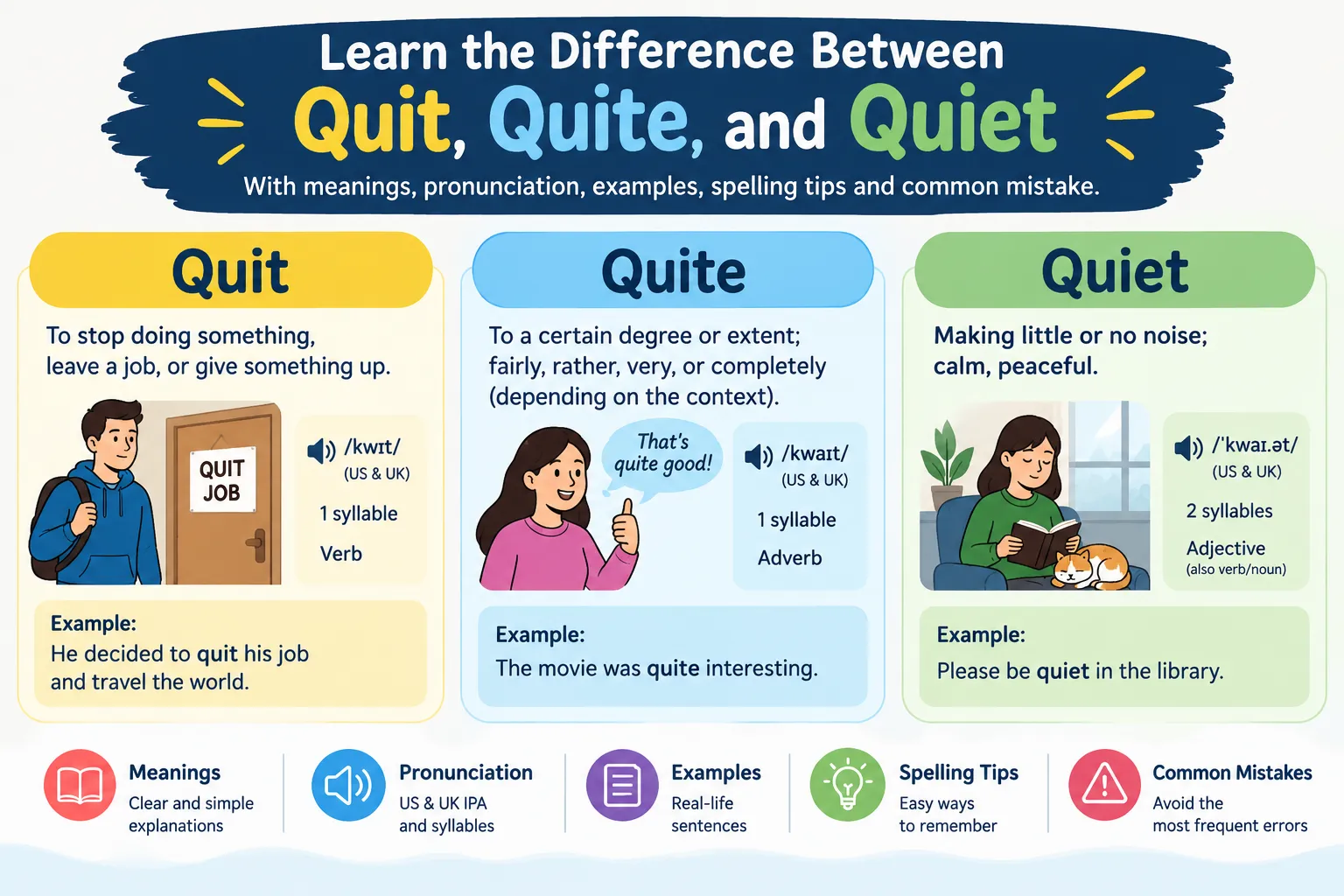
Quit is a verb. It means to stop doing something, leave a job or place, or give up an activity.
Meaning of quit
- To stop an activity or habit.
- To leave a job, school, or position.
- To stop taking part in something.
Examples of quit
- She decided to quit smoking.
- He will quit his job next month.
- Do not quit when the work becomes hard.
- They quit the game because it started raining.
- I want to quit wasting time on my phone.
Pronunciation of quit
- US IPA: /kwɪt/
- UK IPA: /kwɪt/
- Syllables: 1
- Part of speech: Verb
Say the word with a short vowel sound, like the vowel in sit. Do not add an extra syllable.
Forms of quit
| Form | Example |
| Present | I quit when I need to. |
| Past | She quit her job yesterday. |
| Past participle | He has quit smoking. |
| -ing form | They are quitting the team. |
2. What Does Quite Mean?
Quite is an adverb. It tells us the degree or extent of something. Depending on the sentence and the type of word it describes, it can mean fairly, rather, very, or completely.
Meaning of quite
- Fairly or to some degree.
- Very or to a high degree.
- Completely or entirely in certain expressions.
Examples of quite
- The book was quite interesting.
- I am quite tired after the walk.
- Are you quite sure about your answer?
- The two pictures are quite different.
- We waited for quite a long time.
- I am not quite ready yet.
Pronunciation of quite
- US IPA: /kwaɪt/
- UK IPA: /kwaɪt/
- Syllables: 1
- Part of speech: Adverb
The vowel sound is the same as in my or light. The final e is silent. It changes the vowel sound compared with quit; it does not add another syllable.
3. What Does Quiet Mean?
Quiet describes a person, place, or thing that makes little or no noise. It can also describe a calm place or a time with little activity.
Meaning of quiet
- Making little or no noise.
- Calm and peaceful.
- Without much activity or disturbance.
Examples of quiet
- Please be quiet while the baby sleeps.
- Our street is quiet at night.
- She is a quiet student who listens carefully.
- I enjoy reading in a quiet room.
- The town becomes quiet after sunset.
Quiet can also be used as a verb, as in “Please quiet the crowd,” and as a noun, as in “I enjoy the quiet.” However, its most common use for learners is as an adjective.
Pronunciation of quiet
- US IPA: /ˈkwaɪ.ət/
- UK IPA: /ˈkwaɪ.ət/
- Syllables: 2
- Part of speech: Usually an adjective
Say it slowly in two parts: qui-et. Remember that quiet has an extra vowel sound and an extra syllable compared with quite.
4. Quit vs. Quite vs. Quiet: Key Differences
| Word | Main meaning | Part of speech | Syllables | Example |
| Quit | Stop or leave | Verb | 1 | I will quit smoking. |
| Quite | To a degree or completely | Adverb | 1 | The room is quite large. |
| Quiet | Not noisy or peaceful | Usually adjective | 2 | The room is quiet. |
The main rule is simple:
- Quit = stop
- Quite = degree
- Quiet = silence or calm
5. How to Remember the Spelling
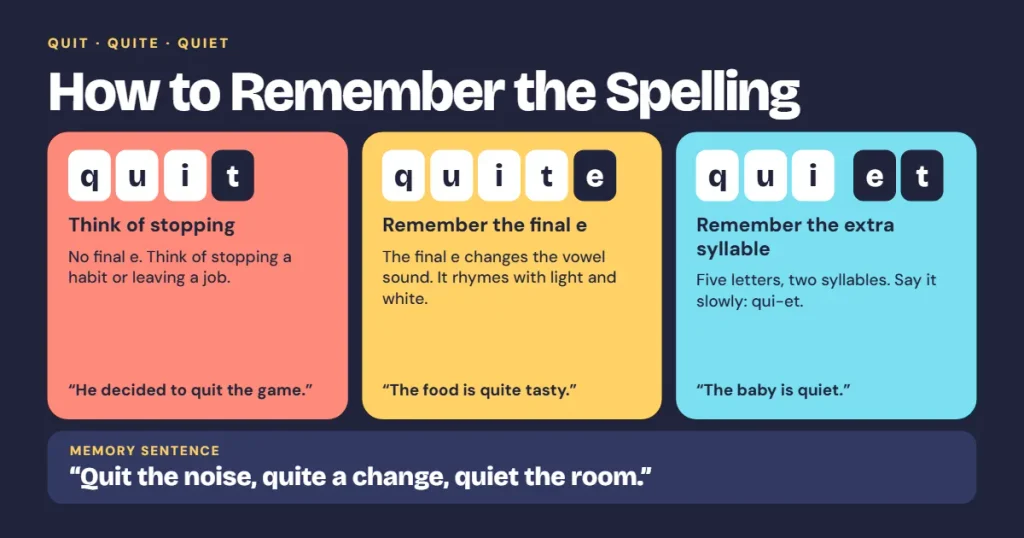
These words are easier to remember when you connect each spelling with its meaning.
Quit: Think of stopping
The word quit has no final e. Think of stopping a habit, leaving a job, or giving up an activity.
Example: He decided to quit the game.
Quite: Remember the final e
The final e changes the vowel sound. Quite rhymes with light and white.
Example: The food is quite tasty.
Quiet: Remember the extra syllable
Quiet has five letters and two syllables. Say it slowly to hear both parts.
Example: The baby is quiet.
A useful memory sentence is:
“Quit the noise, quite a change, quiet the room.”
It uses all three words, but remember that quit and quiet have different meanings: to quit is to stop or leave, while to quiet something is to make it less noisy.
For further information https://orchoice.com/pecks-or-pecs/
6. Common Mistakes with Quit, Quite, and Quiet
Mistake 1: Using quite instead of quit
Incorrect: I want to quite my job.
Correct: I want to quit my job.
Why? The sentence means that you want to leave your job, so you need the verb quit.
Mistake 2: Using quiet instead of quite
Incorrect: The lesson was quiet easy.
Correct: The lesson was quite easy.
Why? The word describes the degree of difficulty, so use the adverb quite.
Mistake 3: Using quite instead of quiet
Incorrect: Please be quite.
Correct: Please be quiet.
Why? You are asking someone to make little or no noise.
Mistake 4: Adding a syllable to quite
Incorrect idea: Saying quite as two syllables.
Correct: Quite has one syllable. Quiet has two.
Mistake 5: Thinking quite always means very
Quite does not always mean very. It can mean fairly or completely, depending on context.
Example: I am quite tired, but I can still walk.
Mistake 6: Forgetting the grammar
- I quit the club. (Quit is a verb.)
- The club is quite popular. (Quite modifies the adjective popular.)
- The club is quiet today. (Quiet describes the club.)
7. Quit, Quite, and Quiet in Everyday English
Here are examples of how the words appear in common situations.
At work
- I may quit my job if I find a better one.
- The new task is quite difficult.
- The office is quiet early in the morning.
At school
- He wanted to quit the team.
- The homework was quite simple.
- The class became quiet during the test.
In home
- She plans to quit drinking sugary drinks.
- It is quite cold outside.
- Please keep the house quiet while the baby sleeps.
While travelling
- They decided to quit the trip early.
- The journey was quite long.
- We stayed in a quiet village.
These examples show why spelling matters. Each word gives a different meaning to the sentence.
8. British and American English: Does Quite Mean Something Different?
The word quite can be understood differently in British and American English. However, the difference is not absolute, and the meaning depends on the sentence.
In British English, quite can mean fairly or to some degree.
Example: The film was quite good.
In some contexts, British speakers also use quite to mean completely or very, especially with words that express an extreme quality.
Example: The view was quite amazing.
In American English, quite often means very, really, or completely.
Example: The result was quite impressive.
These are general patterns, not strict rules. Readers should consider the whole sentence rather than assuming that quite always has one meaning in a particular country.
9. A Simple Comparison to Check Your Understanding
Read each sentence and notice the job of the bold word.
- I will quit if the game becomes unfair.
- This is quite a big house.
- The streets are quiet after midnight.
- She has quit eating junk food.
- The answer is quite clear.
- We need a quiet place to study.
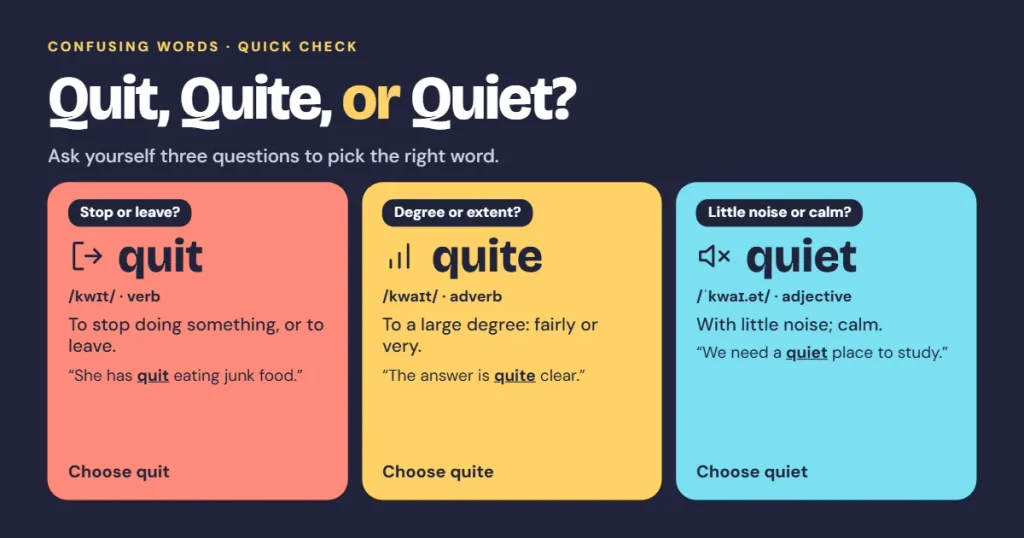
Ask yourself three questions:
- Does the sentence mean stop or leave? Choose quit.
- Does it express a degree or extent? Choose quite.
- Does it describe little noise or calm? Choose quiet.
10. Practice Quiz: Quit, Quite, or Quiet?
Choose the correct word to complete each sentence.
- I want to ______ my bad habit.
- Please be ______ while the teacher is speaking.
- The movie was ______ funny.
- She decided to ______ her job.
- Our neighborhood is very ______ at night.
- Are you ______ sure about the answer?
- He has ______ playing the game.
- The room became ______ after the music stopped.
- It was ______ a long journey.
- Do not ______ trying to learn English.
Quiz answers
- Quit
- Quiet
- Quite
- Quit
- Quiet
- Quite
- Quit
- Quiet
- Quite
- Quit
Quick challenge: Write one sentence using each word. Then check whether each sentence matches the word’s meaning.
11. Possible Asked Questions
1. What is the difference between quit and quite?
Quit means to stop doing something or leave a job. Quite is an adverb that expresses degree or extent.
Examples:
- I will quit smoking.
- The book is quite interesting.
2. What is the difference between quite and quiet?
Quite shows how much or to what degree something is true. Quiet means making little noise or being calm.
Examples:
- The room is quite large.
- The room is quiet.
3. How many syllables do quit, quite, and quiet have?
Quit has one syllable. Quite also has one syllable. Quiet usually has two syllables.
4. Is quit a verb?
Yes. Quit is mainly used as a verb meaning to stop, leave, or give up something.
Example: He decided to quit his job.
5. Is quite an adjective?
No. Quite is an adverb. It often describes an adjective, another adverb, or sometimes a verb.
Example: The test was quite easy.
6. Can quiet be a verb?
Yes. Quiet can be a verb meaning to make someone or something less noisy.
Example: The teacher tried to quiet the class.
7. Does quite always mean very?
No. It can mean fairly, rather, very, or completely, depending on the sentence and context.
Example: I am quite tired can mean fairly tired. The two answers are quite different means they are completely different.
Conclusion
The words quit, quite, and quiet look similar, but they have different meanings and uses. Once you understand these differences, you can choose the right word with confidence. Use quit when you mean to stop an activity, leave a job, or give something up. Use quite when you want to express a degree or extent, and use quiet when you mean little noise, silence, or peace. Remember their pronunciation, too: quit and quite have one syllable, while quiet has two. The vowel sound in quit is short, while quite has the vowel sound heard in light. Read the examples, practice the quiz, and try using all three words in your own sentences. A little practice each day will help you avoid spelling mistakes and improve your English writing.

I’m Samia Jamshaid, an English language specialist, SEO specialist, digital publisher, and researcher. I create clear, accurate, and well-researched content on English grammar, vocabulary, word meanings, and language comparisons, helping readers understand and use English with confidence.