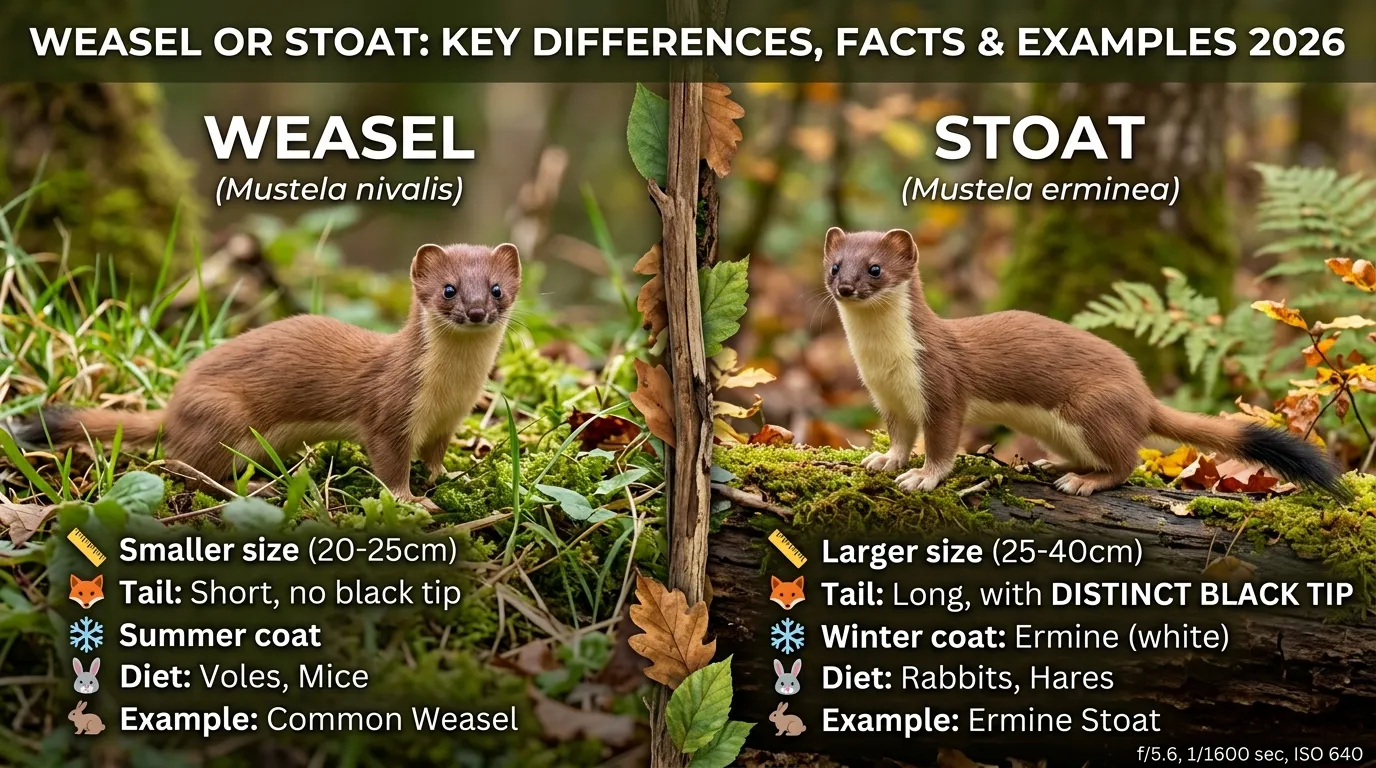
A weasel is smaller, while a stoat is larger and has a black-tipped tail. Both animals are small, fast, and good hunters. They have long bodies, short legs, and brown fur. They can be hard to spot because they move quickly and often hide in grass, bushes, and other cover.
Imagine walking through a field. A small brown animal suddenly runs across your path. You see it for only a few seconds. Was it a weasel or a stoat? Many people ask this question because the two animals look very much alike.
The easiest way to tell them apart is to look at the tail. A stoat has a longer tail with a black tip. A weasel has a short tail without a black tip. Stoats are also usually bigger than British weasels.
The names can also change by country. In Britain, weasel usually means Mustela nivalis. Stoat means Mustela erminea. In North America, Mustela erminea is often called a short-tailed weasel or ermine.
Weasel or Stoat Pronunciation
| Word | US Pronunciation | UK Pronunciation |
| Weasel | /ˈwiːzəl/ | /ˈwiːzəl/ |
| Stoat | /ˈstoʊt/ | /ˈstəʊt/ |
Difference Between Weasel and Stoat
1. Scientific Name
The British weasel is called Mustela nivalis. The stoat is called Mustela erminea. They are two different species.
Examples:
- The guide said the animal was a weasel.
- The black tail tip showed that it was a stoat.
2. Size
In Britain, weasels are smaller than stoats. British weasels are about 17–22 cm long. Stoats are usually longer.
Examples:
- The tiny animal looked like a weasel.
- The larger animal looked like a stoat.
3. Tail
The tail is the best clue.
A stoat has a longer tail with a black tip. A weasel has a much shorter tail with no black tip.
Examples:
- The black tail tip showed it was a stoat.
- The short brown tail suggested a weasel.
4. Winter Coat
Some stoats turn white in winter. Their black tail tip stays black. This white coat is called ermine.
British weasels stay brown in winter.
Examples:
- We saw a white stoat in the snow.
- The weasel stayed brown during winter.
5. Fur Pattern
Both animals have brown fur on top and pale fur underneath.
A stoat often has a clear line between the brown and pale fur. A weasel often has a less even line.
Examples:
- The clear color line helped identify the stoat.
- The uneven line suggested a weasel.
6. Running Style
Both animals can run very fast.
A stoat may look more bouncy when it runs. A weasel often stays low to the ground.
This clue is useful, but the tail is more reliable.
Examples:
- The animal bounced across the field like a stoat.
- The small animal ran low through the grass.
7. Food
Weasels mainly hunt small animals such as mice and voles. Their thin bodies help them enter small animal holes.
Stoats also eat small animals. They can hunt larger prey, including rabbits. They may also eat birds and eggs.
Examples:
- The weasel caught a mouse.
- The stoat hunted a rabbit.
8. Where They Live
Both animals can live in many places.
You may find them near:
- grasslands
- farms
- woods
- hedges
- walls
- areas with thick plants
Examples:
- We saw signs of a weasel near the hedge.
- A stoat crossed the open field.
9. Tracks
Both animals have five toes on each foot. Their tracks can look very similar.
Stoat tracks are usually bigger than weasel tracks. Still, tracks can be hard to identify on their own.
Examples:
- The larger tracks may have been made by a stoat.
- The tiny tracks could have come from a weasel.
10. Names by Country
This is an important point.
In Britain, weasel usually means Mustela nivalis. Stoat means Mustela erminea.
In North America, Mustela erminea is often called the short-tailed weasel or ermine.
Examples:
- A British book may call the animal a stoat.
- An American book may call it a short-tailed weasel.
Nature and Behaviour
Weasels and stoats belong to the mustelid family. This family also includes otters, badgers, mink, martens, and wolverines.
Both animals have long bodies and short legs. They are strong hunters for their size.
Weasels are very good at hunting mice and voles. Their slim bodies let them move through small holes.
Stoats can also hunt small animals. They can take larger prey, such as rabbits.
Both animals can be active during the day and at night. They often stay hidden, so people may only see them for a few seconds.
Keep exploring https://orchoice.com/rogue-or-rouge/
Why People Get Confused
Weasels and stoats look alike.
Both have:
- long bodies
- short legs
- brown upper fur
- pale underparts
- sharp claws
- fast movements
They also live in many of the same places.
The tail gives you the best clue.
Stoat = black-tipped tail.
Weasel = short brown tail with no black tip.
Comparison Table
| Feature | Weasel | Stoat |
| British scientific name | Mustela nivalis | Mustela erminea |
| Size | Smaller | Larger |
| Body | Long and very slim | Long and slim |
| Tail | Short and brown | Longer with black tip |
| Winter coat in Britain | Stays brown | May turn white |
| Tail in winter | Brown | Black tip stays |
| Fur underneath | Pale or white | Pale or cream |
| Main food | Mice and voles | Small animals and rabbits |
| Tracks | Usually smaller | Usually larger |
| British name | Weasel | Stoat |
| North American name for M. erminea | — | Short-tailed weasel or ermine |
Origin of the Words
The word weasel is very old. It comes from Old English words linked to the animal. Its deeper origin is not fully clear.
The word stoat is also very old. It appeared in older forms of English many centuries ago. Its exact origin is not certain.
The word ermine came into English through French. It can refer to the stoat and its valuable white winter fur.
British vs American English
| Region | Common Name | Scientific Name | Extra Notes |
|---|---|---|---|
| Britain | Weasel | Mustela nivalis | Usually refers to the weasel species. |
| Britain | Stoat | Mustela erminea | The common British name for this animal. |
| Britain | Ermine | Mustela erminea | Can refer to a stoat, especially its white winter fur or the fur itself. |
| North America | Short-tailed weasel | Mustela erminea | A common name for the animal called a stoat in Britain. |
| North America | Ermine | Mustela erminea | Also used for this animal and its white winter fur. |
| North America | Long-tailed weasel | Mustela frenata | A different weasel species. |
| North America | Least weasel | Mustela nivalis | Another different weasel species. |
Which One Should You Use?
Use weasel when you mean the British animal Mustela nivalis.
Use stoat when you mean Mustela erminea in British English.
If you are writing for American readers, be careful with the word weasel. It can refer to several species.
If you are not sure which animal you mean, use the scientific name or explain its features.
For example:
“The animal had a long tail with a black tip.”
Common Mistakes
Mistake 1: Thinking a stoat and a weasel are the same animal
They are different species in the usual British comparison.
Mistake 2: Looking only at the color
Both animals can have brown upper fur and pale lower fur.
Look at the tail too.
Mistake 3: Forgetting the black tail tip
A black tail tip is the easiest clue for a stoat.
Mistake 4: Thinking every white weasel is a stoat
In Britain, weasels stay brown in winter. Some stoats turn white.
Mistake 5: Using the same name in every country
American guides may use short-tailed weasel for Mustela erminea.
Mistake 6: Using size as the only clue
Stoats are usually bigger, but size can be hard to judge when an animal moves quickly.
Everyday Usage Examples
In an Email
“I think we saw a weasel near the garden.”
This works when talking about a wildlife sighting.
On Social Media
“We spotted a stoat today. Its black tail tip was easy to see.”
This gives readers a useful clue.
In a News Article
“A stoat was seen near the village this morning.”
This is simple and clear.
In Formal Writing
“The stoat can be told apart from the weasel by its black-tipped tail.”
This works well in school or nature writing.
Usage Trends
The word weasel is more common in everyday English than stoat.
Stoat is a more specific animal name. It often appears in wildlife books, nature guides, and British writing.
Weasel also has another meaning.
Calling someone a weasel can mean that the person is sneaky or not trustworthy.
The phrase weasel out means to avoid something you should do.
For example:
“He tried to weasel out of his promise.”
Metaphors and Similes
Weasel-like
“Weasel-like” can describe someone who seems sneaky.
Example:
“His weasel-like actions made people worried.”
Weasel out
This means to avoid a duty or promise.
Example:
“She tried to weasel out of the deal.”
Stoat-like
“Stoat-like” is not common in everyday English.
A writer may use it to suggest speed or alertness.
Example:
“The boy moved like a stoat through the grass.”
Connotative Meaning
The animal meanings of weasel and stoat are neutral.
But weasel can have a negative meaning when used for a person.
It may suggest that someone is:
- sneaky
- tricky
- dishonest
- hard to trust
Idioms and Proverbs
Weasel out of
This means to avoid a duty or promise.
Example:
“He tried to weasel out of his promise.”
Weasel words
This means words that are vague or misleading.
Example:
“The writer used weasel words instead of giving a clear answer.”
Pop Goes the Weasel
Pop Goes the Weasel is a well-known English nursery rhyme and song.
Literature and Movies
Weasels and stoats appear in books, stories, and films.
One famous example is The Wind in the Willows by Kenneth Grahame. The book includes weasels and stoats among its animal characters.
Stories may use animals to show ideas such as speed, danger, cleverness, or mischief. A fictional animal does not always behave exactly like the real animal.
Why the Difference Matters
Knowing the difference helps you describe wildlife correctly.
It can help with:
- school projects
- nature walks
- wildlife photos
- animal reports
- field guides
- nature videos
- animal tracking
A British source may use stoat. An American source may use short-tailed weasel for the same species, Mustela erminea.
Usefulness in Daily Life
You may not see a stoat or weasel often. Both animals are quick and often stay hidden.
Still, knowing the difference can help when you:
- see one on a walk
- watch a nature video
- read a wildlife book
- look at a trail-camera photo
- study animal tracks
- write about wildlife
When you see one, look at the tail first.
Black tip = stoat.
Short brown tail = weasel.
Situational Preference: Which Word Fits Best?
Use weasel for Mustela nivalis when writing about British wildlife. Use stoat for Mustela erminea in British English. For American readers, check the species name because Mustela erminea is often called a short-tailed weasel or ermine. If you are unsure, describe the animal or give its scientific name. This helps in schoolwork, wildlife reports, social media posts, and nature writing. The black tail tip is also a useful clue when you see the animal in the wild. A clear description helps readers understand exactly which animal you mean.
What People Ask About Weasel or Stoat
1. Is a stoat a weasel?
A stoat and a weasel are different species in the usual British comparison. The stoat is Mustela erminea. The British weasel is Mustela nivalis.
2. How can you tell a stoat from a weasel?
Look at the tail. A stoat has a longer tail with a black tip. A weasel has a short brown tail without a black tip.
3. Is a stoat bigger than a weasel?
Yes. British stoats are generally larger than British weasels.
4. Do stoats turn white in winter?
Some stoats turn partly or fully white in winter. Their black tail tip stays visible.
5. Do weasels turn white in winter?
British weasels do not turn white in winter. Their brown coat remains.
6. What is a stoat called in America?
In North America, Mustela erminea is often called the short-tailed weasel or ermine.
7. What do stoats and weasels eat?
Weasels mainly eat small animals such as mice and voles. Stoats also eat small animals and can take larger prey, such as rabbits.
Conclusion
Weasel or stoat can look very similar, but they are not the same animal. In Britain, a weasel is usually smaller and has a short tail without a black tip. A stoat is larger and has a longer tail with a black tip. Some stoats also turn white in winter. The names can differ in North America, where stoats are often called short-tailed weasels or ermines. Knowing these simple differences can help you identify each animal. Whether you are reading a wildlife guide, writing about animals, or spotting one outdoors, the tail is one of the easiest clues to check. Understanding weasel or stoat also helps you use the right name for your region.

I’m Samia Jamshaid, an English language specialist, SEO specialist, digital publisher, and researcher. I create clear, accurate, and well-researched content on English grammar, vocabulary, word meanings, and language comparisons, helping readers understand and use English with confidence.








1 thought on “Weasel or Stoat: Key Differences, Facts & Examples 2026”