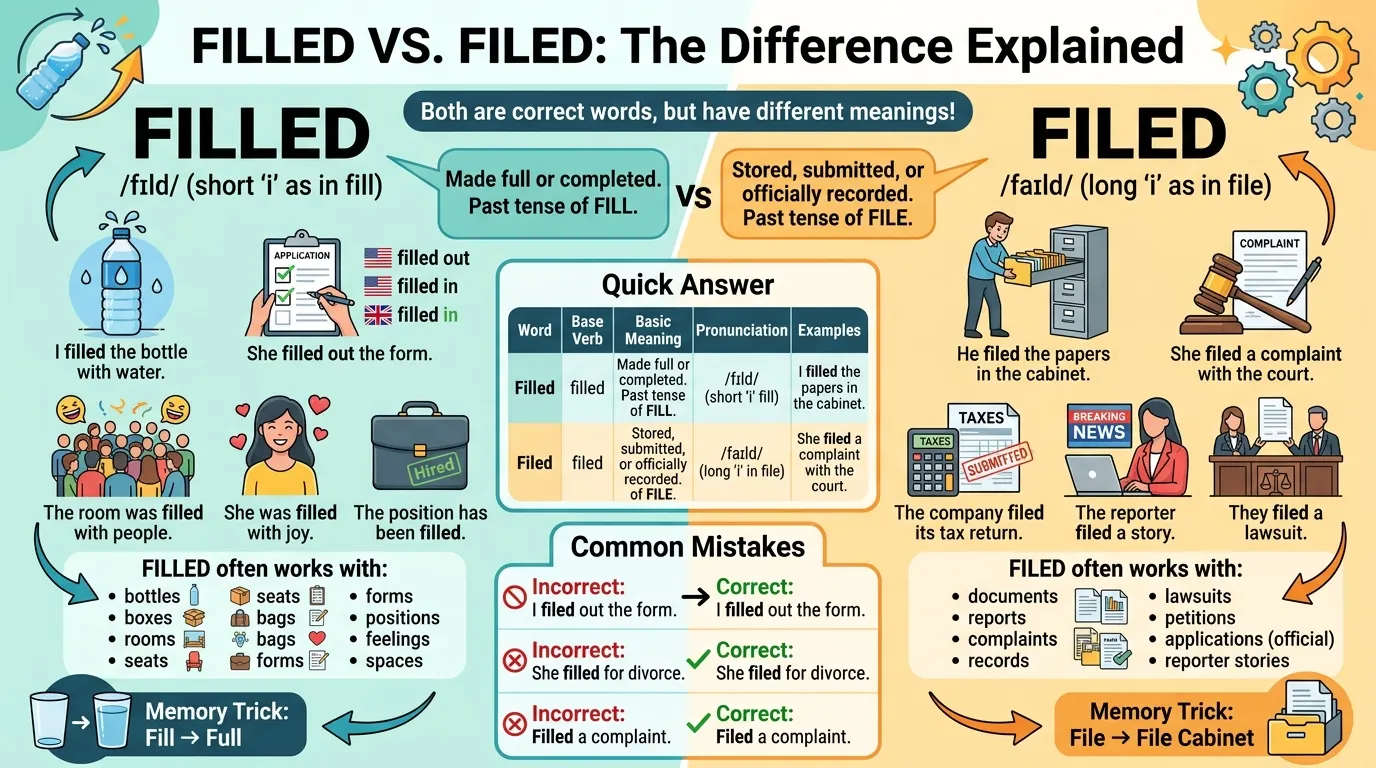
Filled means made full or completed. Filed means stored, submitted, or officially recorded. Have you ever typed filed when you meant filled? These two words look very similar, so it is easy to mix them up. The problem often appears in forms, emails, work messages, and official documents.
For example, you may write, “I filed out the form.” That sentence is incorrect if you mean that you completed the form. The correct phrase is “I filled out the form.” In British English, “filled in the form” is also common.Now consider a different sentence: “She filed a complaint.” Here, filed is correct because the complaint was officially submitted or recorded.
So, filled or filed is not a choice between two spellings of the same word. They are different words with different meanings.This guide explains the difference between filled or filed, their meanings, pronunciation, examples, common mistakes, and everyday use. By the end, you will know which word to choose.
Filled or Filed: Quick Answer
Filled is the past tense of fill. It means something was made full, occupied, or completed.
Filed is the past tense of file. It can mean something was stored, organized, submitted, or officially recorded.
| Word | Basic Meaning | Example |
| Filled | Made full or completed | I filled the bottle with water. |
| Filed | Stored, submitted, or recorded | She filed the report. |
Easy memory test
Ask yourself:
Do I mean “made full” or “completed”? → Filled
Do I mean “stored,” “submitted,” or “officially recorded”? → Filed
Pronunciation of Filled and Filed
| Word | US Pronunciation | UK Pronunciation |
| Filled | /fɪld/ | /fɪld/ |
| Filed | /faɪld/ | /faɪld/ |
Filled has the vowel sound in words such as “fill.”
Filed has the long vowel sound found in “file.”
Difference Between Filled and Filed
1. Filled means made full
Use filled when something becomes full.
Example 1: I filled the glass with water.
Example 2: She filled the box with books.
2. Filed means stored or organized
Use filed when documents or information are put into an organized record.
Example 1: He filed the papers in the cabinet.
Example 2: She filed the documents under the correct name.
3. Filled can mean completed
We often use filled out or filled in for forms.
Example 1: I filled out the application.
Example 2: She filled in the registration form.
4. Filed can mean officially submitted
Use filed when a document is officially sent to an authority.
Example 1: The company filed its tax return.
Example 2: She filed a complaint with the court.
5. Filled can describe an occupied space
Use filled when people or things occupy a space.
Example 1: The room was filled with people.
Example 2: The stadium was filled with fans.
6. Filed can describe official records
Use filed for documents kept as records.
Example 1: The clerk filed the documents.
Example 2: All reports were filed by date.
7. Filled can describe feelings
Filled can also describe strong feelings.
Example 1: She was filled with joy.
Example 2: He felt filled with pride.
8. Filed can describe legal action
Filed is common in legal English.
Example 1: They filed a lawsuit.
Example 2: The lawyer filed a petition.
9. Filled can describe a job or position
A job or position can be filled when someone takes it.
Example 1: The company filled the open position.
Example 2: The teaching position has been filled.
10. Filed can describe work sent by a reporter
Journalists can file stories or reports with their news organization.
Example 1: The reporter filed a story before noon.
Example 2: Our journalist filed the report from the scene.
You May Also Like https://orchoice.com/weasel-or-stoat/
Nature and Behaviour of Filled and Filed
The easiest way to understand these words is to look at what they usually act on.
Filled
Filled often works with:
- bottles
- boxes
- rooms
- seats
- bags
- forms
- positions
- feelings
- spaces
Examples:
The bottle was filled with milk.
The room was filled with laughter.
Filed
Filed often works with:
- documents
- reports
- complaints
- records
- taxes
- lawsuits
- petitions
- applications
- legal papers
Examples:
She filed the report yesterday.
He filed a complaint with the company.
Why Do People Get Confused?
The words filled and filed have similar spelling.
They both:
- start with fil
- end with -ed
- are past-tense forms
- can appear in office writing
- can appear near words such as “form,” “report,” and “document”
This makes them easy to mix up.
The problem becomes clearer when you compare these sentences:
I filled out the form. You completed the form.
I filed the form. You submitted or stored the form as a record.
Filled vs. Filed Comparison Table
| Feature | Filled | Filed |
| Base verb | Fill | File |
| Basic meaning | Make full or complete | Store, submit, or record |
| Pronunciation | /fɪld/ | /faɪld/ |
| Common with bottles | Yes | No |
| Common with forms | Yes, with “out/in” | Yes, when submitted or stored |
| Common with complaints | No | Yes |
| Common with feelings | Yes | No |
| Common with records | Sometimes | Yes |
| Common with lawsuits | No | Yes |
| Example | I filled the bottle. | I filed the report. |
Origin of Filled and Filed
Filled comes from the verb fill, which has a long history in English. Its basic idea has remained connected to making something full or occupying an empty space.
Filed comes from the verb file. The word developed meanings connected with arranging and keeping information or documents in an organized way. It later became common in official and legal language.
British English vs. American English
The main difference appears with forms.
In American English, fill out a form is very common.
I filled out the form.
In British English, fill in a form is very common.
I filled in the form.
Both expressions can mean completing a form. Cambridge lists fill in a form as mainly UK and fill out a form as the usual US form.
This does not mean that “filed” changes to “filled” in British English or American English.
The basic difference stays the same:
filled = made full or completed
filed = stored, submitted, or officially recorded
Which One Should You Use?
Use filled when you mean:
- made full
- occupied
- completed
- supplied with information
- full of a feeling
Use filed when you mean:
- stored
- organized
- officially submitted
- officially recorded
- sent to an authority
- placed in a file
For US English
I filled out the form.
For UK English
I filled in the form.
For official submission
I filed the form with the office.
Common Mistakes with Filled and Filed
Mistake 1: Filed out the form
Incorrect: I filed out the form.
Correct: I filled out the form.
Mistake 2: Filled for divorce
Incorrect: She filled for divorce.
Correct: She filed for divorce.
Mistake 3: Filed the bottle with water
Incorrect: He filed the bottle with water.
Correct: He filled the bottle with water.
Mistake 4: Filled a complaint
Incorrect: They filled a complaint.
Correct: They filed a complaint.
Mistake 5: Filed with people
Incorrect: The room was filed with people.
Correct: The room was filled with people.
Mistake 6: Filled the documents in a cabinet
Incorrect: She filled the documents in the cabinet.
Correct: She filed the documents in the cabinet.
A Simple Trick to Remember the Difference
Think of fill and full together.
Fill → full
Fill the cup. The cup is full.
Now think of file and a file cabinet.
File → file cabinet
File the documents. The documents go into the file.
So remember:
Fill = make full
File = put in a file
Filled or Filed in Everyday Usage
In emails
Filled:
I filled out the form you sent me.
Filed:
I filed the report this morning.
At work
Filled:
We filled the open position.
Filed:
We filed the documents by date.
At school
Filled:
Please fill out this questionnaire.
Filed:
The teacher filed the student records.
In news writing
Filled:
The hall was filled with visitors.
Filed:
The reporter filed a story before the deadline.
In legal writing
Filled:
The form was filled out correctly.
Filed:
The lawyer filed a lawsuit.
In casual conversation
Filled:
I filled my bag with clothes.
Filed:
I filed those papers yesterday.
Filled or Filed in Common Phrases
Common phrases with filled
- filled with water
- filled with joy
- filled with people
- filled with food
- filled out a form
- filled in a form
- filled the position
- filled the room
Common phrases with filed
- filed a complaint
- filed a lawsuit
- filed a report
- filed a tax return
- filed documents
- filed records
- filed charges
- filed for divorce
- filed a petition
Usage Trends
Both filled and filed are common English words.
They should not be compared simply by asking which one is “better.” They have different meanings and appear in different situations.
Historical language data can show how often words appeared in published texts. However, older Google Ngram data should not be presented as a current 2026 measure of everyday English.
For a learner, meaning and context are much more useful than trying to decide which word is used more often.
Metaphors and Similes
Filled is often used in figurative language.
For example:
Her heart was filled with happiness.
This does not mean her heart became physically full. It describes a strong feeling.
Another example:
The room was filled with tension.
Here, filled describes the strong feeling or atmosphere in the room.
Filed is less common in this kind of figurative language. It is more closely connected with records, documents, official actions, and organization.
Connotative Meaning
Filled often suggests:
- fullness
- abundance
- completion
- emotion
- satisfaction
For example:
He was filled with pride.
This often has a positive feeling.
Filed usually sounds more practical or official.
It can suggest:
- organization
- paperwork
- records
- legal action
- administration
For example:
She filed a complaint.
The sentence sounds formal because the action is official.
Idioms and Common Expressions
Filled appears in many common expressions.
Examples include:
- filled with joy
- filled with hope
- filled with fear
- filled to the brim
- filled with excitement
Filed is common in set expressions related to official actions.
Examples include:
- filed a complaint
- filed a lawsuit
- filed a report
- filed for divorce
- filed a tax return
Filled and Filed in Literature and Movies
Both words can appear in stories, novels, movies, and news reports.
Filled is useful when a writer describes:
- a crowded room
- strong emotions
- a full container
- a completed space
For example:
The theater was filled with excited fans.
Filed is useful when a story includes:
- police reports
- legal cases
- official documents
- records
- journalism
For example:
The detective filed a report after the investigation.
Why the Difference Matters
Using the wrong word can change the meaning of a sentence.
Compare:
I filled the form.
This may suggest completing the form, though filled out or filled in is clearer.
Now compare:
I filed the form.
This suggests that the form was submitted or stored as an official record.
The difference is especially important in:
- job applications
- emails
- business writing
- legal documents
- school forms
- government paperwork
- professional reports
Usefulness in Daily Life
You may use filled when talking about:
- food
- drinks
- bags
- rooms
- seats
- forms
- jobs
- feelings
You may use filed when talking about:
- documents
- reports
- complaints
- lawsuits
- taxes
- records
- petitions
- official requests
Situational Preference
Use filled when you talk about making something full or completing information. For a form, American English commonly uses fill out, while British English commonly uses fill in. Use filed when you mean that something was stored, submitted, or officially recorded. For example, you fill out a form, but you file a complaint. You fill a bottle with water, but you file documents in a cabinet. When you are unsure, ask whether the action means making full or completing or storing or submitting. This quick question can help you choose the correct word.
Common Questions and Answers About Filled or Filed
1. Is “filled” or “filed” correct?
Both are correct words.
Filled means made full or completed.
Filed means stored, submitted, or officially recorded.
2. Is it “filled out” or “filed out”?
The correct phrase is filled out when you mean completed a form.
Example: I filled out the application.
In British English, filled in is also very common.
3. Is it “filled for divorce” or “filed for divorce”?
The correct phrase is filed for divorce.
Example: She filed for divorce last year.
4. Is it “filled a complaint” or “filed a complaint”?
The correct phrase is filed a complaint.
Example: He filed a complaint with the company.
5. Can “filled” describe feelings?
Yes.
Example: She was filled with happiness.
It means she experienced a strong feeling.
6. Can “filed” mean stored?
Yes.
Example: The assistant filed the documents in the cabinet.
It means the documents were placed in an organized file or record.
7. What is an easy way to remember filled and filed?
Think:
Filled → full
Filed → file cabinet
If you mean make full, choose filled.
If you mean store, submit, or record, choose filed.
Conclusion
Filled or filed are both correct English words, but they have different meanings. Filled is the past tense of fill and means making something full, completing a form, occupying a space, or showing a strong feeling. Filed is the past tense of file and means storing documents, organizing records, submitting something officially, or recording information. A simple way to remember the difference is to connect filled with full and filed with a file cabinet. You fill out a form when you complete it, while you file a complaint when you submit it officially. In British English, fill in a form is also common. When choosing between filled or filed, always focus on the meaning of the sentence. If you mean making something full or completing it, use filled. If you mean storing, submitting, or officially recording something, use filed.

I’m Samia Jamshaid, an English language specialist, SEO specialist, digital publisher, and researcher. I create clear, accurate, and well-researched content on English grammar, vocabulary, word meanings, and language comparisons, helping readers understand and use English with confidence.










1 thought on “Filled or Filed: Difference, Examples & Usage 2026”