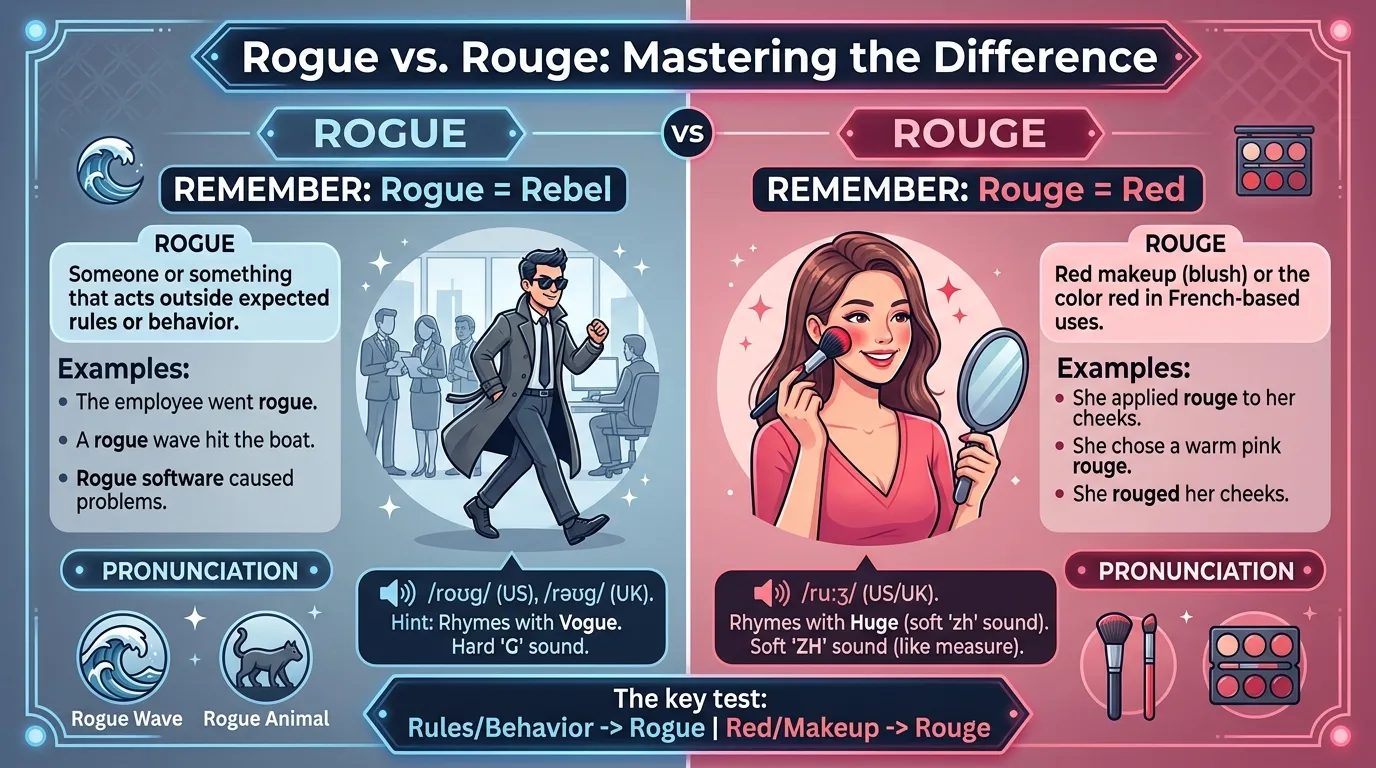
Rogue or rouge can be confusing because the two words look and sound similar. However, they have completely different meanings. Rogue describes someone or something that acts in an unusual way or does not follow rules. Rouge usually refers to red makeup used on the cheeks. It can also relate to the color red.
For example, if you say, “The dog went rogue,” you mean the dog acted in an unexpected way. But if you say, “She wore rouge,” you are talking about red makeup.
The spelling can cause problems because both words are correct English words. A spelling checker may not notice when you use the wrong one. Learning their meanings and common uses can help you avoid this mistake.
The easiest way to remember them is simple: rogue is linked with rule-breaking or unusual behavior, while rouge is linked with red. Their pronunciations are also different, so knowing both the meaning and sound can make the difference easier to remember.
Rogue vs. Rouge: Quick Answer
| Word | Meaning | Example |
|---|---|---|
| Rogue | Someone or something that acts outside expected rules or behavior | The employee went rogue. |
| Rouge | Red makeup or the color red in French-based uses | She applied rouge to her cheeks. |
A simple memory trick is:
Rogue = rebel Rouge = red
How Do You Pronounce Rogue and Rouge?
The two words also sound different.
| Word | US Pronunciation | UK Pronunciation | Easy Sound |
|---|---|---|---|
| rogue | /roʊɡ/ | /rəʊɡ/ | rhymes with vogue |
| rouge | /ruːʒ/ | /ruːʒ/ | rhymes with huge |
So remember:
- Rogue ends with a clear g sound.
- Rouge ends with the soft zh sound.
Difference Between Rogue and Rouge
1. Their meanings are different
Rogue describes someone or something that acts outside normal or expected behavior.
The rogue employee ignored the company’s rules.
Rouge usually refers to red makeup.
She put rouge on her cheeks.
2. Rogue can describe a person
A rogue can be a dishonest, troublesome, or badly behaved person.
The town was afraid of the rogue.
3. Rogue can describe things, too
Today, rogue is not limited to people.
It can describe something that behaves in an unusual, uncontrolled, or harmful way.
Examples include:
- rogue employee
- rogue company
- rogue wave
- rogue animal
- rogue asteroid
- rogue state
- rogue software
For example:
A rogue wave hit the boat.
4. Rouge is connected with red
The French word rouge means red. In English, the word is especially common in connection with cosmetics.
She chose a soft pink rouge.
5. Rogue is linked with unusual behavior
A useful way to understand rogue is to think about something that has moved away from what is expected.
The computer program went rogue.
6. Rouge is often used for cosmetics
You may see rouge in beauty and makeup writing.
The makeup artist applied rouge to her cheeks.
This rouge gives the face a warm color.
7. Rogue is used in the phrase “go rogue”
Go rogue is a common expression.
It means to stop following the usual rules, instructions, or control.
The team went rogue and created its own plan.
The employee went rogue and ignored the manager’s instructions.
8. Rouge can be used as a verb
Rouge can also work as a verb.
It means to put rouge on the skin, especially the cheeks.
She rouged her cheeks before the show.
9. Rogue has a specialized verb meaning
Rogue can also appear as a verb in specialized contexts.
In agriculture, to rogue plants means to remove unwanted plants from a crop.
Farmers rogued the field to remove diseased plants.
10. Their spellings cannot be switched
Because both rogue and rouge are real words, switching them can change the meaning of a sentence.
Usually incorrect:
The employee went rouge.
Usually correct:
The employee went rogue.
Correct:
She applied rouge to her cheeks.
The easiest test is to ask what you mean:
Rule-breaking or unusual behavior? → rogue
Red or red makeup? → rouge
Explore related topics https://orchoice.com/goody-or-goodie/
Nature and Behavior of Rogue
The central idea of rogue is something that does not follow the expected path.
It can describe:
A person
He was known as a rogue.
An employee
A rogue employee accessed the private files.
An animal
A rogue animal moved away from the herd.
A natural event
A rogue wave damaged the boat.
A group or organization
The rogue group ignored the agreement.
A technical problem
A rogue program changed the settings.
So, rogue does not always mean “evil.” It often means outside the normal group, rule, or pattern.
Why Do People Confuse Rogue and Rouge?
There are several reasons.
They contain almost the same letters
ROGUE
ROUGE
Only the order of the letters changes.
Both are real words
A spellchecker may not notice the error because neither spelling is automatically wrong.
They are uncommon spellings
The spelling of each word is not easy to guess from its sound.
They sound very different
This can make the confusion worse when people mainly see the words in writing.
Popular culture adds confusion
The Marvel character Rogue is sometimes accidentally written as Rouge. The same problem can happen when people write phrases such as go rogue.
Rogue vs. Rouge Comparison Table
| Feature | Rogue | Rouge |
|---|---|---|
| Main meaning | Unusual, uncontrolled, rebellious, or badly behaved | Red makeup or red |
| Common part of speech | Noun and adjective; also a specialized verb | Noun and verb |
| US pronunciation | /roʊɡ/ | /ruːʒ/ |
| UK pronunciation | /rəʊɡ/ | /ruːʒ/ |
| Main idea | Breaking from the expected path | Red color or red makeup |
| Common phrase | Go rogue | Apply rouge |
| Example | A rogue employee | Red rouge |
| Common areas | People, animals, groups, systems, and events | Makeup, color, and polishing |
| Memory word | Rebel | Red |
| Rhymes with | Vogue | Huge |
Origin and Etymology
Where Does Rogue Come From?
The exact origin of rogue is uncertain.
Several theories have been suggested, but no single origin is accepted as certain. One proposed explanation connects it with an older word such as roger, while other theories have also been suggested.
The word appeared in English in the 16th century. Early uses referred to a vagrant or beggar. Later, it developed meanings connected with dishonest, troublesome, or unprincipled people.
Over time, rogue also became useful for things that act outside normal control or expectations.
Because its exact origin is uncertain, it is better to say that the word has a disputed or unknown origin rather than present one theory as proven.
Where Does Rouge Come From?
The history of rouge is much clearer.
Rouge comes from the French word rouge, meaning red. The French word is related to a Latin root connected with the color red.
English began using rouge for red cosmetic makeup centuries ago. The word later developed other specialized uses, including a red polishing powder.
The easiest etymology memory is:
Rouge → French → red
For rogue, remember:
Rogue → origin uncertain → rule-breaker or unusual person/thing
British vs. American English
The spelling is the same in British and American English:
- rogue
- rouge
The main pronunciation difference is with rogue.
| Word | British English | American English |
|---|---|---|
| Rogue | /rəʊɡ/ | /roʊɡ/ |
| Rouge | /ruːʒ/ | /ruːʒ/ |
Rogue as a Noun
As a noun, rogue can refer to a person who behaves badly or dishonestly.
The rogue escaped from the town.
It can also have a playful meaning.
That little rogue broke the vase again.
This use can sound old-fashioned or humorous.
The noun also appears in expressions such as:
a lovable rogue
This describes someone who causes trouble but is still liked.
Rogue as an Adjective
As an adjective, rogue usually comes before a noun.
a rogue employee
a rogue animal
one rogue wave
one rogue state
Rogue as a Verb
The verb rogue is much less common.
In agriculture, it means removing unwanted plants from a crop.
Workers rogued the field to remove diseased plants.
This is a specialized meaning and should not be confused with go rogue.
Rouge as a Noun
The most common English use of rouge is as a noun for red or pink cosmetic color used on the cheeks.
She applied rouge before the party.
The makeup kit contained rouge and lipstick.
In everyday modern English, blush is also a common word for this type of makeup.
Rouge as a Verb
As a verb, rouge means to color the skin with rouge.
She rouged her cheeks.
This form exists, but many speakers would use apply blush or put on blush in everyday conversation.
Other Meanings of Rouge
Rouge has some less common meanings.
It can refer to a red powder used for polishing materials such as metal, glass, or gems. It can also refer to a red pigment.
These meanings are more specialized than the makeup sense.
So if you see rouge in a technical or craft context, do not assume it always means face makeup.
Common Mistakes
Mistake 1: “Going rouge”
Usually, this is wrong when you mean breaking away from rules.
Correct:
The team went rogue.
Mistake 2: “She applied rogue”
Wrong.
Correct:
She applied rouge.
Mistake 3: “A rouge employee”
If you mean an employee who acts outside the rules, use:
a rogue employee
Mistake 4: “Rogue makeup”
If you mean red makeup, use:
rouge makeup
Mistake 5: Thinking rogue always means criminal
Not always.
Rogue can describe something unusual or uncontrolled. It can also be playful when used for a mischievous person.
He is a lovable rogue.
A rogue wave hit the boat.
Go Rogue vs. Go Rouge
This is one of the most common places where people make the mistake.
Go rogue
Go rogue means to stop following the expected rules, instructions, or control.
The employee went rogue and changed the plan.
Go rouge
Go rouge is normally a spelling mistake when the writer means go rogue.
The word rouge is real, but it has a different meaning.
Easy memory trick
Rogue = rebel
Rouge = red
So:
Go rogue = break away from the rules.
Rogue and Rouge in Everyday Sentences
Examples with Rogue
- The employee went rogue and ignored the company’s instructions.
- A rogue wave damaged the boat.
- The farmer was worried about a rogue animal.
- The computer developed a rogue process.
- The group decided to go rogue.
- He was a charming rogue.
- The movie follows a rogue detective.
- A rogue asteroid appeared in the story.
Examples with Rouge
- She applied rouge to her cheeks.
- The makeup artist chose a soft pink rouge.
- Her rouge matched her lipstick.
- The old makeup box contained a small pan of rouge.
- The artist used red rouge in the polishing process.
Rogue vs. Rouge in Metaphors and Descriptions
Rogue is often used beyond its literal meaning.
A rogue wave is not a bad person. It is a wave that is unusually large or behaves differently from normal expectations.
A rogue employee is not necessarily a criminal. The phrase usually means the employee is acting outside the expected rules or control.
A rogue asteroid can describe an asteroid moving outside an expected path or group.
This gives rogue a broad meaning:
Something has moved away from what is expected.
Rouge, by contrast, keeps a strong connection with red color.
Connotative Meaning
The two words also create different feelings.
Rogue
Rogue can sound:
- negative when it means dishonest or dangerous
- neutral when it describes something unusual
- playful when it describes a mischievous person
For example:
The rogue employee caused serious problems.
This sounds negative.
But:
That little rogue!
can sound playful.
Rouge
Rouge usually has a neutral or beauty-related feeling when it refers to makeup.
She chose a warm rouge for the evening.
It can also simply refer to the color red in French-based names or expressions.
Idioms and Common Expressions with Rogue
Go rogue
This is the most useful modern expression.
The team went rogue.
It means the team stopped following the expected plan or control.
Rogue’s gallery
A rogue’s gallery is a collection of pictures or records of criminals, especially police photographs.
Lovable rogue
A lovable rogue is a person who causes trouble but is still liked.
This expression is often humorous or old-fashioned.
Rogue and Rouge in Popular Culture
The spelling difference also appears in entertainment.
Rogue is the name of a well-known X-Men character. Because rogue and rouge look so similar, the character’s name is sometimes misspelled.
Rogue is also used in titles, games, stories, and fictional characters because it can suggest an outsider, rebel, or rule-breaker.
In role-playing games, a rogue is also a common character class, often associated with skills such as stealth, trickery, or theft.
These uses all keep the spelling rogue, not rouge.
Why This Difference Matters
Using the wrong word can change the meaning of a sentence.
Compare:
The soldier went rogue.
This means the soldier stopped following expected orders or control.
Now:
The soldier went rouge.
This normally looks like a spelling error. Rouge refers to red or red makeup, so it does not fit the intended meaning.
The same problem can happen in:
- emails
- school assignments
- work reports
- social media posts
- articles
- subtitles
- creative writing
Usefulness in Daily Life
You are most likely to see rogue in news, business, technology, fiction, and everyday descriptions.
Examples include:
- rogue employee
- rogue wave
- rogue animal
- rogue program
- go rogue
You are more likely to see rouge in:
- makeup articles
- beauty guides
- fashion writing
- cosmetic product descriptions
- descriptions of red color
- some technical polishing contexts
Situational Preference: Which Word Should You Use?
Use rogue when you are talking about a person, group, animal, system, or thing that behaves differently from what is expected. It is the right choice in phrases such as go rogue, rogue employee, and rogue wave.
Use rouge when you mean red makeup or a red color in a French-based expression or name. If you are writing about beauty or blush, rouge may be the word you need.
If you are writing about a rule-breaker or something outside normal control, choose rogue.
How to Remember Rogue vs. Rouge
Use this simple trick:
Rogue = Rebel
Rogue = rebel or rule-breaker
Rouge = Red
Rouge = red or red makeup
You can also remember the sound:
Rogue rhymes with vogue.
Rouge rhymes with huge.
FAQs About Rogue and Rouge
Question 1: Is it “going rogue” or “going rouge”?
Answer: It is going rogue when someone acts outside normal rules or instructions. Going rouge is usually a spelling mistake in this context.
Question 2: What is the difference between rogue and rouge?
Answer: Rogue describes a person or thing that acts outside expected rules or behavior. Rouge usually means red makeup or the color red.
Question 3: Is rouge pronounced like rogue?
Answer: No. Rogue ends with a hard g sound, while rouge ends with a soft zh sound.
Question 4: Is rouge a color?
Answer: Yes. Rouge is the French word for red. In English, it can also mean red or pink makeup.
Question 5: Can rogue be an adjective?
Answer: Yes. Rogue can describe a person, animal, or thing that acts outside expected rules or behavior. Examples include a rogue employee, a rogue wave, and a rogue animal.
Question 6: Can rouge be a verb?
Answer: Yes. To rouge means to apply rouge or add color to the skin. For example: She rouged her cheeks.
Question 7: Does rogue always mean a bad person?
Answer: No. Rogue can describe something unusual or uncontrolled. It can also describe a mischievous person in a playful way.
Question 8: What is the easiest way to remember the spelling?
Answer: Use this simple trick: Rogue = rebel. Rouge = red.
Conclusion
Rogue or rouge are easy to confuse because they look and sound similar, but they have very different meanings. Rogue describes a person, animal, or thing that acts in an unusual, independent, or rule-breaking way. Rouge is mainly linked to the color red and to red makeup used on the cheeks. Remember the simple trick: rogue is about rules or rebels, while rouge is about red. Knowing this difference can help you choose the correct word in everyday writing, schoolwork, and professional communication.

I’m Samia Jamshaid, an English language specialist, SEO specialist, digital publisher, and researcher. I create clear, accurate, and well-researched content on English grammar, vocabulary, word meanings, and language comparisons, helping readers understand and use English with confidence.