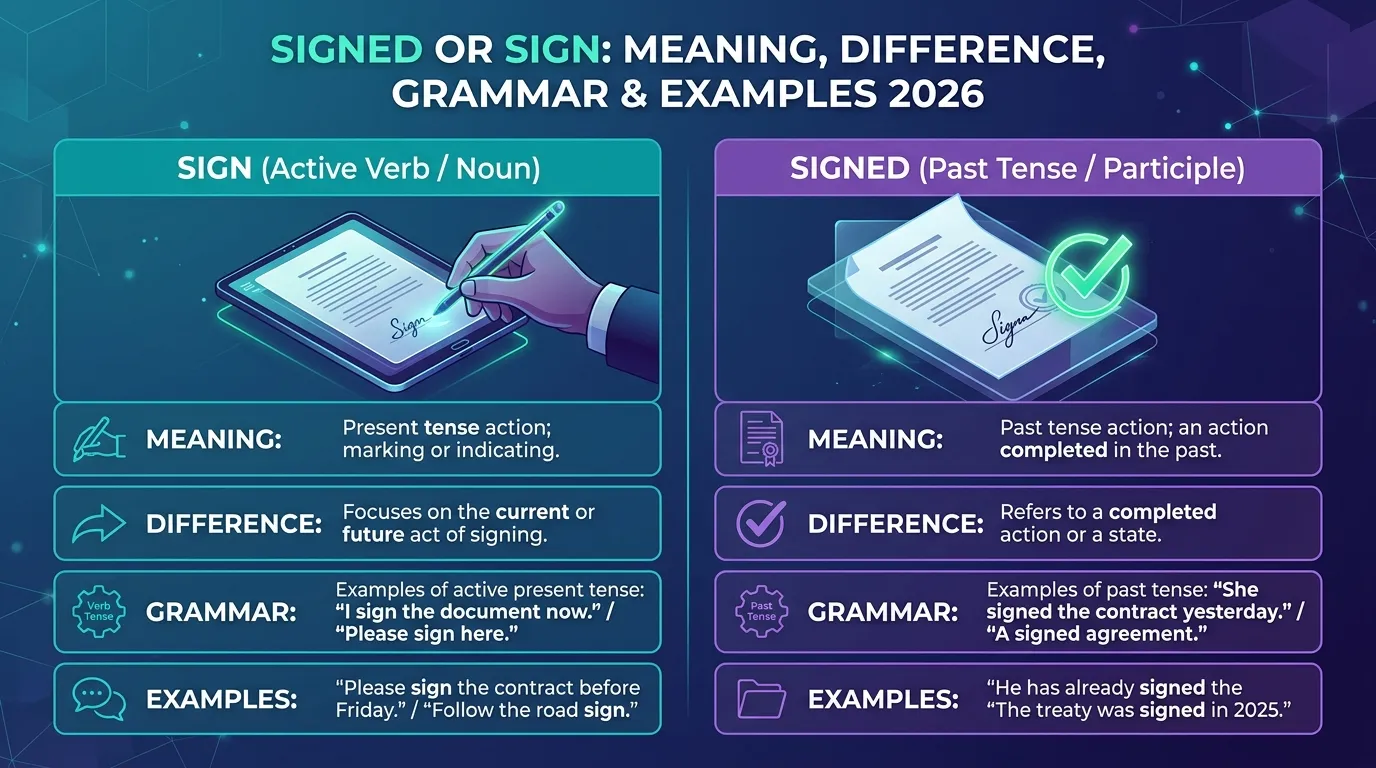
Sign is the base form of the verb, while signed is the past form and past participle of sign.
Imagine your teacher gives you a form and says, “Please sign your name here.” You write your name on the form. Later, you tell your parent, “I signed the form.” Both sign and signed are correct, but they are used in different ways.
The main difference is simple. Sign is used for the basic form of the verb, commands, and many present or future actions. Signed is used for an action that happened in the past or with helping verbs such as has, have, and had.
The word sign can also be a noun. It can mean a notice, symbol, mark, signal, or clue. For example, a road sign tells drivers something important.
Many English learners search for signed or sign because the two words look almost the same. The extra -ed can make the grammar confusing.
In this guide, you will learn the difference between signed or sign, their meanings, grammar rules, pronunciation, examples, common mistakes, and everyday uses.
Pronunciation
| Word | US Pronunciation | UK Pronunciation |
|---|---|---|
| Sign | /saɪn/ | /saɪn/ |
| Signed | /saɪnd/ | /saɪnd/ |
Both words have one syllable. Signed has a /d/ sound at the end.
Difference Between Signed or Sign
1. Sign is the base form
Sign is the basic form of the verb.
We use it for general actions, instructions, and after words such as to, will, can, and should.
Examples:
- Please sign this form.
- I need to sign the paper.
2. Signed is the past form
Signed is the simple past form of sign.
Use it when the action happened before now.
Examples:
- I signed the form yesterday.
- She signed the letter this morning.
3. Use sign after “to”
After to, use the base form sign.
Examples:
- I need to sign the contract.
- He wants to sign the card.
Do not write:
- ❌ I need to signed the contract.
- ❌ He wants to signed the card.
4. Use signed after “have” or “has”
Use signed after have or has when using the present perfect.
Examples:
- I have signed the form.
- She has signed the agreement.
5. Use signed after “had”
Use signed after had in the past perfect.
Examples:
- He had signed the paper before lunch.
- They had signed the deal before the meeting.
6. Sign is used for instructions
We often use sign when telling someone what to do.
Examples:
- Please sign here.
- Sign your name at the bottom.
7. Signed can show a finished action
Signed can show that someone completed the act of signing.
Examples:
- She signed the document.
- We signed the agreement.
8. Sign can be a noun
Sign is also a noun.
It can mean a notice, symbol, mark, signal, or clue.
Examples:
- The road sign says “Stop.”
- A smile can be a sign of happiness.
9. Signed can describe a document
Signed can describe something that already has a signature.
Examples:
- Please return the signed form.
- I sent the signed contract.
10. Sign can be used for future or regular actions
Use sign when talking about something that will happen or happens regularly.
Examples:
- I will sign the form tomorrow.
- We usually sign documents online.
Explore related topics https://orchoice.com/genius-or-genious/
Nature and Behaviour of Signed or Sign
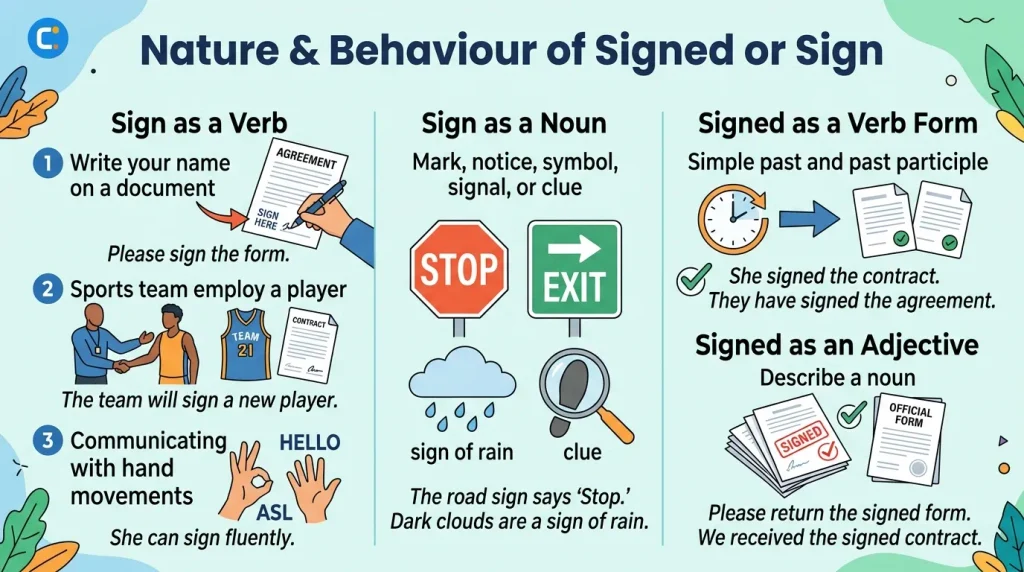
Sign as a Verb
As a verb, sign can mean to write your name on a document. This can show that you agree with the document or that you created it. Cambridge gives this as one of the main uses of sign.
Please sign the form.
Sign can also be used when a sports team makes a legal agreement to employ a player.
The team will sign a new player.
It can also mean communicating with hand or body movements.
Sign as a Noun
As a noun, sign can mean a mark, notice, symbol, signal, or clue.
The road sign says “Stop.”
Dark clouds are a sign of rain.
Signed as a Verb Form
Signed is the simple past and past participle of sign.
She signed the contract.
They have signed the agreement.
Signed as an Adjective
Signed can also describe a noun.
Please return the signed form.
We received the signed contract.
Why People Get Confused About Signed or Sign
The two words come from the same verb:
sign → signed
The main difference is the -ed ending.
English often adds -ed to regular verbs to make the past form.
For example:
- walk → walked
- play → played
- call → called
- sign → signed
The problem happens when a sentence needs the base form but the writer uses signed.
For example:
❌ I need to signed the paper.
Correct:
✅ I need to sign the paper.
But if the action happened yesterday:
✅ I signed the paper yesterday.
The grammar around the word tells you which form to use.
Comparison Table
| Feature | Sign | Signed |
| Main role | Base verb and noun | Past form and past participle |
| Verb form | Basic/present form | Past form |
| Noun | Yes | No |
| After “to” | to sign | ❌ to signed |
| After “will” | will sign | ❌ will signed |
| After “can” | can sign | ❌ can signed |
| After “have” | ❌ have sign | have signed |
| After “has” | ❌ has sign | has signed |
| After “had” | ❌ had sign | had signed |
| As an adjective | Less common | Yes |
| Example | Please sign here. | I signed yesterday. |
The Origin of Sign
The word sign has a long history.
It came into English from Old French signe, which came from Latin signum. The Latin word was connected with ideas such as a mark, symbol, signal, or indication.
Over time, sign developed many meanings.
Today, it can refer to:
- a mark
- a symbol
- a notice
- a signal
- a clue
- writing your name
- communication through signs
Signed is the -ed form of sign.
The basic word family is:
sign → signed → signing
British vs American English
There is no spelling difference between British and American English for sign or signed.
Both use:
- sign
- signed
American English
Please sign the form.
I signed the form yesterday.
British English
Please sign the form.
I signed the form yesterday.
The basic grammar is also the same.
Which One Should You Use?
Use sign when you are talking about a basic, present, future, or planned action.
Utilize signed when the action happened in the past or when it follows have, has, or had.
Use Sign
- Please sign here.
- I need to sign this.
- I will sign it tomorrow.
- You can sign the form now.
Use Signed
- I signed it yesterday.
- She has signed the form.
- They had signed the contract.
- The document was signed on Monday.
A simple rule is:
Basic action → sign
Past or past participle → signed
Common Mistakes with Signed or Sign
Here are some common mistakes learners make.
| ❌ Wrong | ✅ Correct |
| Please signed here. | Please sign here. |
| I need to signed it. | I need to sign it. |
| I will signed the form. | I will sign the form. |
| She can signed the paper. | She can sign the paper. |
| She has sign the paper. | She has signed the paper. |
| He had sign the deal. | He had signed the deal. |
| I sign it yesterday. | I signed it yesterday. |
| They signed it tomorrow. | They will sign it tomorrow. |
Easy Rule
After to, use sign:
to sign
After will, can, should, or must, use sign:
will sign
can sign
should sign
must sign
After have, has, or had, use signed:
have signed
has signed
had signed
Signed or Sign in Everyday Examples
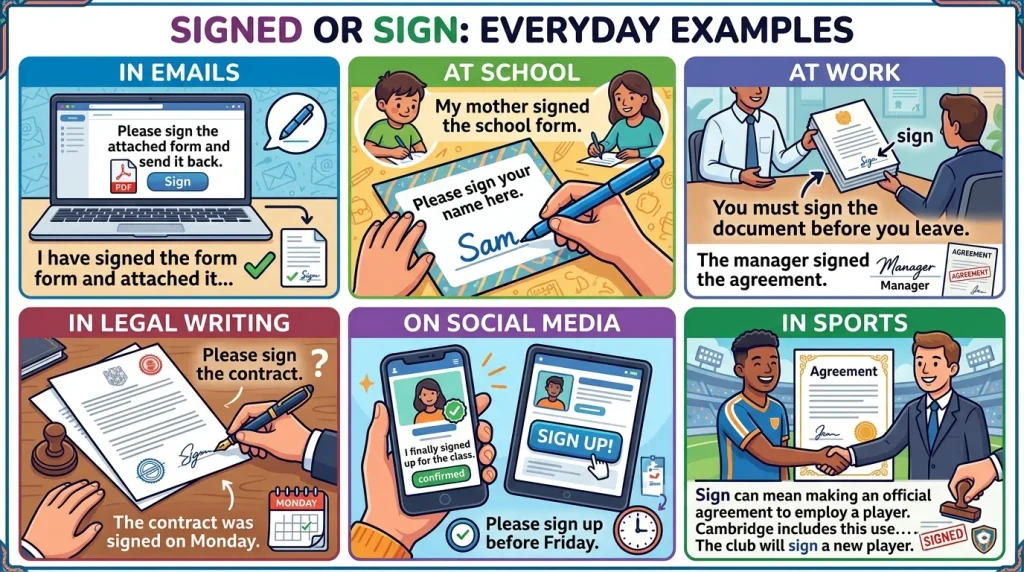
In Emails
Please sign the attached form and send it back.
I have signed the form and attached it to this email.
At School
Please sign your name here.
My mother signed the school form.
At Work
You must sign the document before you leave.
The manager signed the agreement.
In Legal Writing
Please sign the contract.
The contract was signed on Monday.
On Social Media
I finally signed up for the class.
Please sign up before Friday.
In Sports
Sign can mean making an official agreement to employ a player. Cambridge includes this use in its dictionary.
The club will sign a new player.
The team signed a new goalkeeper.
Usage Trends
Sign is a common English word with many uses.
You can see it in:
- school forms
- business documents
- contracts
- emails
- road signs
- news reports
- sports news
- books
- social media
- sign language
Signed is common when talking about completed actions and documents.
Common phrases include:
- signed contract
- signed form
- signed letter
- signed agreement
- signed book
Metaphors and Similes
The word sign is often used in a figurative way.
A Sign of Hope
Something that gives people hope can be called a sign of hope.
The new school was a sign of hope for the town.
A Sign of Change
Something can show that a change is happening.
The new store was a sign of change in the area.
A Sign of Trouble
Something can warn us about a problem.
The broken window was a sign of trouble.
A Sign of Things to Come
A small event can suggest what may happen later.
The early success was a sign of things to come.
These uses show that sign can mean more than a written mark or signature.
Connotative Meaning
Sign can have a positive, negative, or neutral meaning depending on the sentence.
Positive
Her smile was a sign of happiness.
Here, sign gives a positive feeling.
Negative
The dark clouds were a sign of a storm.
Here, sign gives a warning.
Neutral
The road sign says 50 miles per hour.
Here, sign simply gives information.
Signed is usually neutral.
She signed the form.
The feeling depends on the situation around the word.
Idioms and Proverbs
English has several common expressions with sign and signed.
Sign on the Dotted Line
This means to sign an agreement.
He was ready to sign on the dotted line.
Signed, Sealed, and Delivered
This expression describes something that has been completed or made official.
The deal was signed, sealed, and delivered.
A Sign of the Times
This means something shows what life is like during a certain period.
Online shopping is a sign of the times.
Sign of Things to Come
This means something may show what will happen in the future.
The early success was a sign of things to come.
Literature and Movies
The word sign appears in many books and films. It can suggest a clue, warning, symbol, or important message.
Literature
The Sign of the Four is a mystery novel by Arthur Conan Doyle, first published in 1890. It is the second Sherlock Holmes novel.
The word sign in the title connects with the idea of a clue or identifying mark.
Movie
The Sign of Four is also the title of a 1932 British crime film based on Doyle’s novel.
The story uses signs and clues as part of its mystery.
These examples show how sign can have a strong connection with clues and mystery in literature and film.
Why This Difference Matters
Knowing the difference between sign and signed helps you write clear English.
Compare:
❌ I need to signed the paper.
✅ I need to sign the paper.
Now compare:
❌ I sign the paper yesterday.
✅ I signed the paper yesterday.
This small grammar difference is useful in:
- school work
- emails
- forms
- contracts
- job applications
- business writing
- social media
- everyday conversations
Usefulness in Daily Life
You can see sign and signed in many everyday situations.
| Situation | Example |
| School | Please sign this form. |
| Work | I signed the document. |
| Please sign and return it. | |
| Contract | Both sides signed the contract. |
| Road | The sign says “Stop.” |
| Shop | Look at the sign in the window. |
| Sports | The team signed a new player. |
| Online | Please sign up today. |
| Books | The author signed my book. |
| News | The leaders signed an agreement. |
Situational Preference
Use sign when you are asking someone to do something, talking about a general action, or describing something that will happen later. For example, say, “Please sign the form” or “I will sign it tomorrow.” Use signed when the action happened in the past or when it follows have, has, or had. For example, “I signed the form yesterday” and “She has signed the contract.” Remember that sign can also be a noun for a notice, symbol, mark, signal, or clue. These simple rules work in both British and American English.
FAQs About Signed or Sign
1. What is the main difference between sign and signed?
Sign is the base form of the verb. Signed is the past form and past participle.
I will sign it.
I signed it yesterday.
2. Is “Please signed here” correct?
No.
The correct sentence is:
Please sign here.
An instruction uses the base form of the verb.
3. Is “I need to signed” correct?
No.
The correct form is:
I need to sign the form.
Use the base verb after to.
4. What is the past tense of sign?
The past tense is signed.
sign → signed
5. Can signed be an adjective?
Yes.
For example:
Please return the signed form.
Here, signed describes the form.
6. Can sign be a noun?
Yes.
It can mean a notice, symbol, mark, signal, or clue.
The road sign says “Stop.”
7. Do British and American English use the same forms?
Yes. Both use sign and signed.
8. What should I use after “to”?
Use sign.
I want to sign the contract.
Not:
❌ I want to signed the contract.
Conclusion
Sign or signed are both correct words, but they have different jobs in English. Sign is the base form of the verb. It is used for instructions, general actions, and many present or future situations. It can also be a noun that means a notice, symbol, mark, signal, or clue. Signed is the simple past and past participle of sign. Use it when the action happened in the past or after have, has, or had. For example, say, “Please sign the form,” but say, “I signed the form yesterday.” You can also say, “She has signed the agreement.” The spelling and basic grammar are the same in British and American English. A simple way to remember the difference is: sign is the basic form, while signed usually shows a past or completed action. Learning this difference can help you write better emails, forms, contracts, school work, and everyday sentences.

I’m Samia Jamshaid, an English language specialist, SEO specialist, digital publisher, and researcher. I create clear, accurate, and well-researched content on English grammar, vocabulary, word meanings, and language comparisons, helping readers understand and use English with confidence.

1 thought on “Signed or Sign: Meaning, Difference, Grammar & Examples 2026”