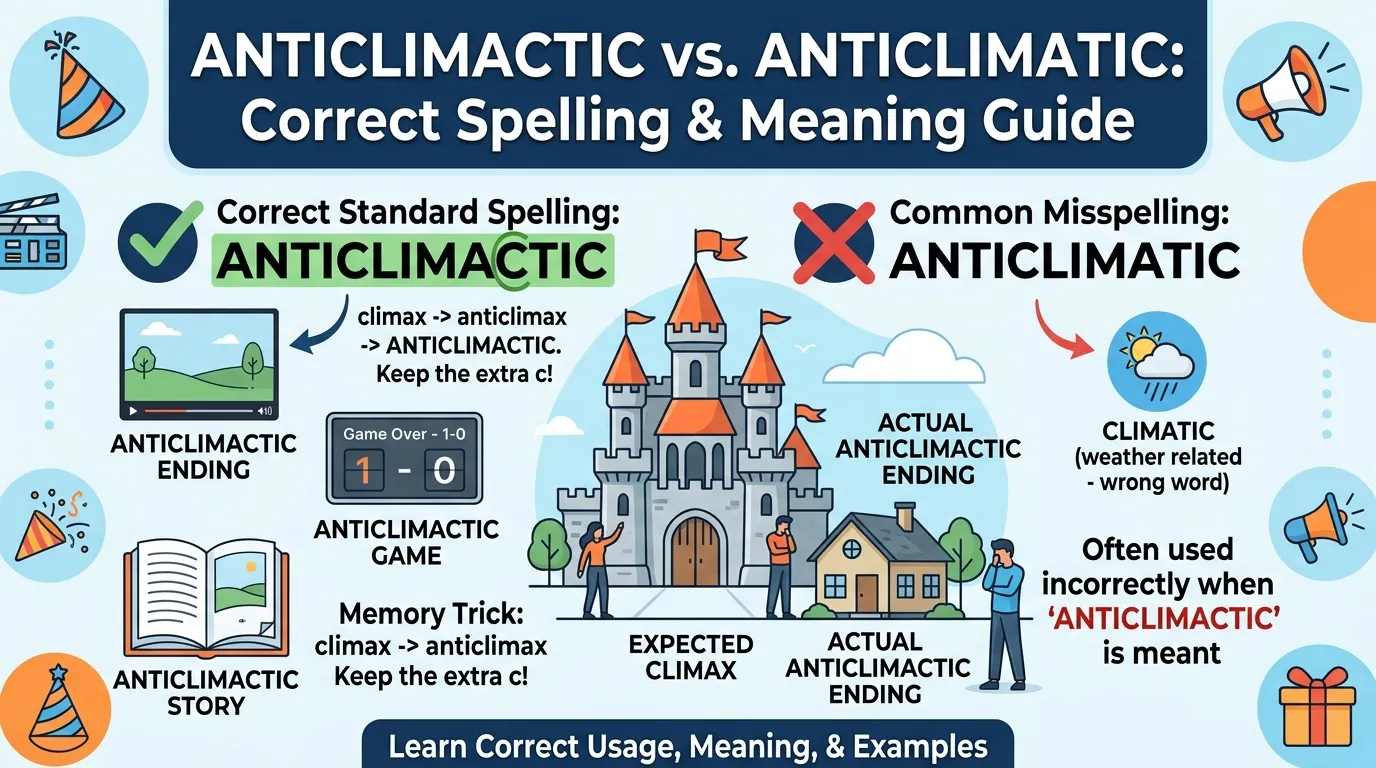
Anticlimactic is the correct spelling. Anticlimatic is usually a spelling mistake when you mean something that is less exciting than expected.
Imagine you are watching a movie. The whole movie builds up to a big final scene. You expect something amazing to happen. But the ending is very simple. You may say, “The ending was anticlimactic.”
The word anticlimactic is used for movies, books, sports, parties, events, and many other things. It describes something that is not as exciting or interesting as you expected.
Many people search for anticlimactic or anticlimatic because the two words look almost the same. It is easy to forget the extra c in anticlimactic.
In this guide, you will learn the correct spelling, meaning, pronunciation, examples, word history, common mistakes, and the difference between anticlimactic, anticlimatic, climactic, and climatic.
Anticlimactic or Anticlimatic: Quick Answer
Anticlimactic is the correct standard spelling.
Anticlimatic is usually a spelling mistake when you mean something that is less exciting than expected.
| Word | Use it? | Meaning |
|---|---|---|
| Anticlimactic | ✅ Yes | Less exciting or satisfying than expected |
| Anticlimatic | ❌ Usually no | Common misspelling of anticlimactic |
Examples
- The movie had an anticlimactic ending.
- The big surprise was anticlimactic.
- The final game felt anticlimactic.
Easy Memory Trick
Remember:
anticlimax → anticlimactic
Keep the c in anticlimactic.
What Does Anticlimactic Mean?
Anticlimactic is an adjective.
It means something is less exciting, interesting, or satisfying than expected.
It can also describe something that feels weak because it comes after a much more exciting event.
Examples
- The movie ending was anticlimactic.
- The party was anticlimactic.
- The final match was anticlimactic.
- The big reveal felt anticlimactic.
Anticlimactic vs. Anticlimatic
The main difference is the spelling.
Anticlimactic
Anticlimactic is the standard word.
Use it when something is less exciting or satisfying than expected.
The ending was anticlimactic.
Anticlimatic
Anticlimatic is often a spelling mistake for anticlimactic when talking about an event or ending.
❌ The ending was anticlimatic. ✅ The ending was anticlimactic.
Climactic vs. Climatic vs. Anticlimactic
These three words can be confusing.
| Word | Related to | Simple Meaning | Example |
|---|---|---|---|
| Climactic | Climax | The most exciting or important part | The movie had a climactic final battle. |
| Climatic | Climate | Related to weather or climate | The area has unusual climatic conditions. |
| Anticlimactic | Anticlimax | Less exciting than expected | The ending was anticlimactic. |
Easy Trick
Think about the word climax.
climax → climactic → anticlimactic
Think about climate.
climate → climatic
Pronunciation of Anticlimactic
The spelling is the same in American and British English.
| Region | Pronunciation |
|---|---|
| US | /ˌæn.t̬i.klaɪˈmæk.tɪk/ |
| UK | /ˌæn.ti.klaɪˈmæk.tɪk/ |
Simple way to say it: an-tee-kly-MAK-tik
Stress: The main stress falls on MAK.
10 Differences Between Anticlimactic and Anticlimatic
| # | Point | Anticlimactic | Anticlimatic |
|---|---|---|---|
| 1 | Spelling | Standard spelling | Usually a misspelling |
| 2 | Meaning | Less exciting than expected | Usually meant to mean anticlimactic |
| 3 | Word family | Comes from anticlimax | Not the usual word for this meaning |
| 4 | Part of speech | Adjective | Usually used by mistake |
| 5 | Movies | Can describe a weak ending | Usually incorrect |
| 6 | Stories | Can describe a weak ending | Usually incorrect |
| 7 | Events | Can describe a less exciting event | Usually incorrect |
| 8 | Formal writing | Good choice | Better to avoid |
| 9 | School writing | Correct choice | Usually incorrect |
| 10 | Memory | anticlimax → anticlimactic | Do not drop the c |
Examples
Correct:
- The movie ending was anticlimactic.
- The final race was anticlimactic.
Usually incorrect:
- The movie ending was anticlimatic.
- The final race was anticlimatic.
Explore Related topics https://orchoice.com/signed-or-sign/
Nature and Behaviour of Anticlimactic
Anticlimactic is an adjective.
It can describe a:
- movie
- book
- story
- game
- party
- event
- ending
- surprise
- result
- performance
Before a noun
- an anticlimactic ending
- an anticlimactic result
- an anticlimactic event
- an anticlimactic surprise
After a linking verb
- The ending was anticlimactic.
- The event felt anticlimactic.
- The result seemed anticlimactic.
Why Are Anticlimactic and Anticlimatic Confused?
The words look very similar.
There is only one main spelling difference:
anticlimactic anticlimatic
The extra c is easy to miss.
Another reason is that people may know the word anticlimax but not know its adjective form.
Remember:
climax → climactic
and
anticlimax → anticlimactic
The c stays in the word.
Comparison Table
| Feature | Anticlimactic | Anticlimatic |
|---|---|---|
| Standard spelling | Yes | Usually no |
| Main meaning | Less exciting than expected | Usually intended to mean anticlimactic |
| Part of speech | Adjective | Usually a spelling error |
| Related noun | Anticlimax | — |
| School writing | Use it | Avoid it |
| Formal writing | Use it | Avoid it |
| American English | Anticlimactic | Usually avoid |
| British English | Anticlimactic | Usually avoid |
| Best choice | Anticlimactic | Not for this meaning |
Origin of Anticlimactic
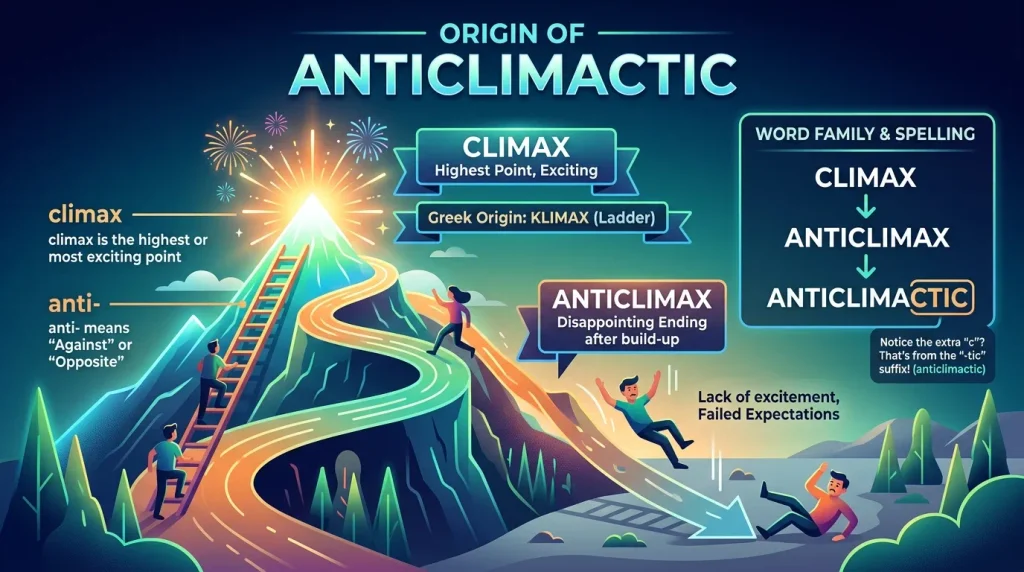
Anticlimactic comes from the word anticlimax.
The word anti- can mean “against” or “opposite.”
The word climax means the highest or most exciting point of something.
So, an anticlimax is something that comes after a build-up but does not give the strong ending people expected.
The word climax comes from Greek and was linked to the idea of a ladder or rising point.
The word family is easy to remember:
climax → anticlimax → anticlimactic
This is why the spelling has the extra c.
British English vs. American English
There is no different spelling for this word in British and American English.
Both normally use:
anticlimactic
The pronunciation can sound a little different.
| English | Spelling |
|---|---|
| American English | anticlimactic |
| British English | anticlimactic |
So, you do not need to learn two spellings.
Just remember anticlimactic.
Which One Should You Use?
Use anticlimactic when something is less exciting or satisfying than you expected.
You can use it for:
- movies
- books
- sports
- parties
- events
- announcements
- performances
- surprises
- endings
Examples
- The movie had an anticlimactic ending.
- The big party was anticlimactic.
- The final game felt anticlimactic.
- The surprise was anticlimactic.
Common Mistakes
Here are some common mistakes.
| ❌ Wrong or less suitable | ✅ Better |
|---|---|
| anticlimatic ending | anticlimactic ending |
| anticlimatic result | anticlimactic result |
| anticlimatic movie | anticlimactic movie |
| anticlimatic surprise | anticlimactic surprise |
| anti-climactic ending | anticlimactic ending |
| climatic final scene | climactic final scene |
Remember
Climactic = related to a climax.
Climatic = related to climate.
Anticlimactic = less exciting than expected.
Everyday Usage
You can hear or see anticlimactic in many places.
Movies
The movie was exciting, but the ending was anticlimactic.
Sports
The final match felt anticlimactic after such an exciting season.
School
The ending of the story was anticlimactic.
Work
The big meeting turned out to be anticlimactic.
Social Media
Everyone expected a huge reveal, but it was anticlimactic.
News
The announcement seemed anticlimactic because most people already knew about it.
The word works well in both casual and formal writing.
Usage in Modern English
Anticlimactic is used in many types of writing and speech.
You may see it in:
- movie reviews
- book reviews
- sports writing
- news
- school work
- blogs
- social media
- everyday conversations
For example:
The ending was a little anticlimactic.
Metaphors and Similes
Writers sometimes use simple images to explain an anticlimactic moment.
Balloon Losing Air
Imagine a big balloon slowly losing its air.
You expect a loud pop, but there is only a small sound.
That can feel anticlimactic.
Falling Flat
You may also hear:
The joke fell flat.
This means the joke did not get the reaction people expected.
Big Build-Up, Small Ending
Another easy way to think about it is:
Big build-up + small result = anticlimactic
For example, everyone waits for a huge birthday surprise. Then the surprise is just a small cupcake.
That might feel anticlimactic.
Connotation
Anticlimactic often has a negative feeling.
People may use it when they feel:
- disappointed
- surprised
- bored
- let down
But anticlimactic does not always mean something is bad.
Sometimes a quiet ending is planned by the writer.
For example, a movie may have many exciting scenes and then end in a calm way. Some viewers may find this ending anticlimactic, while others may like it.
Idioms and Related Expressions
Some phrases have a similar idea to anticlimactic.
A Letdown
If something is a letdown, it does not meet your hopes.
The party was a letdown.
Fall Flat
If something falls flat, it does not have the effect people expected.
His joke fell flat.
All Build-Up and No Payoff
This phrase means there was a lot of excitement or waiting, but the final result was weak.
The story had lots of build-up but no payoff.
These expressions can help you understand the idea behind anticlimactic.
Literature and Movies
Writers often build a story toward a climax.
The climax is usually the biggest or most exciting part.
But sometimes the ending is much quieter.
If readers expected something much bigger, they may call the ending anticlimactic.
Example
Imagine a story about a hero fighting a huge enemy.
The story spends many pages building up the final fight.
But when the fight begins, the enemy quickly runs away.
A reader may think:
“That ending was anticlimactic.”
Why the Difference Matters
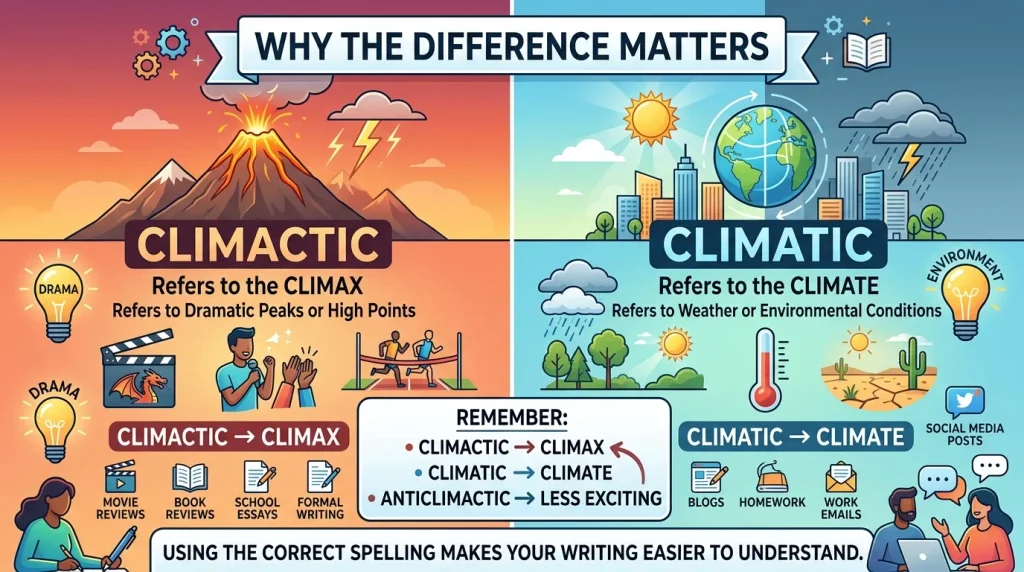
Using the correct spelling makes your writing easier to understand.
This is useful in:
- school essays
- homework
- blogs
- movie reviews
- book reviews
- work emails
- social media posts
- formal writing
Writing anticlimactic also helps you avoid confusion with climatic.
Remember:
climactic → climax
climatic → climate
anticlimactic → less exciting than expected
Usefulness in Daily Life
The word anticlimactic is useful when you want to explain that something did not match your expectations.
| Situation | Example |
|---|---|
| Movie | The ending was anticlimactic. |
| Book | The final chapter felt anticlimactic. |
| Sports | The last game was anticlimactic. |
| Party | The party was anticlimactic. |
| Surprise | The surprise was anticlimactic. |
| Work | The big meeting was anticlimactic. |
| Social Media | The big reveal was anticlimactic. |
It is a helpful word because it says more than simply bad or boring.
It tells us that something was less exciting than we expected.
Situational Preference
Use anticlimactic when an event, story, ending, or result is less exciting than people expected. It works well in everyday speech and writing. You can use it for movies, books, sports, parties, surprises, and announcements. Do not normally use anticlimatic for this meaning. If you are talking about the most exciting part of something, use climactic. If you are talking about weather or climate, use climatic. A simple memory trick is to remember anticlimax → anticlimactic. Keep the c in the middle of the word.
What People Ask About Anticlimactic or anticlimatic
1. Is anticlimactic the correct spelling?
Yes. Anticlimactic is the standard spelling when you mean less exciting or satisfying than expected.
2. Is anticlimatic correct?
Anticlimatic is sometimes seen, but it is commonly treated as a misspelling when the intended meaning is anticlimactic.
3. What does anticlimactic mean?
It means something is less exciting, interesting, or satisfying than expected.
4. What is the noun form of anticlimactic?
The noun is anticlimax.
Example:
The ending was an anticlimax.
5. Is the spelling different in British and American English?
No. Both normally use anticlimactic.
6. What is the difference between climactic and climatic?
Climactic is related to a climax, or the most exciting point.
Climatic is related to climate or weather.
7. How can I remember anticlimactic?
Remember:
anticlimax → anticlimactic
Do not drop the c.
Conclusion
Anticlimactic or anticlimatic can be confusing, but anticlimactic is the standard spelling. Anticlimatic is usually a spelling mistake when you mean something that is less exciting or satisfying than expected. You can use anticlimactic to talk about movies, books, sports, parties, events, surprises, and endings. For example, you can say, “The movie had an anticlimactic ending.” The word comes from anticlimax, which is linked to the idea of a climax or high point. Remember the word family: climax → climactic → anticlimactic. Also, do not confuse climactic with climatic. Climactic relates to a climax, while climatic relates to climate. British and American English both normally use anticlimactic. When you want to say that something was not as exciting as expected, anticlimactic is the word to choose.

I’m Samia Jamshaid, an English language specialist, SEO specialist, digital publisher, and researcher. I create clear, accurate, and well-researched content on English grammar, vocabulary, word meanings, and language comparisons, helping readers understand and use English with confidence.





1 thought on “Anticlimactic or Anticlimatic: Correct Spelling & Usage 2026”