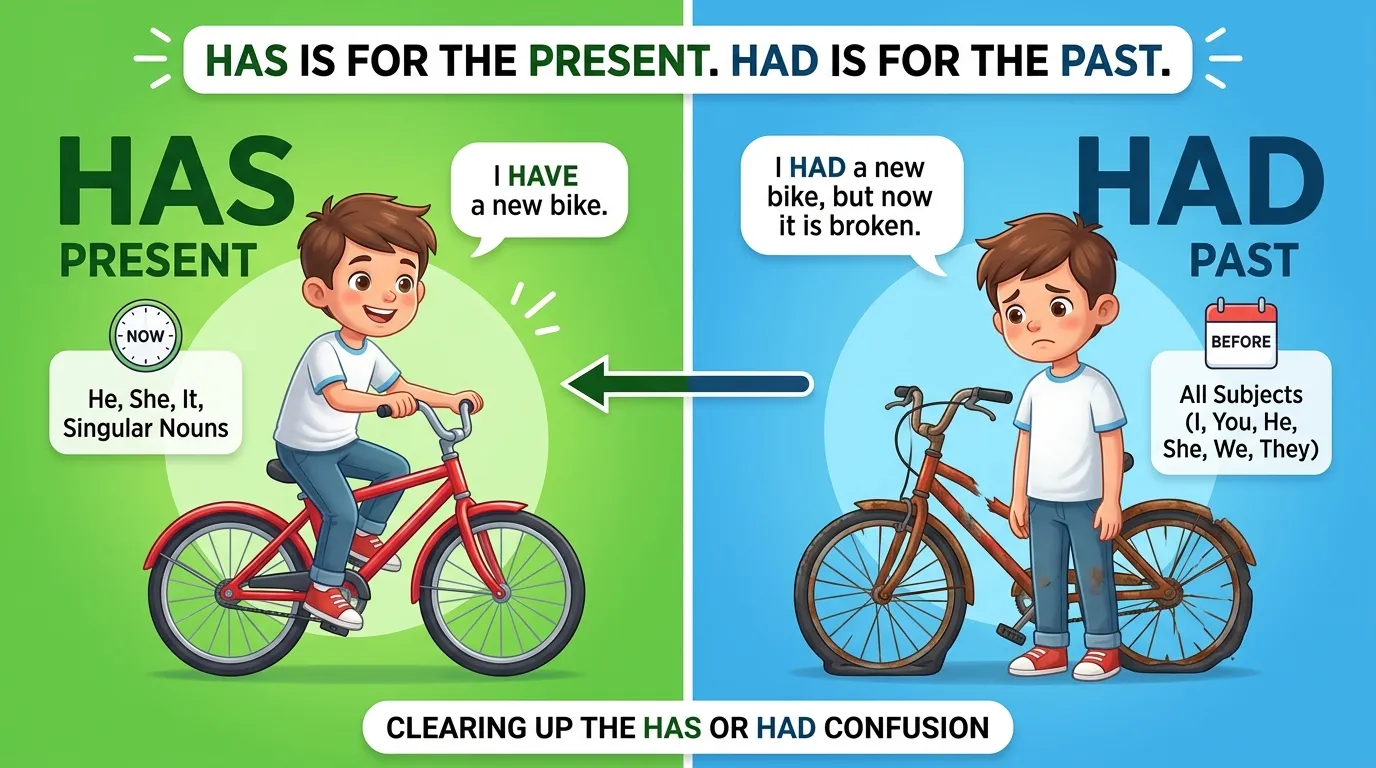
Has is for the present. “Had” is for the past.
Think about a boy who tells his friend, “I have a new bike.” Later, his bike breaks. He says, “I had a new bike, but now it is broken.” The words “has” and “had” show when something was true. “Has” shows something true now. “Had” shows something true before. Many people mix up has or had because both words come from the same verb, “have.” This mix-up causes confusion in school, work, and daily talk. People search for “has or had” because they want to write and speak correct English. This article clears up the confusion between has and had. You will learn the meaning, grammar rules, history, and easy tips to use each word the right way every time.
Pronunciation
| Word | US Pronunciation | UK Pronunciation |
|---|---|---|
| Has | /hæz/ | /hæz/ |
| Had | /hæd/ | /hæd/ |
Transition
Now let’s look closely at how “has” and “had” are different, and how to use each one correctly.
Difference Between Has and Had
1. Time
“Has” talks about now. “Had” talks about the past.
- Example: “She has a dog.” (now)
- Example: “She had a dog.” (before)
2. Subject Rule
“Has” is used with he, she, it, and singular nouns. “Had” is used with every subject.
- Example: “He has a car.”
- Example: “He had a car. They had a car too.”
3. Verb Tense
“Has” is present tense. “Had” is past tense.
- Example: “I think she has the keys.”
- Example: “I knew she had the keys.”
4. Use with “I” and “You”
“Has” is not used with “I” or “you.” “Had” works with every subject, including “I” and “you.”
- Example: “I have a pen.” (not “I has”)
- Example: “I had a pen yesterday.”
5. Use in Questions
“Has” asks about now. “Had” asks about the past.
- Example: “Has she finished her work?”
- Example: “Had she finished her work before you called?”
6. Use in Negative Sentences
“Has” and “had” both work with “not,” but they still follow the same time rule.
- Example: “He has not seen the movie.” (now)
- Example: “He had not seen the movie before last night.” (past)
7. Use with Perfect Tense
“Has” is used in present perfect tense. “Had” is used in past perfect tense.
- Example: “She has eaten lunch.” (present perfect)
- Example: “She had eaten lunch before noon.” (past perfect)
8. Everyday Speech
“Has” shows a current fact. “Had” shows something that changed.
- Example: “My brother has a new phone.”
- Example: “My brother had an old phone before this one.”
9. Storytelling
“Had” is common in stories because stories often happen in the past.
- Example: “The girl had a secret.”
- Example: “The king had many lands.”
10. Formal Writing
Both words are correct in formal writing, but the right choice depends on the time of the action.
- Example: “The report has new data.” (current report)
- Example: “The old report had wrong data.” (past report)
Keep Exploring https://orchoice.com/anticlimactic-or-anticlimatic/
Nature and Behaviour of Has and Had
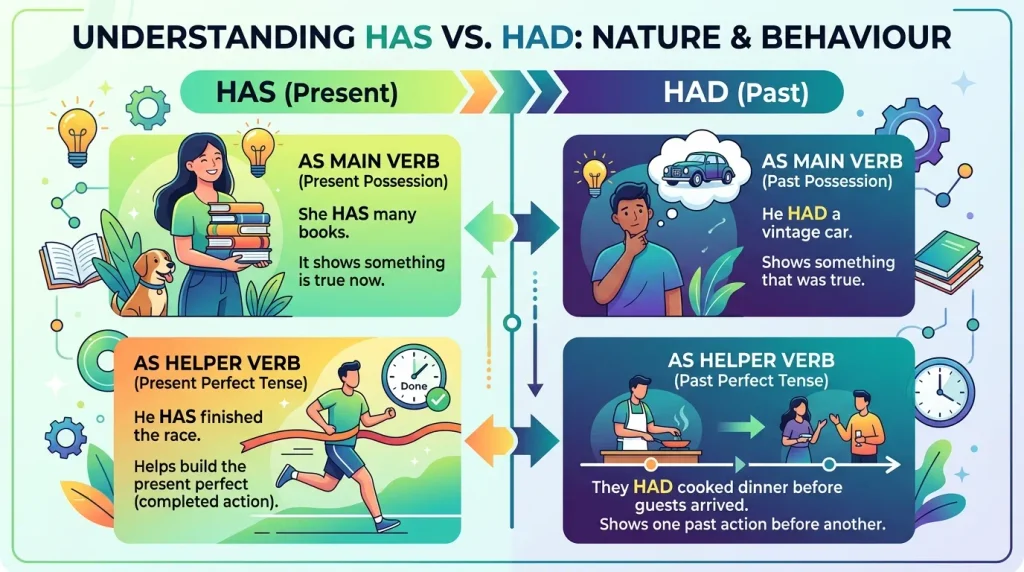
Has behaves as a helper word and a main verb. It shows something is true right now. It also helps build the present perfect tense, like “has finished” or “has seen.”
Had behaves the same way, but it moves the action into the past. It can be a main verb, like “I had a dream.” It also helps build the past perfect tense, like “had finished” or “had seen,” which shows one past action happened before another.
Why People Get Confused About Has and Had
People get confused because “has” and “had” come from the same base verb, “have.” Many English learners forget that the subject changes which word to use. Others mix up the tense, using “has” when they mean the past, or “had” when they mean now.
Comparison Table
| Feature | Has | Had |
| Tense | Present | Past |
| Used with | He, she, it, singular nouns | All subjects (I, you, he, she, it, we, they) |
| Main use | Shows something true now | Shows something true before |
| Perfect tense | Present perfect (has done) | Past perfect (had done) |
| Common in | Daily talk, news, reports | Stories, memories, past events |
The Origin of Has/Had
Both words come from the Old English verb habban, which meant “to have” or “to hold.” Over time, this verb changed form based on time and subject. “Has” grew from the old third-person form. “Had” grew from the old past-tense form. Both words have stayed close to their old meaning: holding or owning something.
British vs American English
| Feature / Tense | British English (UK) | American English (US) | Example |
| Present Perfect (Third Person Singular) | Uses “has” + past participle | Uses “has” + past participle | She has finished her homework. |
| Past Perfect (All Persons) | Uses “had” + past participle | Uses “had” + past participle | They had left before I arrived. |
| Possession (Present) | Uses “has” (or has got) | Uses “has” (or has) | He has a car. / He has got a car. (UK) He has a car. (US) |
| Spelling Rules | Standard English grammar rules | Standard English grammar rules | Identical across both regions. |
Which One Should You Use?
- In the US: Use “has” for the present and “had” for the past, just like standard grammar rules.
- In the UK: Use the same rule. There is no regional difference here.
- Globally: Always check the time of the action. If it is happening now, use “has” (with he, she, it). If it already happened, use “had.”
Common Mistakes
- ❌ “I has a book.” → ✅ “I have a book.”
- ❌ “She have a car.” → ✅ “She has a car.”
- ❌ “He has a car yesterday.” → ✅ “He had a car yesterday.”
- ❌ “They had a meeting now.” → ✅ “They have a meeting now.”
Everyday Usage Examples
Email:
“She has completed the report and sent it to you.”
Social Media:
This city has the best food ever.
News:
The company had a difficult year before its recent growth.
Formal Writing:
The committee has reviewed the proposal and had no objections.
Usage Trends
“Has” is very common in news, ads, and daily talk because people often describe things happening now. “Had” is common in stories, memories, and reports about past events. Both words are used equally often across the world, just in different time contexts.
Metaphors and Similes
- “She has the world in her hands” means she has full control or power.
- “He had a heart of stone” means he was very cold or unkind in the past.
Connotative Meaning
- Positive tone: showing ownership or success. “She has a great job.”
- Negative tone: showing loss or regret. “He had a job, but lost it.”
- Neutral tone: simply stating a fact. “The house has three rooms.”
Idioms and Proverbs
- “Had better” means it is wise to do something.
Example: “You had better finish your homework.” - “Has seen better days” means something is old or worn out.
Example: “This old car has seen better days.”
Literature and Movies
In classic literature, “had” appears often in past-tense storytelling. Great Expectations, a novel by Charles Dickens (1861), uses “had” throughout to describe past events in the main character’s life. In movies, narration often uses “had” to explain backstory, as seen in many historical dramas from both the US and UK film industries.
Why This Difference Matters
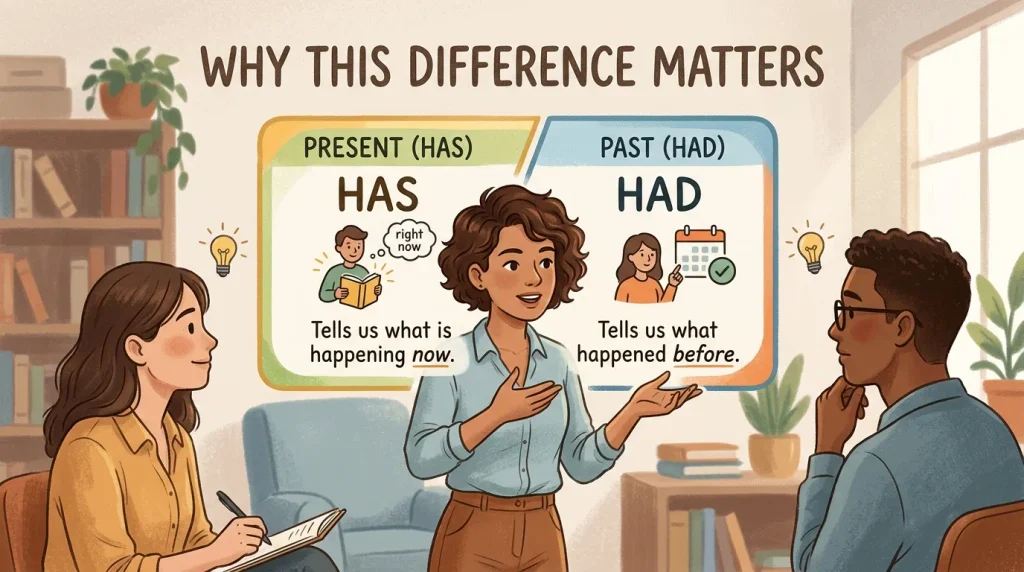
Knowing when to use “has” or “had” helps you speak and write clearly. It shows whether something is true now or happened before. For English learners, this small rule builds strong grammar skills and helps avoid confusion in school, work, and daily conversation.
Usefulness in Daily Life
People use “has” and “had” every day in talk, texts, emails, and stories. Knowing the right word helps you explain events clearly, whether you are talking about today or something from the past.
Situational Preference
Use “has” when talking about something true right now, like a job, an item, or a fact. Use “had” when talking about something from the past, like an old memory or a finished event. In storytelling, “had” is often the better choice since most stories describe past events. In daily updates, reports, or news about current events, “has” fits best. Always check the time of the action before choosing the right word.
What People Ask About has or had
- What is the difference between has and had?
“Has” shows something true now. “Had” shows something true in the past. - When should I use “has”?
Use it with he, she, it, or a singular noun, to talk about the present. - When should I use “had”?
Use it with any subject to talk about the past. - Can “has” and “had” be used in the same sentence?
Yes, especially when comparing past and present, like “He had a car, but now he has a bike.” - Is “had” used in past perfect tense?
Yes. “Had” plus a past participle forms the past perfect tense, like “had finished.” - Is “has” used with “I”?
No. Use “have” with “I,” not “has.” - Why do people confuse has and had?
Because both come from the same verb, “have,” and people sometimes forget the tense or subject rule.
Conclusion
Has or had both come from the verb “have,” but they show different times. “Has” tells us something is true right now. “Had” tells us something was true in the past. Knowing the difference between has or had helps you speak and write with more confidence. Simple rules guide the choice: match the subject, and check the time of the action. Writers, students, and daily English users all benefit from learning this small but important grammar rule. Practice using both words in short sentences every day. Soon, choosing between has and had will feel natural and easy, making your English clearer and stronger.

I’m Samia Jamshaid, an English language specialist, SEO specialist, digital publisher, and researcher. I create clear, accurate, and well-researched content on English grammar, vocabulary, word meanings, and language comparisons, helping readers understand and use English with confidence.





1 thought on “Has or Had: Which One Should You Use?”