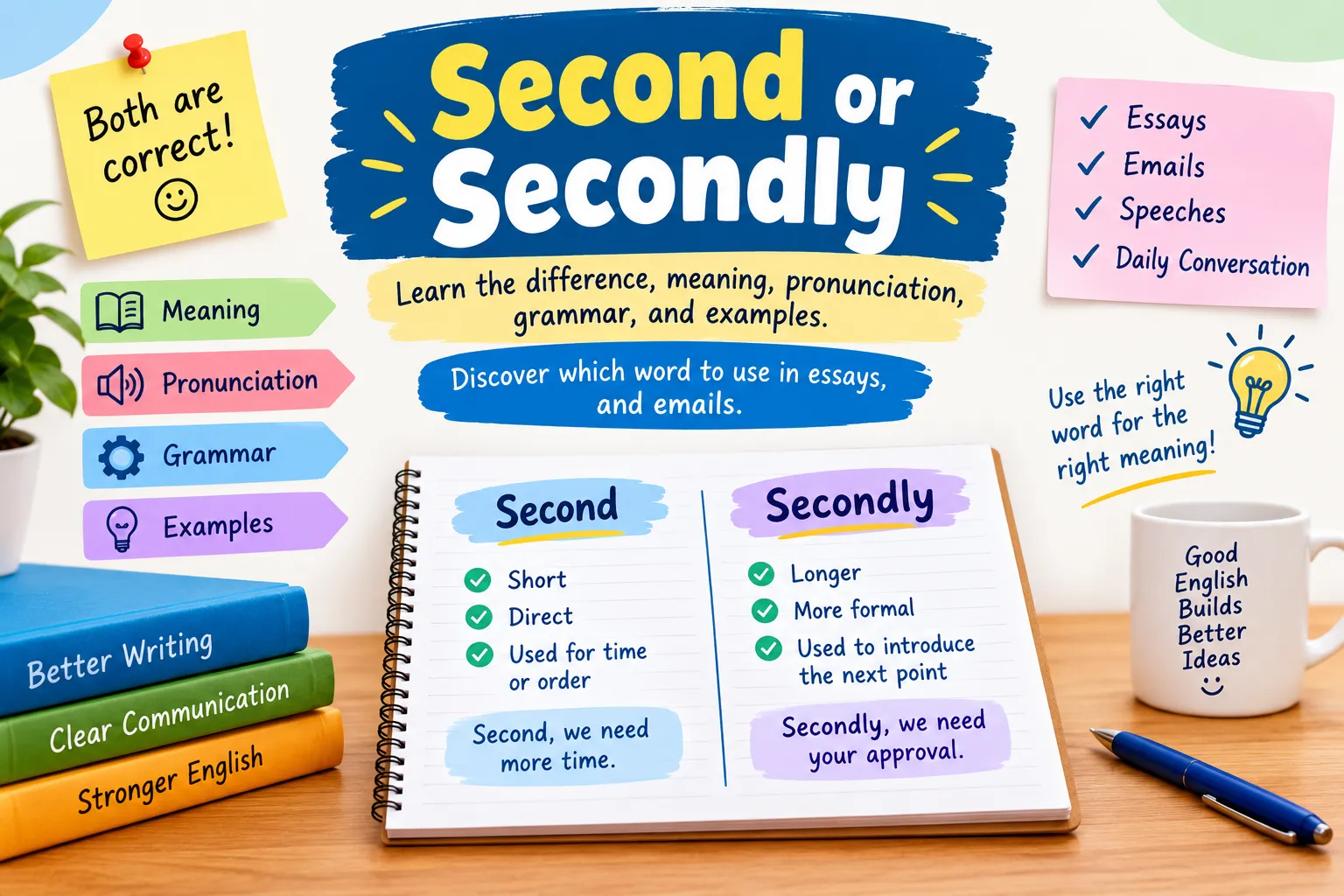
“Second” and “secondly” can both introduce the second point in a list. The main difference is how they sound and fit into a sentence.
Imagine you are writing an email to your teacher. You have two reasons for missing class. You write, “First, I was sick. Secondly, I had no way to travel.” Is this correct? Yes, it is. You could also write, “First, I was sick. Second, I had no way to travel.”
Both versions are correct. However, “second” is shorter and often sounds more natural. “Secondly” can sound more formal or careful. Neither word is wrong when used correctly.
People search for second or secondly because they want to write clear English. Some believe “secondly” is incorrect because “second” is already an order word. Others are unsure which word suits essays, emails, or daily speech.
This guide explains the meaning, pronunciation, grammar, and use of both words. You will learn how to choose the right form and avoid common mistakes. Simple examples will help you use both words with confidence.
Pronunciation of Second and Secondly
| Word | US pronunciation | UK pronunciation | Part of speech |
| Second | /ˈsekənd/ | /ˈsekənd/ | Adjective, noun, verb, or transition word |
| Secondly | /ˈsekəndli/ | /ˈsekəndli/ | Adverb |
The two words have similar sounds. “Secondly” adds an extra ending. Both words have their main stress on the first syllable.
Difference Between Second and Secondly
1. Word Length
“Second” is shorter than “secondly.” Both can introduce your next point.
- Second: Second, we need more time.
- Secondly: Secondly, we need more time.
Both sentences are correct. Choose the one that fits your style.
2. Sound and Style
“Second” often sounds direct and simple. “Secondly” can sound more formal.
- Second: Second, check the door.
- Secondly: Secondly, please check the door.
3. Formal Writing
You can use either word in essays and reports. Keep your style the same throughout.
- Second: Second, the study needs more data.
- Secondly: Secondly, the study needs more data.
4. Everyday Speech
“Second” is a short choice for daily speech. “Secondly” also works when you list points aloud.
- Second: First, wash your hands. Second, dry them.
- Secondly: First, wash your hands. Secondly, dry them.
5. Listing Reasons
Both words can introduce the second reason for an opinion.
- Second: Second, the plan costs too much.
- Secondly: Secondly, the plan costs too much.
6. Numbered Instructions
Use “second” when giving short steps. “Secondly” can also introduce the next point.
- Second: First, open the box. Second, remove the parts.
- Secondly: First, open the box. Secondly, remove the parts.
7. Time Order
When describing events in time, “second” can show what happened next. “Secondly” is usually better for listing points than telling a simple story.
- Second: First, we ate lunch. Second, we went home.
- Secondly: Firstly, we planned the trip. Secondly, we booked the hotel.
8. Essays and Schoolwork
Students can use either form in essays. The important thing is to connect each point clearly.
- Second: Second, exercise can improve sleep.
- Secondly: Secondly, exercise can improve sleep.
9. Speeches and Presentations
Both words work when you speak to a group. Choose the form that feels natural.
- Second: Second, I want to thank our team.
- Secondly: Secondly, I want to thank our team.
10. Grammar and Meaning
“Secondly” is an adverb. It often introduces the second item in a list. “Second” has several grammar roles, including an ordinal form.
- Second: Maya came second in the race.
- Secondly: Secondly, Maya will explain the results.
Nature and Behaviour of Second and Secondly
How Second Works
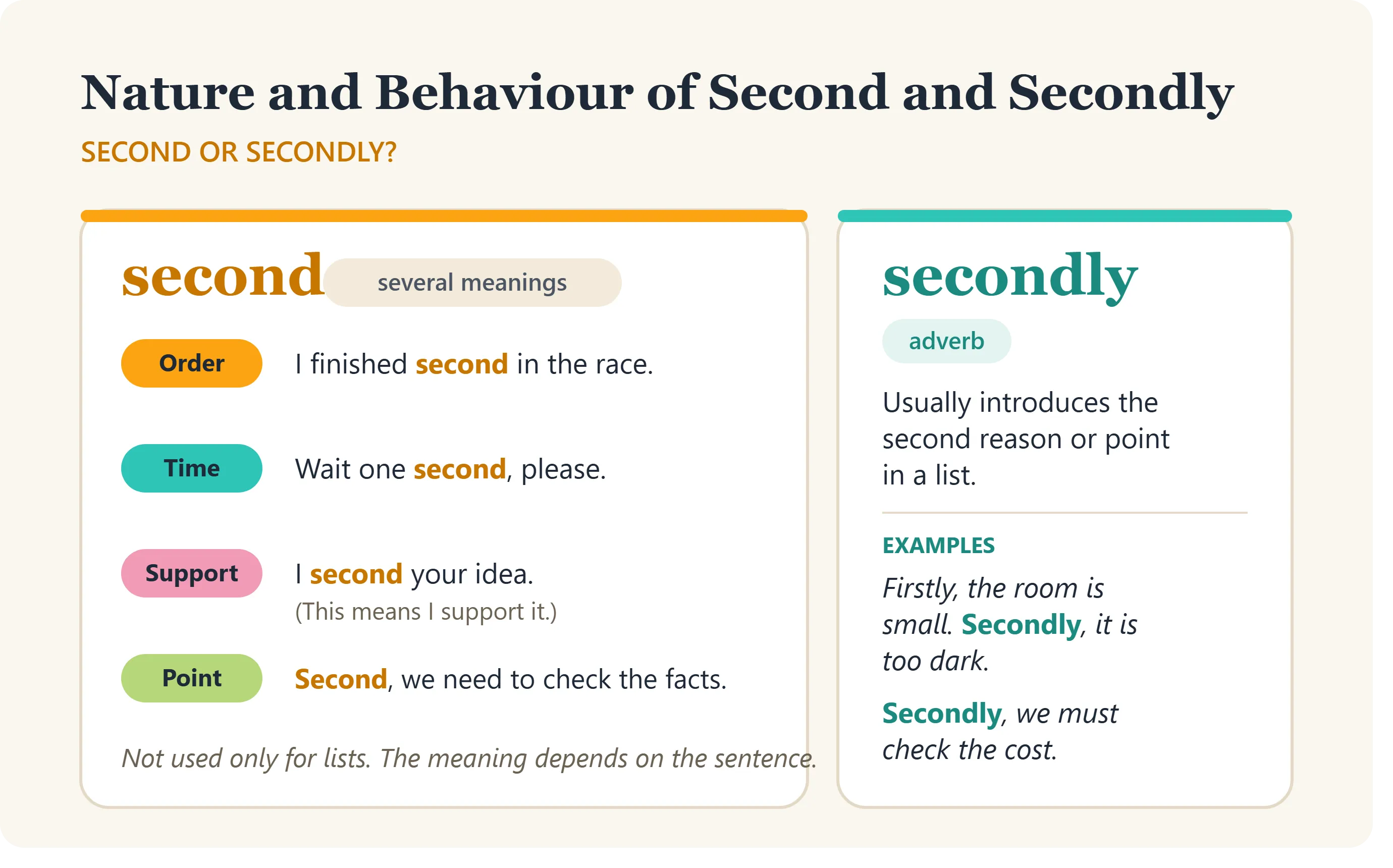
“Second” has several meanings. It can show order, time, or support.
- I finished second in the race.
- Wait one second, please.
- I second your idea. (This means I support it.)
- Second, we need to check the facts.
The meaning depends on the sentence. “Second” is not used only for lists.
How Secondly Works
“Secondly” is an adverb. It usually introduces the second reason or point in a list.
- Firstly, the room is small. Secondly, it is too dark.
- Secondly, we must check the cost.
Why People Get Confused About Second or Secondly
People get confused because both words can introduce the same point. They also share the same root word.
Some people think every list needs “firstly” and “secondly.” Others think “secondly” is always wrong. Neither belief is correct.
You can write “first, second, and third.” You can also write “firstly, secondly, and thirdly.” The key is to use each form clearly and consistently.
You May Also Like https://orchoice.com/liqueur-or-liquor/
Comparison Table
| Feature | Second | Secondly |
| Main use | Shows order or introduces a point | Introduces the second point |
| Part of speech | Several roles, including adjective and adverb uses | Adverb |
| Meaning in a list | The next point | The next point |
| Length | Shorter | Longer |
| Formal writing | Correct | Correct |
| Daily speech | Common and direct | Correct, but can sound more formal |
| Time meaning | Can mean a short unit of time | Does not mean a unit of time |
| Race results | Can show a person’s place | Does not show a race position |
| Example | Second, check the figures. | Secondly, check the figures. |
| Main advice | A simple choice for many lists | Useful when it fits your style |
The Origin of Second and Secondly
“Second” comes from older forms of French and Latin. The Latin word secundus meant “following” or “next.” English later used “second” to show order.
“Secondly” comes from “second” plus the ending “-ly.” This ending helps form adverbs. It turns the word into a form used to introduce a point.
The two words share the same history. Their modern uses have grown from the idea of coming next in a series.
British vs. American English
There is no major spelling difference between British and American English here. Both use “second” and “secondly.”
| Situation | British English | American English |
| Introduce a point | Secondly, we need help. | Secondly, we need help. |
| Use a shorter form | Second, we need help. | Second, we need help. |
| Write a school essay | Both forms are accepted | Both forms are accepted |
| Show race order | She came second. | She came second. |
| Show a unit of time | Wait a second. | Wait a second. |
Which One Should You Use?
Use “second” when you want a short, clear sentence. It works well in emails, instructions, essays, and daily speech.
Use “secondly” when you are listing points and prefer that style. It is common in formal writing and speech. It is not a grammar mistake.
For readers around the world, either form is easy to understand. The best choice is the one that makes your writing clear. If you start with “first,” you can continue with “second” and “third.” If you start with “firstly,” you can use “secondly” and “thirdly.”
Common Mistakes
Mistake 1: Saying Secondly Is Always Wrong
Incorrect claim: “Secondly” is never correct.
Correction: “Secondly” is accepted when introducing the second point.
Example: Firstly, we need a plan. Secondly, we need time.
Mistake 2: Mixing Forms Without a Reason
Less consistent: Firstly, we need money. Second, we need workers.
More consistent: First, we need money. Second, we need workers.
You can mix forms when needed. However, a matching style can make a list easier to follow.
Mistake 3: Using Secondly for Race Results
Incorrect: She finished secondly in the race.
Correct: She finished second in the race.
Use “second” to show someone’s place in a race.
Mistake 4: Using Secondly to Mean a Short Time
Incorrect: Please wait secondly.
Correct: Please wait a second.
“Secondly” introduces a point. It does not mean a short unit of time.
Mistake 5: Adding Too Many List Words
Less clear: Firstly, we came in. Secondly, we sat down. Thirdly, we opened our books. Fourthly, we read.
Clearer: We came in, sat down, opened our books, and read.
List words help when readers need to follow separate points. Too many can make simple writing feel stiff.
Mistake 6: Forgetting the Comma
When “second” or “secondly” begins a sentence as a list marker, a comma often follows it.
- Better: Second, we checked the door.
- Better: Secondly, we checked the door.
Everyday Usage Examples
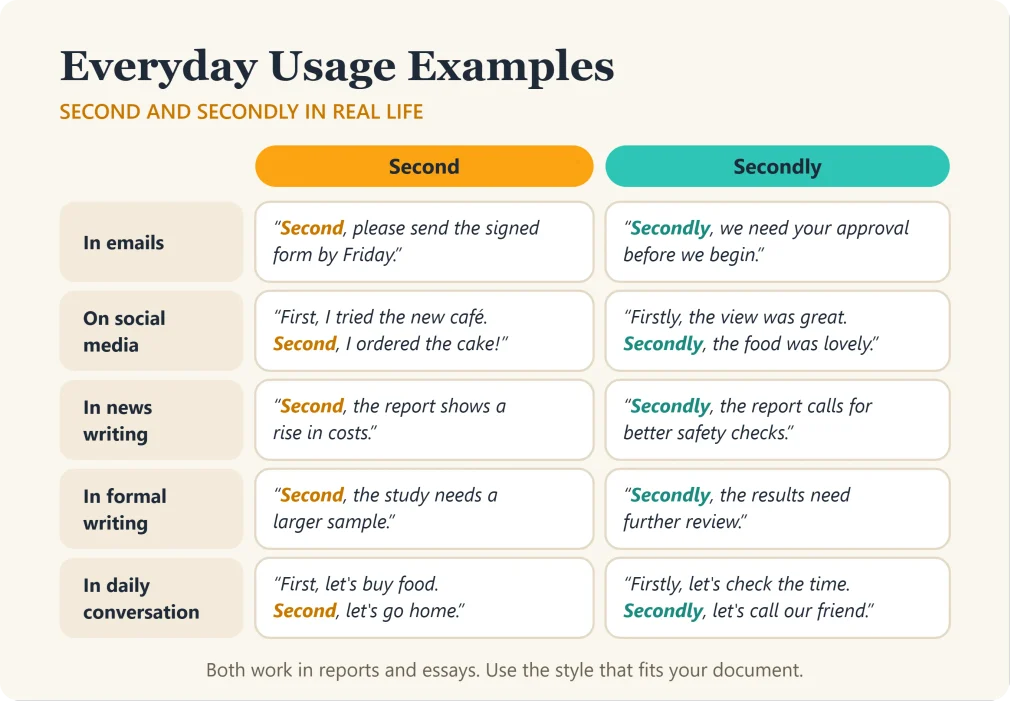
In Emails
“Second, please send the signed form by Friday.”
“Secondly, we need your approval before we begin.”
On Social Media
“First, I tried the new café. Second, I ordered the cake!”
“Firstly, the view was great. Secondly, the food was lovely.”
In News Writing
“Second, the report shows a rise in costs.”
“Secondly, the report calls for better safety checks.”
News writing often uses clear transitions to guide readers through facts.
In Formal Writing
“Second, the study needs a larger sample.”
“Secondly, the results need further review.”
Both can work in reports and essays. Use the style that fits your document.
In Daily Conversation
“First, let’s buy food. Second, let’s go home.”
“Firstly, let’s check the time. Secondly, let’s call our friend.”
Usage Trends
Both “second” and “secondly” appear in modern English. Their use depends on the writer, the task, and the style.
“Second” is short and direct. “Secondly” can sound more formal. Neither form is limited to one country.
There is no need to force one word into every list. Use clear wording and avoid extra transitions that add little meaning.
Metaphors and Similes
“Second” and “secondly” are not common metaphors or similes by themselves. They mainly show order. However, you can use them in creative sentences.
- Second chance: “He got a second chance to try again.”
- Second to none: “Her kindness is second to none.”
- Secondly, like a new door opening: “Secondly, the new plan gave us hope.”
Connotative Meaning
These words have little emotional meaning by themselves. Their main job is to show order.
Positive Meaning
They can help a speaker sound organized and clear.
Example: “Second, we can save money by planning ahead.”
Negative Meaning
Using too many list words may make writing feel stiff or boring.
Example: “Firstly, we waited. Secondly, we sat. Thirdly, we waited again.”
Neutral Meaning
Most of the time, they simply show the order of ideas.
Example: “Second, turn left at the bridge.”
The sentence around the word gives it most of its feeling.
Idioms and Proverbs
“Second” appears in several common expressions. “Secondly” is not often used in idioms.
| Expression | Meaning | Example |
| Second to none | As good as any other | Her work is second to none. |
| A second chance | Another chance to try | He got a second chance to pass. |
| In the second place | As another point | In the second place, we need more time. |
| Every second counts | Every moment matters | Hurry up; every second counts. |
Literature and Movies
Writers use “second” and “secondly” to show order and help readers follow ideas. These words are common in essays, speeches, and everyday dialogue.
“Second” also appears in titles and stories about time, choices, or another chance. For example, Secondhand Lions is a 2003 American comedy-drama film. Its title uses “secondhand,” not “secondly.”
There is no need to name a book or film just because it contains either word. For this grammar topic, clear examples are more helpful than unrelated titles.
Why This Difference Matters
Knowing the difference helps you write clear English. You can list reasons without worrying that one form is always wrong.
It also helps you avoid common errors. For example, you should say “I finished second,” not “I finished secondly.” The right word depends on the meaning of your sentence.
For English learners, the key lesson is simple. Learn what each word does. Then choose the form that fits your sentence.
Usefulness in Daily Life
You can use these words in many situations.
- At school: “Second, we must answer the last question.”
- At work: “Secondly, we need to check the budget.”
- In an email: “Second, please review the attached file.”
- In a speech: “Secondly, I want to thank my family.”
- In a plan: “First, buy the tickets. Second, book a room.”
Situational Preference
Use “second” when you want a short and simple style. It is useful in everyday speech, short emails, and step-by-step instructions. Use “secondly” when you are listing reasons or points in a more formal style. Both forms work in British and American English. For global readers, either is clear. The most important rule is to use the word that matches your meaning. Use “second” for a place in a race or a short unit of time. Use “secondly” to introduce the next point. Keep your list easy to follow, and avoid extra words that do not help.
Common Questions and Answers
1. Is “second or secondly” the correct form?
Both are correct when introducing the second point in a list. Choose the form that fits your style.
2. Is “secondly” grammatically wrong?
No. “Secondly” is a correct adverb. Dictionaries list it as a way to introduce the second point.
3. Is “second” better than “secondly”?
Not in every case. “Second” is shorter, while “secondly” can sound more formal.
4. Can I use “secondly” in an essay?
Yes. You can use it in an essay to introduce your second point. Keep your writing style consistent.
5. Do British and American writers use these words differently?
Both forms are used in British and American English. There is no major spelling difference.
6. Should I write “firstly, secondly, thirdly”?
Yes, this is an accepted pattern. You can also write “first, second, third.”
7. Can “secondly” mean a short unit of time?
No. Use “second” for a short unit of time. For example, “Wait a second.”
Conclusion
Second and “secondly are both correct words used to introduce the second point in a list. The main difference is their style: “second” is short and direct, while “secondly” can sound more formal. Both are accepted in British and American English and can be used in essays, emails, speeches, and daily conversation. Use “second” to show a place in a race or a short unit of time, and use “secondly” to introduce the next point in a list. You do not need to avoid “secondly” just because some people dislike it. For clear writing, choose either “first, second, third” or “firstly, secondly, thirdly.” Avoid using list words in every sentence, and use them only when they help readers follow your ideas.

I’m Samia Jamshaid, an English language specialist, SEO specialist, digital publisher, and researcher. I create clear, accurate, and well-researched content on English grammar, vocabulary, word meanings, and language comparisons, helping readers understand and use English with confidence.




1 thought on “Second or Secondly: What Is the Difference? 2026”