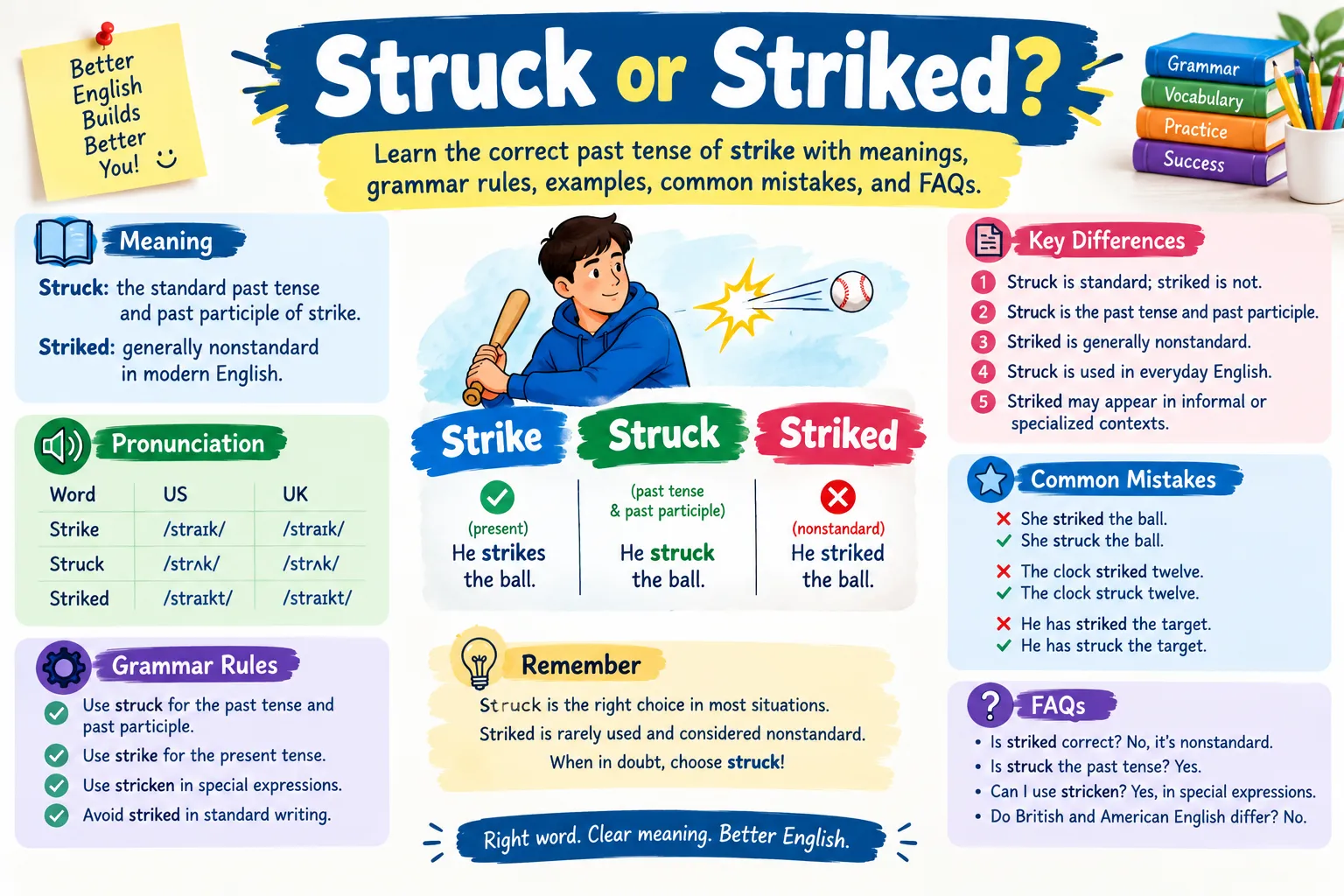
Have you ever wondered whether to write struck or striked? Many English learners find this question confusing. Both words may look correct at first. However, struck is the standard past tense of strike in modern English. It is also the usual past participle. For example, you can say, “The ball struck the window” or “The ball has struck the window.”
The confusion comes from a common English rule. Many verbs form the past tense by adding -ed. For example, walk becomes walked, and clean becomes cleaned. But strike is an irregular verb. It changes to struck instead of striked in standard everyday English.
In this guide, you will learn the meaning of both forms, their grammar, pronunciation, and correct usage. You will also see simple examples, common mistakes, and answers to frequently asked questions. By the end, you will know how to use struck with confidence in speaking and writing.
Answer: Struck or Striked?
Struck is the correct choice in most modern English sentences. Striked is generally nonstandard, although it appears in some less common or specialized uses.
- Correct: The stone struck the wall.
- Correct: The workers went on strike.
- Usually incorrect: The stone striked the wall.
The verb forms are:
| Verb form | Word |
| Present | Strike |
| Past tense | Struck |
| Past participle | Struck |
| -ing form | Striking |
Example: “She strikes the ball, struck it yesterday, and has struck it well many times.”
What Does Struck Mean?
Struck is the past tense and past participle of the verb strike. It can mean hit, affected, attacked, or suddenly caused a feeling or thought.
The exact meaning depends on the sentence.
Examples:
- The car struck a tree.
- A strange idea struck me during class.
- Lightning struck the tall building.
- We have struck a deal with the seller.
What Does Striked Mean?
Striked is formed by adding -ed to strike. However, standard modern English usually uses struck instead.
You may see striked in informal writing, learner mistakes, or some specialized contexts. It should not be used as the normal past tense in schoolwork, formal writing, or everyday English.
Examples:
- Nonstandard: He striked the ball hard.
- Standard: He struck the ball hard.
- Nonstandard: The clock striked twelve.
- Standard: The clock struck twelve.
Pronunciation: Struck vs. Striked
Pronunciation helps you recognize the difference when speaking.
| Word | US pronunciation | UK pronunciation |
| Strike | /straɪk/ | /straɪk/ |
| Struck | /strʌk/ | /strʌk/ |
| Striked | /straɪkt/ | /straɪkt/ |
The standard past-tense form struck has a short vowel sound. It rhymes with words such as luck and truck in many English accents.
Remember: the correct spelling is not decided by how easy a word is to pronounce. The standard past form is struck.
Ten Key Differences Between Struck and Striked
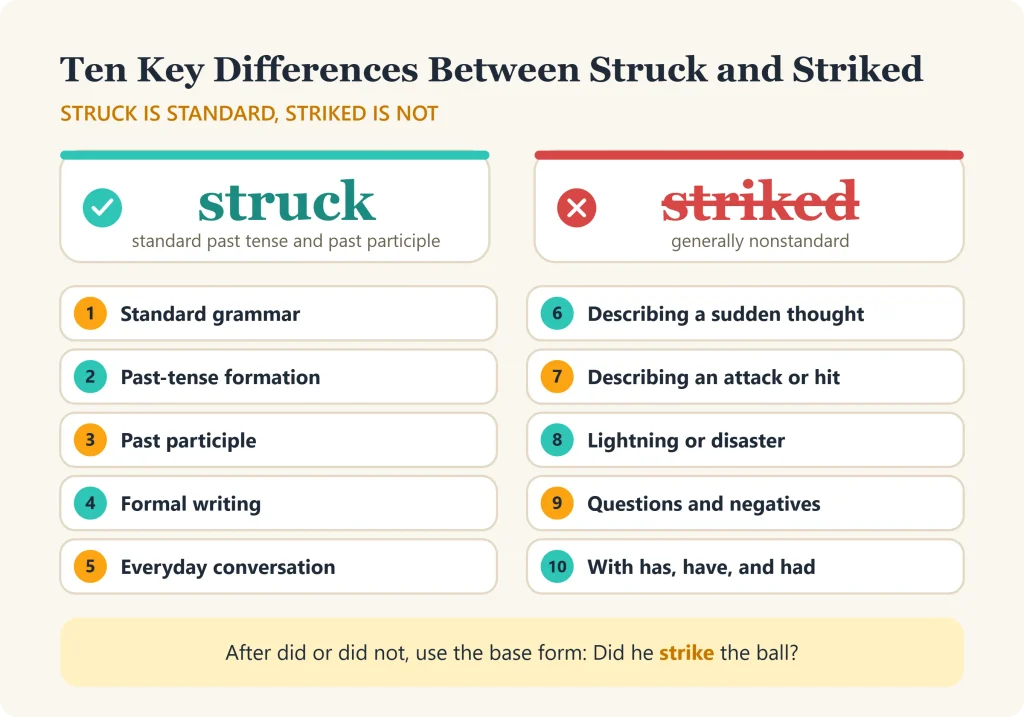
1. Standard Grammar
Struck is the standard past tense of strike. Striked is generally nonstandard.
- Correct: The player struck the ball.
- Nonstandard: The player striked the ball.
2. Past-Tense Formation
Strike is an irregular verb. It changes form instead of simply adding -ed.
- Correct: She struck the table.
- Incorrect in standard usage: She striked the table.
3. Past Participle
Struck is also the usual past participle after words such as has, have, and had.
- Correct: He has struck the target.
- Nonstandard: He has striked the target.
4. Formal Writing
Use struck in school essays, reports, emails, and formal documents.
- The storm struck the coast last night.
- The storm striked the coast last night. (Avoid this form.)
5. Everyday Conversation
Native speakers commonly use struck in ordinary conversation.
- A ball struck my window.
- A ball striked my window. (Not the usual standard form.)
6. Describing a Sudden Thought
Use struck when an idea suddenly comes to mind.
- A new idea struck me.
- A new idea striked me. (Nonstandard.)
7. Describing an Attack or Hit
Use struck when someone or something hits a person or object.
- The boxer struck his opponent.
- The boxer striked his opponent. (Avoid this form.)
8. Describing Lightning or Disaster
Use struck to describe a sudden event that causes harm.
- Lightning struck the tree.
- Lightning striked the tree. (Not standard.)
9. Use in Questions and Negative Sentences
After did or did not, use the base form strike, not struck or striked.
- Correct: Did he strike the ball?
- Incorrect: Did he struck the ball?
- Incorrect: Did he striked the ball?
10. Use With “Has,” “Have,” and “Had”
After these helping verbs, use the past participle struck.
- Correct: They had struck an agreement.
- Incorrect: They had striked an agreement.
You May Also Like https://orchoice.com/second-or-secondly/
Comparison Table: Struck or Striked?
| Feature | Struck | Striked |
| Standard past tense | Yes | Generally no |
| Standard past participle | Yes | Generally no |
| Suitable for schoolwork | Yes | Avoid |
| Common in everyday English | Yes | Uncommon |
| Formed by adding -ed | No | Yes |
| Best choice for learners | Yes | No |
How to Use Strike, Struck, and Stricken
The word strike has several meanings. Learning its forms will help you avoid mistakes.
Strike — Present Tense
Use strike for actions in the present or after will, can, did, and similar words.
- I strike the ball every morning.
- They will strike if talks fail.
- Did she strike the correct key?
Struck — Past Tense
Use struck for a completed action in the past.
- The clock struck six.
- The car struck a fence.
- His words struck me as rude.
Struck — Past Participle
Use struck after has, have, or had.
- The storm has struck the city.
- The workers had struck a deal.
- She has struck the right balance.
Stricken — A Special Form
Stricken appears in some expressions that describe serious harm, distress, or a strong emotional state.
- He was stricken with grief.
- The town was poverty-stricken.
- She looked stricken by the news.
Common Mistakes With Struck and Striked
English learners often apply regular verb rules to irregular verbs. Here are some mistakes to avoid.
Mistake 1: Adding -ed to strike
Incorrect: The boy striked the ball.
Correct: The boy struck the ball.
Mistake 2: Using the past form after did
Incorrect: Did the clock struck twelve?
Correct: Did the clock strike twelve?
Mistake 3: Using striked after has
Incorrect: The storm has striked the town.
Correct: The storm has struck the town.
Mistake 4: Confusing struck and stricken
Incorrect: He was struck with grief. (This can be grammatical in some contexts, but it may not be the intended expression.)
Also correct: He was stricken with grief.
Use stricken with grief when describing deep emotional pain. Use struck when describing a hit or a sudden effect, depending on the sentence.
Mistake 5: Assuming every verb takes -ed
Incorrect: The clock striked nine.
Correct: The clock struck nine.
British English vs. American English
Both British and American English use struck as the standard past tense and past participle of strike. There is no general rule that American English prefers striked.
Examples in both varieties:
- The car struck a wall.
- Lightning struck the roof.
- The workers have struck a deal.
Why Do People Get Confused?
There are three main reasons.
First, many verbs use -ed. Words such as talked, played, and jumped follow a regular pattern. Learners may expect striked to follow the same rule.
Second, English has many irregular verbs. For example, write becomes wrote, take becomes took, and strike becomes struck.
Third, people may see unusual forms online. Not every form found on a website or social media post follows standard modern usage. When in doubt, check a trusted dictionary.
Everyday Examples of Struck
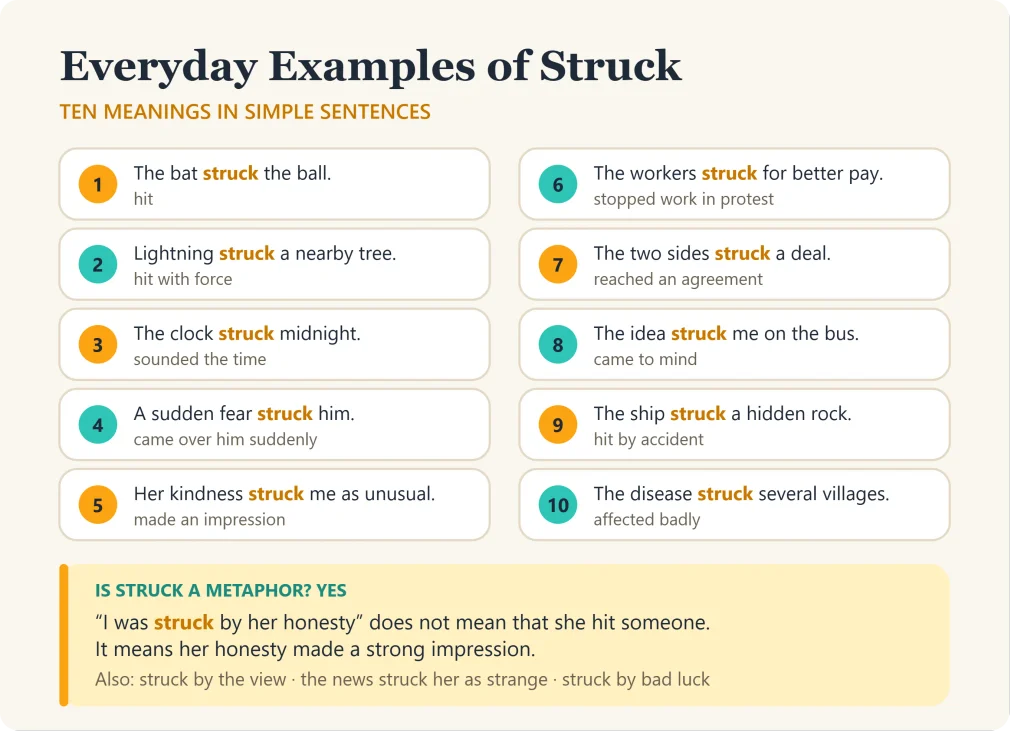
Here are simple sentences that show different meanings of struck.
- The bat struck the ball.
- Lightning struck a nearby tree.
- The clock struck midnight.
- A sudden fear struck him.
- Her kindness struck me as unusual.
- The workers struck for better pay.
- The two sides struck a deal.
- The idea struck me on the bus.
- The ship struck a hidden rock.
- The disease struck several villages.
Is Struck a Metaphor?
Yes. Struck can be used in a non-literal way.
For example, “I was struck by her honesty” does not mean that she hit someone. It means her honesty made a strong impression.
Other examples include:
- He was struck by the beauty of the view.
- The news struck her as strange.
- The family was struck by bad luck.
Why Does This Difference Matter?
Choosing the correct verb form makes your English clearer and more natural. It also helps you avoid grammar mistakes in exams, essays, and work emails.
Remembering strike → struck → struck is easier than guessing each time.
Try to learn irregular verbs in small groups. Write the base form, past tense, and past participle together. Then use each form in a short sentence.
For example:
- Present: I strike the ball.
- Past: I struck the ball.
- Present perfect: I have struck the ball.
Top Asked Questions
1. Is struck or striked correct?
Struck is the standard past tense of strike. Striked is generally nonstandard in modern everyday English.
2. Is striked ever used?
Yes, it appears in some texts and specialized contexts. However, struck is the safer choice for standard writing and speech.
3. Is struck the past tense or past participle?
It is both. You can say, “She struck the ball” and “She has struck the ball.”
4. Should I say “has struck” or “has striked”?
Use has struck. The past participle is normally struck.
5. Is “the clock striked twelve” correct?
No, not in standard modern English. Write, “The clock struck twelve.”
6. What is the difference between struck and stricken?
Struck is the usual past tense and past participle. Stricken is also used in certain expressions, such as stricken with grief or stricken by illness.
7. Do British and American speakers use different forms?
Both varieties commonly use struck. Striked is not the normal American or British past tense.
Conclusion
The difference between struck and striked is simple once you learn the rule. Struck is the standard past tense and past participle of strike. Use it when talking about a hit, a sudden event, a thought, or an agreement. For example, “The ball struck the window” and “They have struck a deal” are correct.
Avoid striked in standard schoolwork, formal writing, and everyday English. Also remember that stricken is used in special expressions, such as “stricken with grief.” To learn the forms, practice saying and writing strike, struck, struck. A few short examples each day can help you remember the correct form and use it with confidence.

I’m Samia Jamshaid, an English language specialist, SEO specialist, digital publisher, and researcher. I create clear, accurate, and well-researched content on English grammar, vocabulary, word meanings, and language comparisons, helping readers understand and use English with confidence.





1 thought on “Struck or Striked: When to Use Each One 2026”