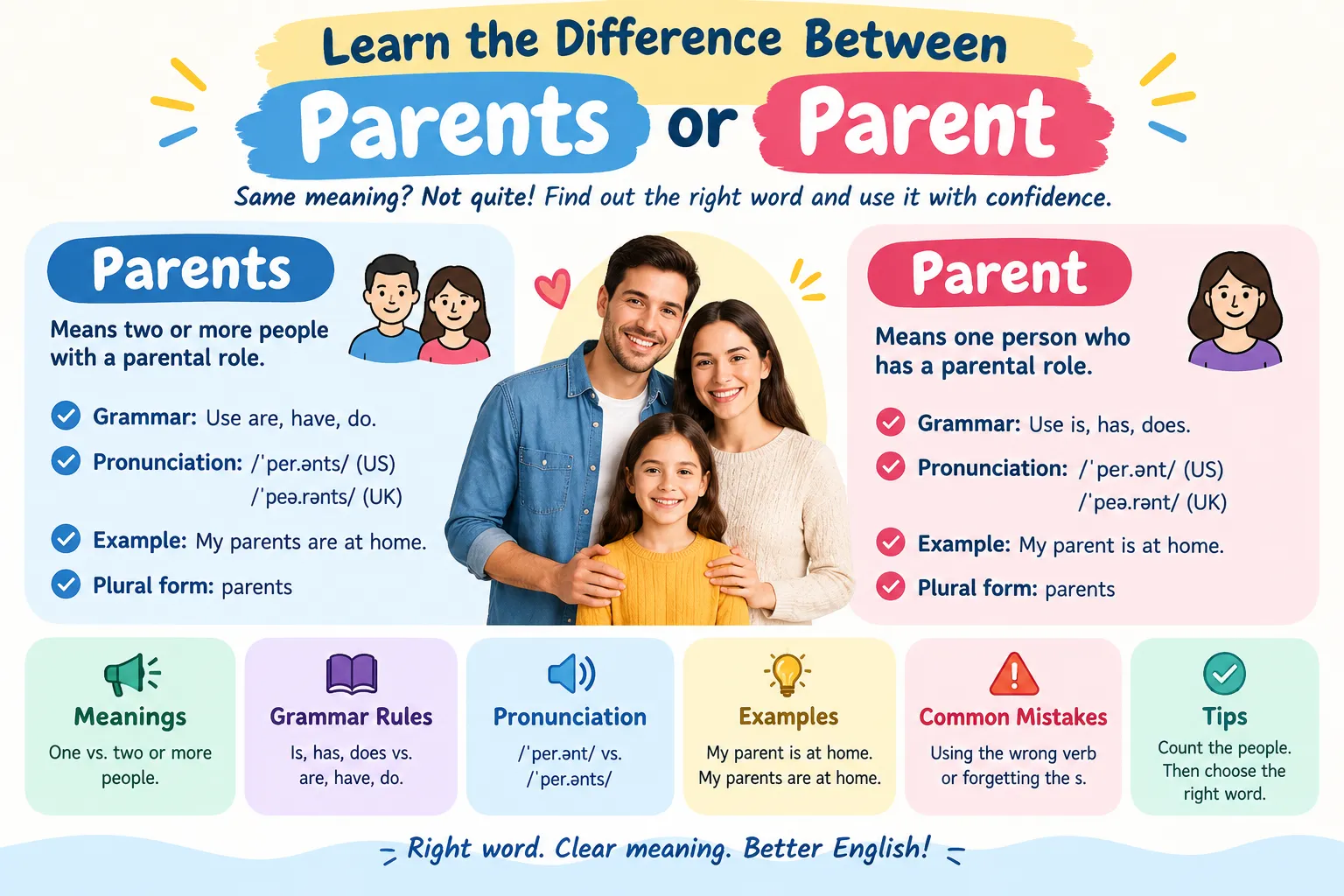
The main difference between parent and parents is simple: parent means one mother or father, while parents means two or more parents.
For example, you can say, “My parent is at home” when talking about one parent. You can say, “My parents are at home” when talking about both parents. Imagine your school sends a message about a meeting for families. If the message is for one person, it may say “Dear Parent.” If it is for many families, it may say “Dear Parents.”
Both words are common in daily English. However, using the wrong word can cause grammar mistakes. Many English learners search for parents or parent because the words look almost the same. The extra letter s changes the meaning and the verb used in the sentence. In this guide, you will learn the meanings, pronunciation, grammar rules, and examples of both words. You will also learn common mistakes and easy tips for choosing the correct word.
Pronunciation
Parent
- US: /ˈper.ənt/
- UK: /ˈpeə.rənt/
Parents
- US: /ˈper.ənts/
- UK: /ˈpeə.rənts/
Difference Between Parents and Parent
1. One Person vs. Two or More People
Parent means one person with a parental role. Parents means two or more people with that role.
Examples:
- My parent is at home.
- My parents are at home.
2. Singular vs. Plural
Parent is a singular noun. Parents is a plural noun.
Examples:
- A parent came to the school.
- Three parents came to the school.
3. Verb Agreement
Use singular verbs with parent. Use plural verbs with parents.
Examples:
- My parent is kind.
- My parents are kind.
4. Using “Has” and “Have”
Use has with parent. Use have with parents.
Examples:
- My parent has a car.
- My parents have a car.
5. Using “Does” and “Do”
Use does with parent. Use do with parents.
Examples:
- Does your parent work here?
- Do your parents work here?
6. Talking About School
Use parent when you mean one parent. Use parents when you mean more than one.
Examples:
- One parent joined the meeting.
- Both parents joined the meeting.
7. Talking About Rules
A parent may set rules for a child. Parents may set rules together.
Examples:
- My parent says I must study.
- My parents say I must study.
8. Talking About Support
Both words can describe care and help. The number of people changes.
Examples:
- My parent helps me with homework.
- My parents help me with homework.
9. Using “This” and “These”
Use this with parent. Use these with parents.
Examples:
- This parent is helpful.
- These parents are helpful.
10. Talking About Family
Use parent for one person. Use parents for two or more people with a parental role.
Examples:
- My parent called me today.
- My parents called me today.
For more information https://orchoice.com/someone-or-somebody/
Nature and Behaviour of Parents and Parent
Parent
Parent refers to one person who raises or cares for a child. This person may be a mother, father, adoptive parent, or another person with a parental role.
Examples:
- A parent should listen to a child.
- One parent attended the school event.
Parents
Parents refers to two or more people with a parental role. It often means a child’s mother and father.
Examples:
- My parents care about my future.
- The parents met with the teacher.
Why People Get Confused About Parents and Parent
People often mix up these words because they look almost the same. The word parents has only one extra letter: s.
That small change affects grammar. It tells readers whether we mean one person or more than one.
Examples:
- Incorrect: My parents is happy.
- Correct: My parents are happy.
- Incorrect: My parent are busy.
- Correct: My parent is busy.
Comparison Table
| Feature | Parent | Parents |
| Meaning | One person with a parental role | Two or more people with a parental role |
| Number | Singular | Plural |
| Verb | Is, has, does | Are, have, do |
| Example | My parent is here. | My parents are here. |
| Pronoun | This parent | These parents |
| Question | Does your parent work? | Do your parents work? |
| Common use | Talking about one parent | Talking about more than one parent |
The Origin of Parent
The word parent comes from the Latin word parens. It refers to a father or mother, or someone who gives birth to a child. The word entered English through French.
The plural form parents is made by adding s, a common way to make English nouns plural.
Today, both words appear in homes, schools, books, news reports, and official papers. Their meaning remains linked to family and child care.
British vs. American English
There is no major difference between British and American English in the use of parent and parents. Both forms have the same meanings and grammar rules.
| Situation | American English | British English |
| One parent | My parent is at work. | My parent is at work. |
| More than one | My parents are at work. | My parents are at work. |
| School event | The parent is here. | The parent is here. |
| Family support | My parents help me. | My parents help me. |
Which One Should You Use?
Choose the word that matches the number of people you mean.
- In the US: Use parent for one person and parents for two or more.
- In the UK: Follow the same rule.
- In global English: Use the same grammar in schoolwork, emails, and daily speech.
Examples:
- My parent is a doctor.
- My parents are teachers.
Common Mistakes
Mistake 1: Using “Is” with “Parents”
Incorrect: My parents is kind.
Correct: My parents are kind.
Mistake 2: Using “Are” with “Parent”
Incorrect: My parent are busy.
Correct: My parent is busy.
Mistake 3: Using “Has” with “Parents”
Incorrect: My parents has a house.
Correct: My parents have a house.
Mistake 4: Forgetting the “S”
Incorrect: Both parent came to the meeting.
Correct: Both parents came to the meeting.
Mistake 5: Using “Does” with “Parents”
Incorrect: Does your parents work here?
Correct: Do your parents work here?
Mistake 6: Using “These” with “Parent”
Incorrect: These parent are helpful.
Correct: These parents are helpful.
Mistake 7: Using “This” with “Parents”
Incorrect: This parents are kind.
Correct: These parents are kind.
Mistake 8: Using a Plural Verb for One Parent
Incorrect: One parent are waiting.
Correct: One parent is waiting.
Everyday Usage Examples
In Emails
- Dear Parent, please attend the school meeting.
- Dear Parents, please attend the school meeting.
Use Parent when writing to one parent. Use Parents when writing to a group.
On Social Media
- My parent always supports me.
- My parents make me smile.
In News
- A parent raised concerns about school safety.
- Parents asked for better school facilities.
In Formal Writing
- Each parent must sign the form.
- All parents must read the school rules.
Usage Trends
Both parent and parents are common in modern English. People use them in daily talks, school messages, news stories, and official documents.
The singular form often appears in rules and instructions. For example, “Each parent must sign the form.”
The plural form often appears when a message is meant for families or a group. For example, “Parents are invited to the meeting.”
The choice depends on meaning and sentence structure, not on whether you use British or American English.
Metaphors and Similes
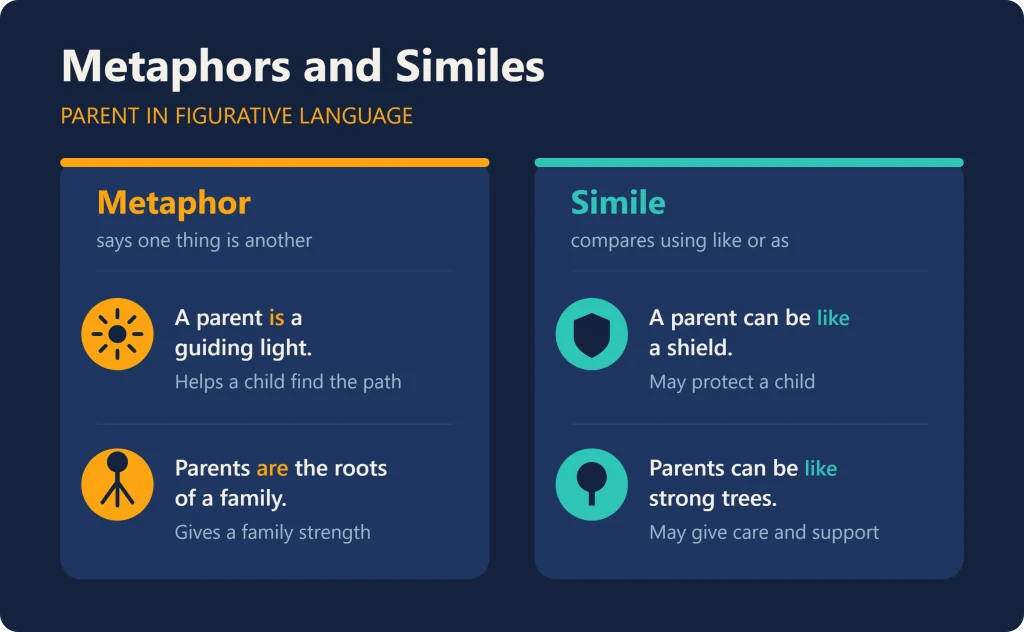
The words parent and parents usually have a direct meaning. They can also appear in figurative language.
Parent as a Metaphor
- A parent is a guiding light. This means a parent can help a child find the right path.
- Parents are the roots of a family. This means they help give a family support and strength.
Parent in a Simile
- A parent can be like a shield. This means a parent may protect a child.
- Parents can be like strong trees. This means they may give care and support.
Connotative Meaning
A word’s feeling can change with the sentence. Parent and parents often carry feelings about family, care, and responsibility.
Positive Meaning
These words can suggest love, safety, and support.
Examples:
- My parent always believes in me.
- My parents help me reach my goals.
Negative Meaning
They can appear in sentences about worry, conflict, or strict rules.
Examples:
- The parent was angry about the result.
- The parents disagreed about the rules.
Neutral Meaning
They can simply name people in a family or school setting.
Examples:
- One parent signed the form.
- The parents attended the meeting.
Idioms and Proverbs
Many family sayings use the words mother, father, or family rather than the exact words parent or parents. Here are a few related expressions.
Like Father, Like Son
This saying means a son may act like his father.
Example: “He loves fixing cars, just like his father. Like father, like son.”
The Apple Doesn’t Fall Far from the Tree
This means children often share traits with their parents.
Example: “She is kind and patient, just like her mother. The apple doesn’t fall far from the tree.”
It Takes a Village to Raise a Child
This saying means raising a child can take help from many people.
Example: “The family, teachers, and neighbors all help the child. It takes a village to raise a child.”
Literature and Movies
Parents play an important role in many books and films. These stories often show family love, rules, conflict, and growth.
Literature
To Kill a Mockingbird (1960) is a novel by Harper Lee. Atticus Finch raises his children and teaches them about fairness and respect.
Little Women (1868–1869) is a novel by Louisa May Alcott. It shows family life and the bond between sisters and their mother.
Movies
The Parent Trap (1998, United States) is a family comedy about twin sisters who meet and try to bring their parents together.
Finding Nemo (2003, United States) is an animated film about a father who searches for his lost son. It shows the strong bond between a parent and a child.
Why This Difference Matters
Using parent and parents correctly makes your meaning clear. It also helps you choose the right verb.
For example, “My parent is here” means one parent is here. “My parents are here” means two or more parents are here.
This difference matters in schoolwork, emails, forms, and daily talks. It can also prevent confusion when you write about family rules or school events.
For English learners, this is a useful way to practise singular and plural nouns. Once you learn the rule, you can use both words with confidence.
Usefulness in Daily Life
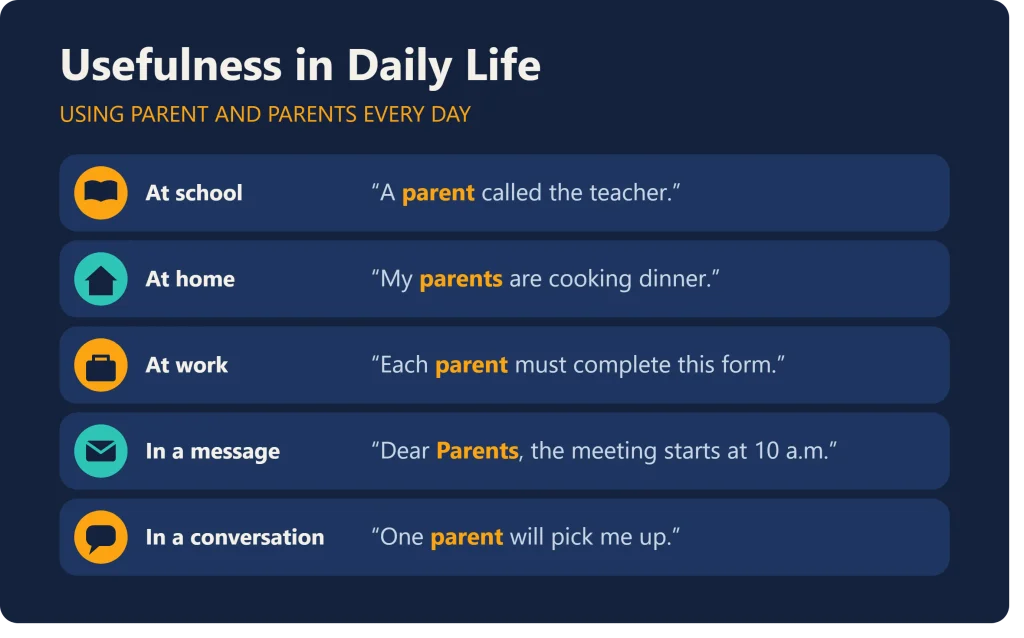
You can use these words in many daily situations.
- At school: “A parent called the teacher.”
- At home: “My parents are cooking dinner.”
- At work: “Each parent must complete this form.”
- In a message: “Dear Parents, the meeting starts at 10 a.m.”
- In a conversation: “One parent will pick me up.”
Situational Preference
Use parent when you mean one mother, father, or person with a parental role. It is useful in school forms, rules, and messages to one person. Use parents when you mean two or more parents. It often appears in family talks, school notices, and group emails. In both American and British English, the rule is the same. Do not choose based only on how formal the sentence sounds. Choose based on the number of people you mean. This simple rule works in most daily situations.
Top Queries
1. What is the main difference between parent and parents?
Parent means one person with a parental role. Parents means two or more such people.
2. Is “parent” singular or plural?
Parent is singular. For example, “My parent is kind.”
3. Is “parents” singular or plural?
Parents is plural. For example, “My parents are kind.”
4. Should I say “my parent is” or “my parents are”?
Use “my parent is” for one parent. Use “my parents are” for two or more parents.
5. Is parent or parents correct in British English?
Both are correct. The choice depends on whether you mean one parent or more than one.
6. Can I use “parent” when I mean my mother or father?
Yes. You can use parent when you mean either your mother or your father without naming which one.
7. Why does “parents” take “are”?
Parents is plural, so it usually takes plural verbs such as are, have, and do.
Conclusion
The difference between parent and parents is simple. Parent means one person who has a parental role, while parents means two or more people with that role. The extra s changes the word from singular to plural and also affects grammar. Use is, has, and does with parent, and use are, have, and do with parents. For example, “My parent is at home” and “My parents are at home” are both correct. Both words are used in American and British English in school notices, emails, books, news reports, and daily talks. Their meanings do not change based on the country. Before you write, ask yourself: Am I talking about one parent or more than one? If you mean one, use parent. If you mean two or more, use parents. This simple rule will help you write clear sentences and avoid common grammar mistakes.

I’m Samia Jamshaid, an English language specialist, SEO specialist, digital publisher, and researcher. I create clear, accurate, and well-researched content on English grammar, vocabulary, word meanings, and language comparisons, helping readers understand and use English with confidence.



1 thought on “Parents or Parent: Grammar Rules, and Examples 2026”