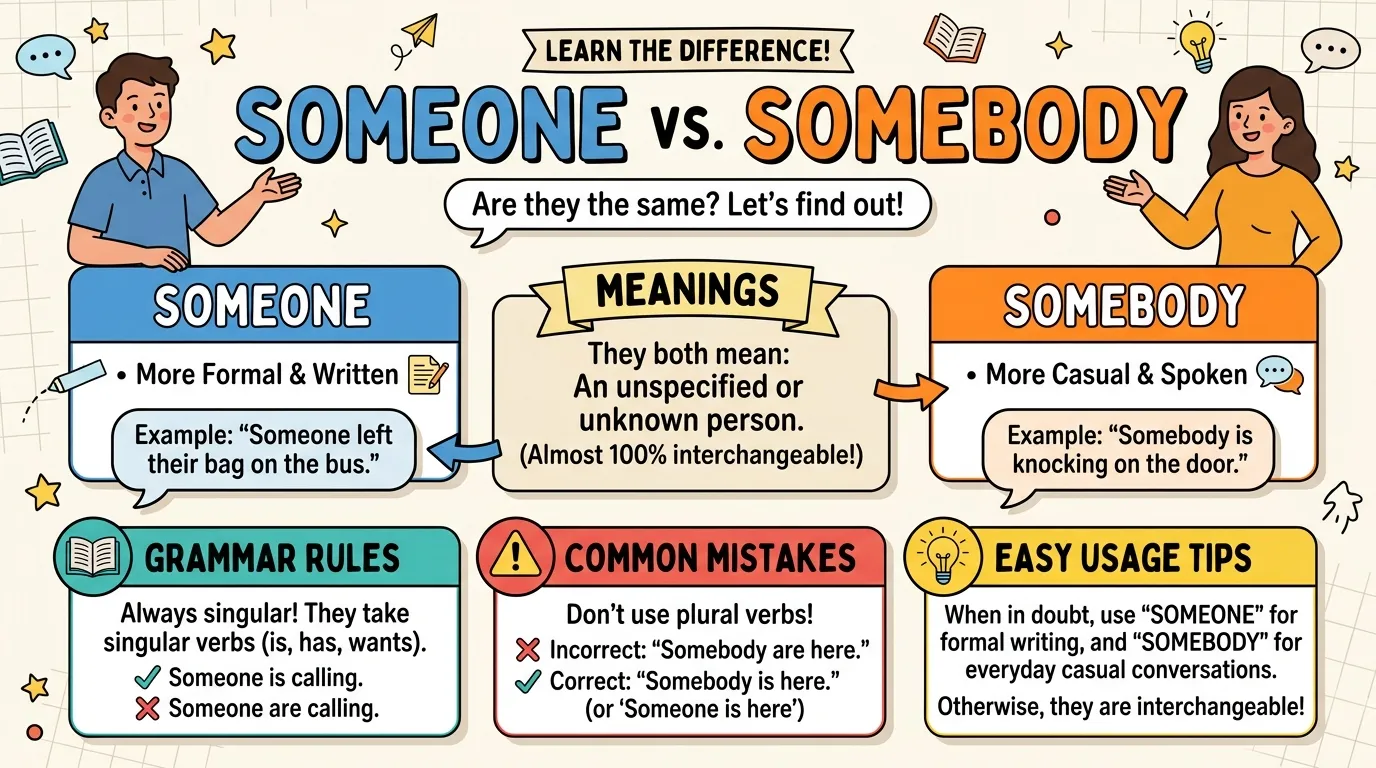
Have you ever wondered whether to use someone or somebody? Both words are common in English. They refer to a person whose name is not known or not given. For example, you might say, “Someone is at the door” or “Somebody is at the door.” Both sentences are correct.
So, is there any real difference between these words? The short answer is that they usually mean the same thing. However, someone may sound a little more formal, while somebody may sound more casual. This is a general feeling, not a strict rule. You can use both words in speaking and writing.
In this guide, you will learn their meanings, small differences, grammar rules, and common mistakes. You will also see easy examples to help you choose the right word.
What Is the Difference Between Someone and Somebody?
The main difference between someone and somebody is their tone. Their basic meaning is the same.
- Someone: A person whose name is not known or given.
- Somebody: A person whose name is not known or given.
Both words are indefinite pronouns. They point to a person without naming them.
Look at these examples:
- Someone left a bag in the classroom.
- Somebody left a bag in the classroom.
Both sentences mean the same thing. We do not know who left the bag.
In some situations, someone may sound more formal. Somebody may sound more relaxed or friendly. But there is no strict rule that limits either word to formal or casual use.
Someone vs. Somebody: Comparison
| Feature | Someone | Somebody |
| Meaning | An unknown or unnamed person | An unknown or unnamed person |
| Part of speech | Indefinite pronoun | Indefinite pronoun |
| Tone | May sound a little more formal | May sound a little more casual |
| Speaking | Commonly used | Commonly used |
| Writing | Commonly used | Commonly used |
| Verb agreement | Usually takes a singular verb | Usually takes a singular verb |
| Plural form | Use “some people” for more than one | Use “some people” for more than one |
Meaning of Someone
Someone means a person whose name or identity is not known or not stated. We use it when we do not need to name the person.
Examples of Someone
- Someone is waiting outside.
- I need someone to help me.
- Someone called you this morning.
- Is someone using my computer?
- Someone has taken my pen.
When Should You Use Someone?
You can use someone in almost any normal situation. It often fits well in formal writing, work messages, and polite questions.
Examples:
- We need someone to check this report.
- Someone will contact you soon.
- Is someone available to help us?
You may also like https://orchoice.com/senselessness-or-silliness/
Meaning of Somebody
Somebody also means a person whose name or identity is not known or not stated. It has almost the same meaning as someone.
Examples of Somebody
- Somebody is knocking at the door.
- Somebody left a phone on the bus.
- I think somebody knows the answer.
- Can somebody help me carry this box?
- Somebody has called your name.
When Should You Use Somebody?
You can use somebody in everyday speech, friendly messages, and casual writing. It may sound a little more relaxed in some situations.
Examples:
- Somebody told me a funny story.
- Can somebody open the window?
- Somebody has left their shoes here.
Is Someone More Formal Than Somebody?
Many speakers feel that someone sounds slightly more formal than somebody. This difference is small. It does not mean that somebody is wrong in formal writing or that someone is only for formal situations.
For example:
- More formal style: The bank needs someone to sign the form.
- Everyday style: Somebody left a jacket in the car.
The first sentence fits a formal setting. The second sounds like everyday talk. However, the words themselves do not create all of this difference. The situation and the rest of the sentence also matter.
Can You Use Someone and Somebody in the Same Sentence?
Yes, you can use both words in one sentence if you are talking about different people or ideas.
Examples:
- Someone called me, but somebody did not leave a message.
- Someone should bring the books, and somebody should bring the pens.
These sentences are grammatically possible, but they may sound repetitive. If both words refer to the same person, using one word is often clearer.
For example:
- Clearer: Someone called me but did not leave a message.
- Also correct: Somebody called me but did not leave a message.
Grammar Rules for Someone and Somebody
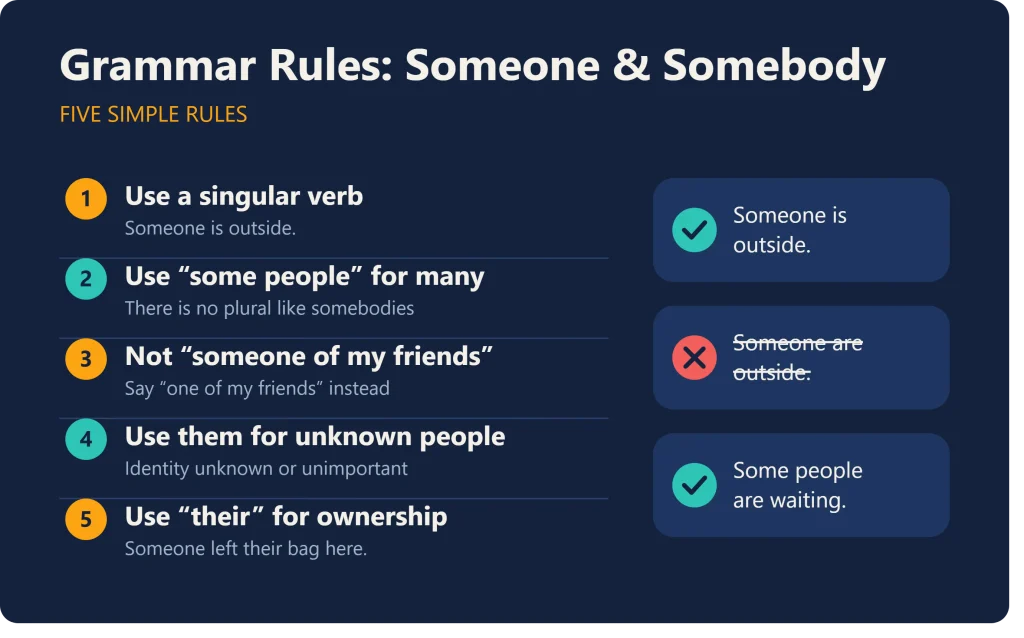
Both words follow the same basic grammar rules.
1. Use a Singular Verb
Someone and somebody usually take singular verbs because they refer to one person.
Correct examples:
- Someone is outside.
- Somebody has my book.
- Someone wants to speak to you.
- Somebody was here earlier.
Avoid these forms:
- Incorrect: Someone are outside.
- Incorrect: Somebody have my book.
2. Use “Some People” for More Than One Person
Neither someone nor somebody has a regular plural form. Do not add -s to make someones or somebodies when you mean several people.
Correct examples:
- Some people are waiting outside.
- Some people want to join the club.
- Several people called this morning.
Incorrect example:
- Somebodies are waiting outside.
3. Do Not Use “Someone of My Friends”
Do not say, “Somebody of my friends is a musician.”
Instead, say:
- One of my friends is a musician.
- Someone I know is a musician.
- Somebody I know is a musician.
4. Use Them Without Naming the Person
Both words are useful when the person’s identity is unknown or unimportant.
Examples:
- Someone is calling your name.
- Somebody left the lights on.
- I need someone to explain this.
- We should ask somebody for help.
5. Use Them With Singular Possessive Words
When you need to show ownership, you can use their after someone or somebody. This is common in modern English when the person’s gender is unknown.
Examples:
- Someone left their bag here.
- Somebody forgot their keys.
Someone vs. Somebody: Examples in Daily Life
Here are examples from common situations.
In Home
- Someone is at the front door.
- Somebody has used my cup.
At School
- Someone forgot their homework.
- Somebody needs a pencil.
At Work
- Someone will send the email today.
- Somebody has moved the files.
With Friends
- Someone told me a joke.
- Somebody wants to watch a movie.
When Asking for Help
- Can someone help me?
- Can somebody help me?
Can Someone and Somebody Mean an Important Person?
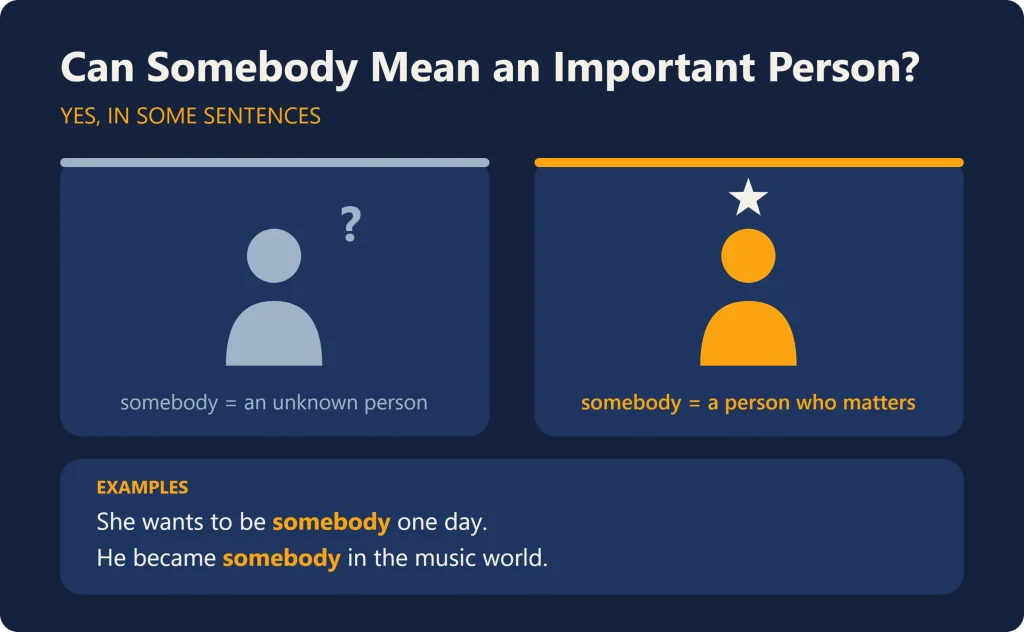
Yes. In some sentences, somebody can mean a person who is important, respected, or successful.
Examples:
- She wants to be somebody one day.
- He became somebody in the music world.
In these sentences, somebody does not simply mean an unknown person. It means a person who matters or has gained respect.
The word someone can also refer to a person who matters in a sentence such as “She wants to be someone.” However, the phrase be somebody is a familiar way to express this idea.
Common Mistakes to Avoid
Here are some mistakes English learners should watch for.
| Incorrect | Correct |
| Someone are waiting. | Someone is waiting. |
| Somebody have my pen. | Somebody has my pen. |
| Somebodies are outside. | Some people are outside. |
| Somebody of my friends called. | One of my friends called. |
| Someone left his or her bag, so I will return it to them. | Someone left their bag, so I will return it to them. |
Why Do People Confuse Someone and Somebody?
People often think these words have different meanings because they look different. One ends in one, and the other ends in body. But both words refer to a person.
The small difference in tone can also cause confusion. Some people prefer someone in formal writing. Others use somebody more often in daily speech.
The best way to remember the difference is simple: both words usually mean the same thing. Use the one that sounds natural in your sentence.
Common Asked Questions
1. Are Someone and Somebody the Same?
Yes. They usually have the same meaning. Both refer to a person whose name is unknown or not given.
2. Is Someone More Formal Than Somebody?
Someone may sound a little more formal, but this is not a strict rule. Both words are used in formal and informal English.
3. Is Somebody Grammatically Correct?
Yes. Somebody is a correct English word. You can use it in speech and writing.
4. Can I Use Somebody in Formal Writing?
Yes. Somebody is not wrong in formal writing. However, you may prefer someone if it better suits the tone of your text.
5. Do Someone and Somebody Take Singular Verbs?
Yes. Say “someone is” and “somebody has.” Do not say “someone are” or “somebody have” when using these words as the subject.
6. What Is the Plural of Someone or Somebody?
They do not have regular plural forms. Use some people when talking about more than one person.
7. Can Somebody Mean a Famous or Important Person?
Yes. In a sentence like “She wants to be somebody,” the word means a person who is important, respected, or successful.
8. Which Word Should I Use?
Both words are correct in most situations. Choose the one that sounds natural and fits the tone of your sentence.
Conclusion
The difference between someone and somebody is very small. Both words refer to a person whose name is unknown or not given, and they usually have the same meaning. Someone may sound a little more formal, while somebody may sound more casual, but both words are common in speaking and writing. They follow the same grammar rules and usually take singular verbs, such as is and has. When talking about more than one person, use some people instead. Remember that somebody can also mean an important or successful person in certain sentences. By learning these simple rules, you can choose the right word and write clear, correct English.

I’m Samia Jamshaid, an English language specialist, SEO specialist, digital publisher, and researcher. I create clear, accurate, and well-researched content on English grammar, vocabulary, word meanings, and language comparisons, helping readers understand and use English with confidence.










1 thought on “Someone or Somebody: Understand the Right Usage 2026”