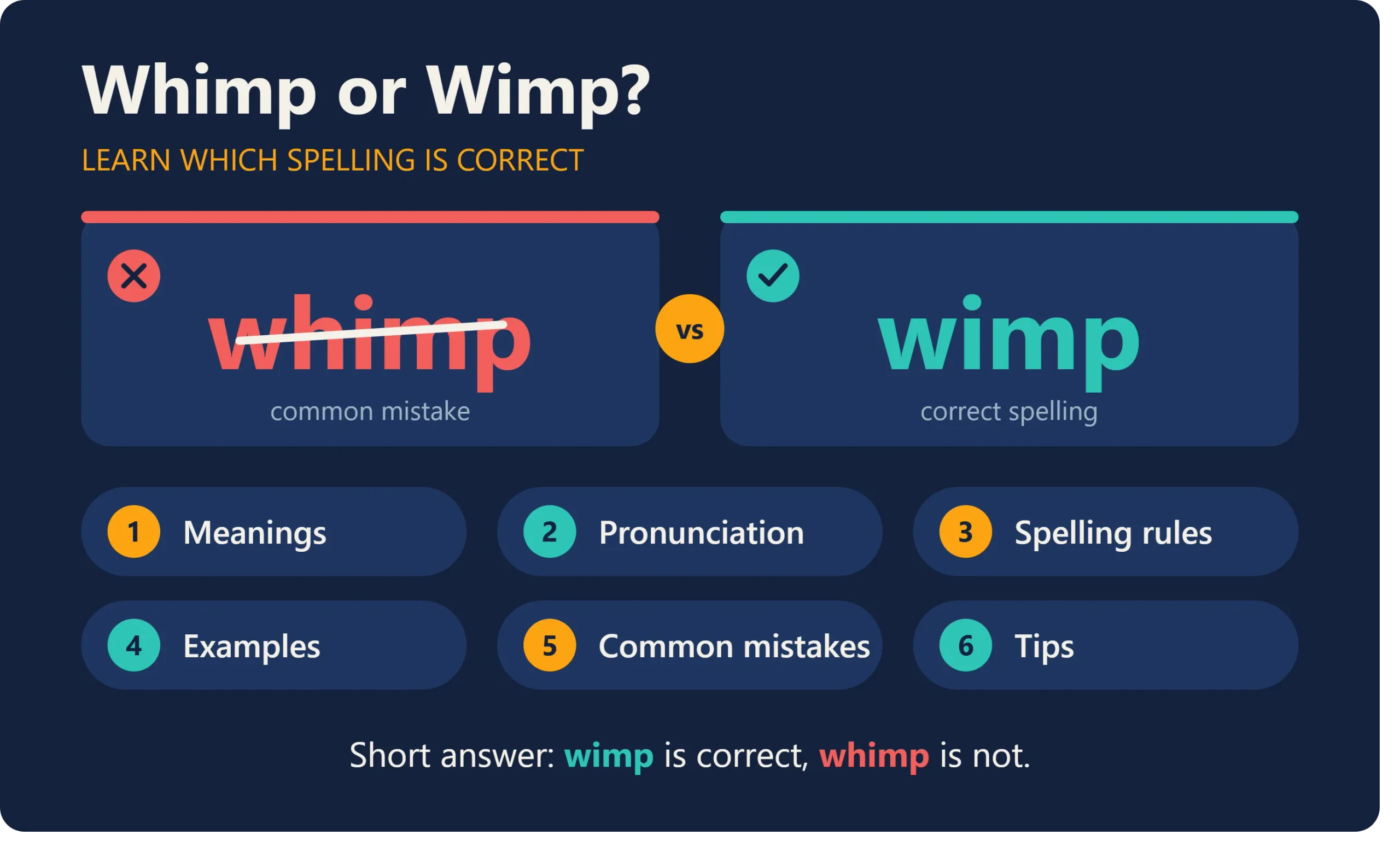
Wimp is the correct and common spelling; whimp is usually a misspelling.
Both words may look right to new English learners, but only wimp is the standard spelling for a person who lacks courage or confidence. Imagine a student who is afraid to speak in front of the class. A friend might call him a “wimp.” The word is informal and can sound rude, so it is best to use it with care. Many people search for whimp or wimp because the two spellings sound almost the same. The extra letter h can cause confusion when writing messages, schoolwork, or online posts.
Knowing the correct form helps you avoid spelling mistakes and understand what other people mean. In this guide, you will learn the meaning, pronunciation, history, and use of wimp. You will also see why whimp is not the usual spelling, how to use the word in sentences, and which common mistakes to avoid.
Pronunciation
Both spellings may be read in the same way when someone writes whimp by mistake. The standard word is wimp.
- Wimp — US: /wɪmp/
- Wimp — UK: /wɪmp/
- Whimp: Usually intended to sound like wimp, but it is not the standard spelling.
Difference Between Whimp and Wimp
There is no major difference in meaning in normal English use. The key difference is spelling: wimp is standard, while whimp is usually a spelling error. The points below explain this difference from ten angles.
1. Correct Spelling
Wimp is the standard spelling. Whimp is usually incorrect when you mean a timid or weak person.
Examples:
- Correct: He called me a wimp.
- Incorrect: He called me a whimp.
2. Meaning
Wimp means a person who seems weak, fearful, or not brave. Whimp usually has no separate meaning in everyday English.
Examples:
- Don’t be a wimp; try your best.
- He felt like a wimp when he gave up.
3. Dictionary Use
Major English dictionaries list wimp as an informal word. Whimp is generally treated as a misspelling or rare form.
Examples:
- I learned the word wimp in class.
- The teacher corrected whimp to wimp.
4. Grammar
Wimp is a noun. Its plural form is wimps. The spelling whimp should not be used as the normal form.
Examples:
- He is acting like a wimp.
- They called the boys wimps.
5. Pronunciation
The intended sound is usually the same. Both are often said like “wimp,” with a short i sound.
Examples:
- Wimp rhymes with limp.
- Wimp rhymes with pimp.
6. Formal Writing
Avoid whimp in schoolwork, work emails, and formal reports. Use wimp only if the informal tone fits.
Examples:
- Informal: Stop acting like a wimp.
- More polite: Don’t give up so quickly.
7. Informal Speech
People may use wimp when teasing someone who seems scared. It can hurt someone’s feelings.
Examples:
- He called his friend a wimp.
- She said she was no wimp.
8. Online Messages
Online, people may type whimp by mistake. Spell-check tools may help find this error.
Examples:
- Incorrect: “You are such a whimp.”
- Correct: “You are such a wimp.”
9. Word Forms
The standard related forms include wimpy and the phrase wimp out. These forms come from wimp, not from the usual misspelling whimp.
Examples:
- That was a wimpy excuse.
- He did not want to wimp out.
10. Best Choice
When you mean a person who lacks courage or confidence, choose wimp. Do not use whimp in standard writing.
Examples:
- Correct: I don’t want to be a wimp.
- Correct: He is not a wimp.
You also like https://orchoice.com/parents-or-parent/
Nature and Behaviour of Whimp and Wimp
Wimp
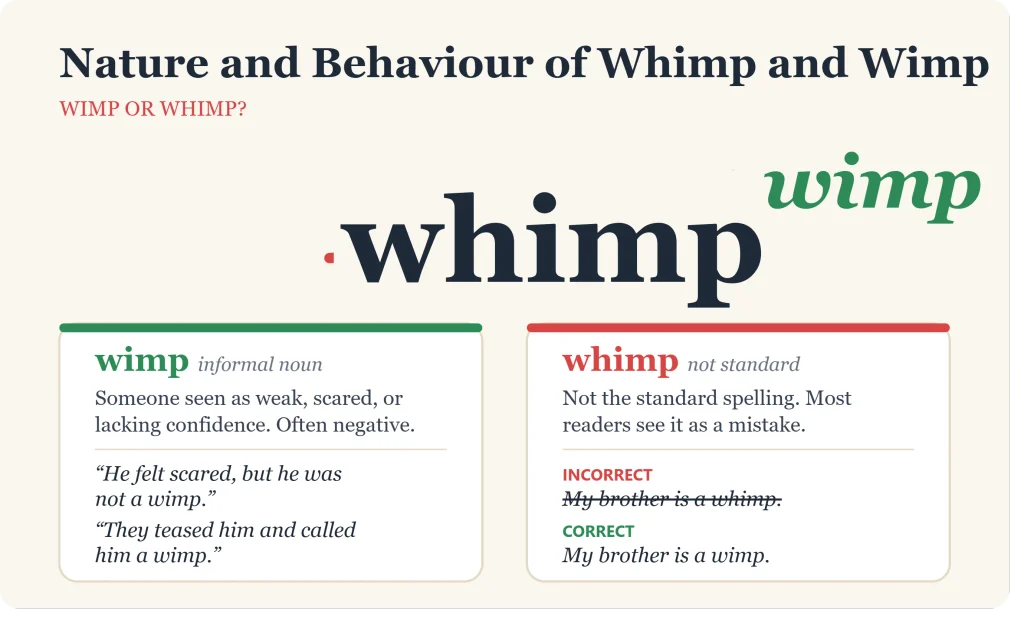
Wimp is an informal noun. It describes someone seen as weak, scared, or lacking confidence. It often carries a negative feeling.
Examples:
- He felt scared, but he was not a wimp.
- They teased him and called him a wimp.
Whimp
Whimp is not the standard spelling for this meaning. Most readers will think it is a spelling mistake.
Example:
- Incorrect: My brother is a whimp.
- Correct: My brother is a wimp.
Why People Get Confused About Whimp and Wimp
People get confused because the two spellings look similar. English has many words that begin with wh, such as when, where, and which. This may lead some people to add h to wimp.
However, the standard spelling has no h. The best way to remember it is to learn the word as a whole: w-i-m-p.
Comparison Table
| Feature | Whimp | Wimp |
| Standard spelling | No, usually a mistake | Yes |
| Meaning | Usually intended to mean a wimp | A person seen as weak or timid |
| Pronunciation | Usually intended as /wɪmp/ | /wɪmp/ |
| Dictionary status | Usually listed as a misspelling or rare form | Common informal word |
| Grammar | Not standard for this meaning | Noun |
| Plural | Not standard | Wimps |
| Related form | No common standard form | Wimpy |
| Formal writing | Avoid | Use only when suitable |
| Informal speech | Avoid in standard spelling | Common |
| Best choice | No | Yes |
The Origin of Wimp
The word wimp appeared in English around the early 1900s. Its exact origin is not certain. One idea links it to whimper, which means to cry or speak in a soft, weak way. The word later became common as an informal name for someone seen as weak or timid.
The spelling whimp may look as if it comes from whimper, but that does not make it the standard spelling for this meaning. In modern everyday English, use wimp.
British vs. American English
British and American English both use wimp. The spelling and basic meaning are the same.
| Situation | American English | British English |
| Correct spelling | wimp | wimp |
| Meaning | A person seen as weak or timid | A person seen as weak or timid |
| Pronunciation | /wɪmp/ | /wɪmp/ |
| Plural | wimps | wimps |
| Related adjective | wimpy | wimpy |
Examples:
- US: Don’t be a wimp.
- UK: Don’t be a wimp.
Which One Should You Use?
Use wimp in the United States, the United Kingdom, and other English-speaking places. It is the standard spelling.
- For US English: Write wimp.
- For UK English: Write wimp.
- For global English: Write wimp.
Examples:
- Informal: He is acting like a wimp.
- Polite: He feels nervous about trying something new.
Common Mistakes
Mistake 1: Adding an H
Incorrect: He is a whimp.
Correct: He is a wimp.
Mistake 2: Using the Wrong Plural
Incorrect: They are wimp.
Correct: They are wimps.
Mistake 3: Using “Wimp” as a Polite Compliment
Incorrect meaning: “You are a wimp” as praise.
Better: “You are brave for trying.”
Wimp is usually negative, not a compliment.
Mistake 4: Using It in Formal Reports
Less suitable: The worker is a wimp.
Better: The worker seems unsure about the task.
Mistake 5: Thinking Fear Always Means Weakness
Incorrect idea: Anyone who feels afraid is a wimp.
Better: People can feel fear and still act with courage.
Mistake 6: Mixing Up “Wimp” and “Whimper”
Wimp is a noun for a person. Whimper is a verb or noun linked to a soft cry.
Examples:
- He is not a wimp.
- The child began to whimper.
Everyday Usage Examples
In Emails
The word wimp can sound rude, so avoid it in work emails.
- Better: I felt nervous about the meeting.
- Better: She was afraid to speak in front of the group.
On Social Media
People may use wimp in jokes or teasing posts.
- He called himself a wimp for avoiding the ride.
- Don’t call someone a wimp just because they feel scared.
In News
News writers may use the word when reporting a quote or discussing an insult.
- The player said he would not be called a wimp.
- The coach rejected the claim that his team was full of wimps.
In Formal Writing
Use clear and respectful words instead of wimp.
- Less suitable: The student is a wimp.
- Better: The student lacks confidence in this task.
Usage Trends
Wimp remains an informal English word. It appears in conversation, films, books, jokes, and online posts. It is often used to tease someone who seems scared or unwilling to try something.
The spelling whimp is much less common and is usually an error. Because both forms may sound alike, a spell-check tool can help, but learning the correct spelling is more useful.
Metaphors and Similes
People sometimes use wimp in comparisons. These examples show how it can appear in figurative language.
Metaphors
- He is a wimp in the face of fear. This means he gives in to fear easily.
- Don’t be a wimp when life gets hard. This means do not give up too quickly.
Similes
- He acted like a wimp. This compares his behavior to that of someone seen as timid.
- She shook like a leaf but still spoke. This simile shows fear without calling her a wimp.
Connotative Meaning
A word’s feeling can change with the situation. Wimp usually has a negative tone.
Positive Meaning
The word wimp itself is rarely positive. A speaker may use it jokingly about themselves.
Example:
- I am a wimp when it comes to scary movies.
The speaker may be making a light joke about their own fear.
Negative Meaning
The word often insults someone by suggesting they lack courage or strength.
Examples:
- He called his classmate a wimp.
- Don’t be a wimp, he said unkindly.
Neutral Meaning
In a neutral or educational discussion, the word can be explained without insulting anyone.
Example:
- The word wimp is informal and often negative.
Idioms and Proverbs
There are no widely used standard proverbs built around whimp. However, the word wimp appears in the phrase wimp out.
Wimp Out
Meaning: To stop doing something because you feel afraid.
Examples:
- He wanted to jump into the pool but wimped out.
- I almost wimped out before my speech.
Here are two related expressions:
Chicken Out
Meaning: To decide not to do something because you are afraid.
Example: She planned to ride the roller coaster but chickened out.
Face Your Fears
Meaning: To try to deal with the things that scare you.
Example: He faced his fears and spoke to the class.
These expressions can help you talk about fear without using an insult.
Literature and Movies
The idea of a timid or fearful person appears in many stories and films. The word wimp is informal, so it may appear in dialogue rather than formal descriptions.
Literature
Real Men Don’t Eat Quiche (1982) is a humorous book by Bruce Feirstein. It discusses ideas about masculinity and social behavior. The word wimp appears in the wider culture around such ideas.
Movies and Cartoons
Popeye the Sailor (cartoon series, United States) features J. Wellington Wimpy, a character whose name is linked to the history of the word wimp. The word’s exact origin is uncertain, so this connection should not be treated as a proven source. <Cite refs={[“turn526599search0″,”turn526599search1”]}/>
Why This Difference Matters
Choosing the correct spelling makes your writing clear. If you write whimp, readers may think you made a spelling mistake. Writing wimp helps readers understand your meaning at once.
It is also important to understand the tone. Calling someone a wimp can hurt their feelings. A person may feel scared without being weak. If you want to be polite, use words such as nervous, afraid, or unsure.
For English learners, this is a useful lesson in spelling and word choice. One small letter can make a word look wrong, while the right word can make a sentence clear.
Usefulness in Daily Life
You may see wimp in casual talks, jokes, movies, and online posts. Knowing its meaning helps you understand what people are saying.
Examples:
- “I’m a wimp around spiders” means the speaker is scared of spiders.
- “Don’t wimp out now” means do not quit because of fear.
- “He called me a wimp” means he insulted the speaker by calling them timid.
Situational Preference
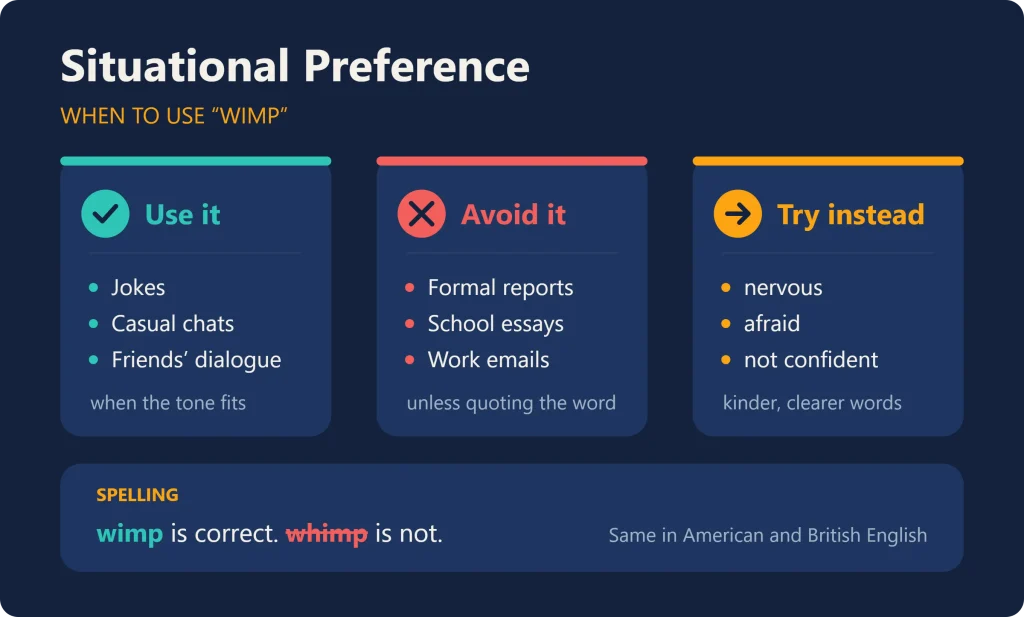
Use wimp when you are reading or writing informal English and the tone fits. It may appear in jokes, casual chats, or dialogue between friends. Avoid it in formal reports, school essays, and work emails unless you are discussing the word itself or quoting someone. Do not use whimp as the normal spelling. This rule is the same in American and British English. If you want a kinder word, try nervous, afraid, or not confident. These words explain how someone feels without labelling them as weak.
More About
1. Is whimp or wimp correct?
Wimp is the standard spelling. Whimp is usually a misspelling.
2. What does wimp mean?
A wimp is someone seen as weak, timid, or not brave. The word is informal and often negative.
3. How do you pronounce wimp?
It is pronounced /wɪmp/ in both common US and UK pronunciations.
4. What is the plural of wimp?
The plural is wimps.
Example: The boys were called wimps.
5. Is wimp a rude word?
It can be rude because it suggests that someone is weak or afraid. Use it with care.
6. What does “wimp out” mean?
It means to stop or avoid doing something because you feel afraid.
Example: He wimped out before the race.
7. Is whimp ever correct?
It is found as a rare or dated form, but it is not the standard spelling for a timid person. Use wimp in normal modern English.
Conclusion
The difference between whimp and wimp is mainly a matter of spelling. Wimp is the standard English word for a person who seems weak, timid, or not brave, while whimp is usually a misspelling and should be avoided in normal writing. Both forms may be intended to sound the same, but wimp is the usual choice in modern English. You can use wimp in casual talks, jokes, and stories. Its related forms include wimpy and the phrase wimp out. In schoolwork, emails, and formal writing, words such as nervous, afraid, or not confident may be better choices. The spelling rule is the same in British and American English. When you are unsure, remember to write w-i-m-p. Learning this simple difference will help you avoid a common spelling mistake and use English more clearly.

I’m Samia Jamshaid, an English language specialist, SEO specialist, digital publisher, and researcher. I create clear, accurate, and well-researched content on English grammar, vocabulary, word meanings, and language comparisons, helping readers understand and use English with confidence.


1 thought on “Whimp or Wimp: Correct Spelling, and Examples 2026”