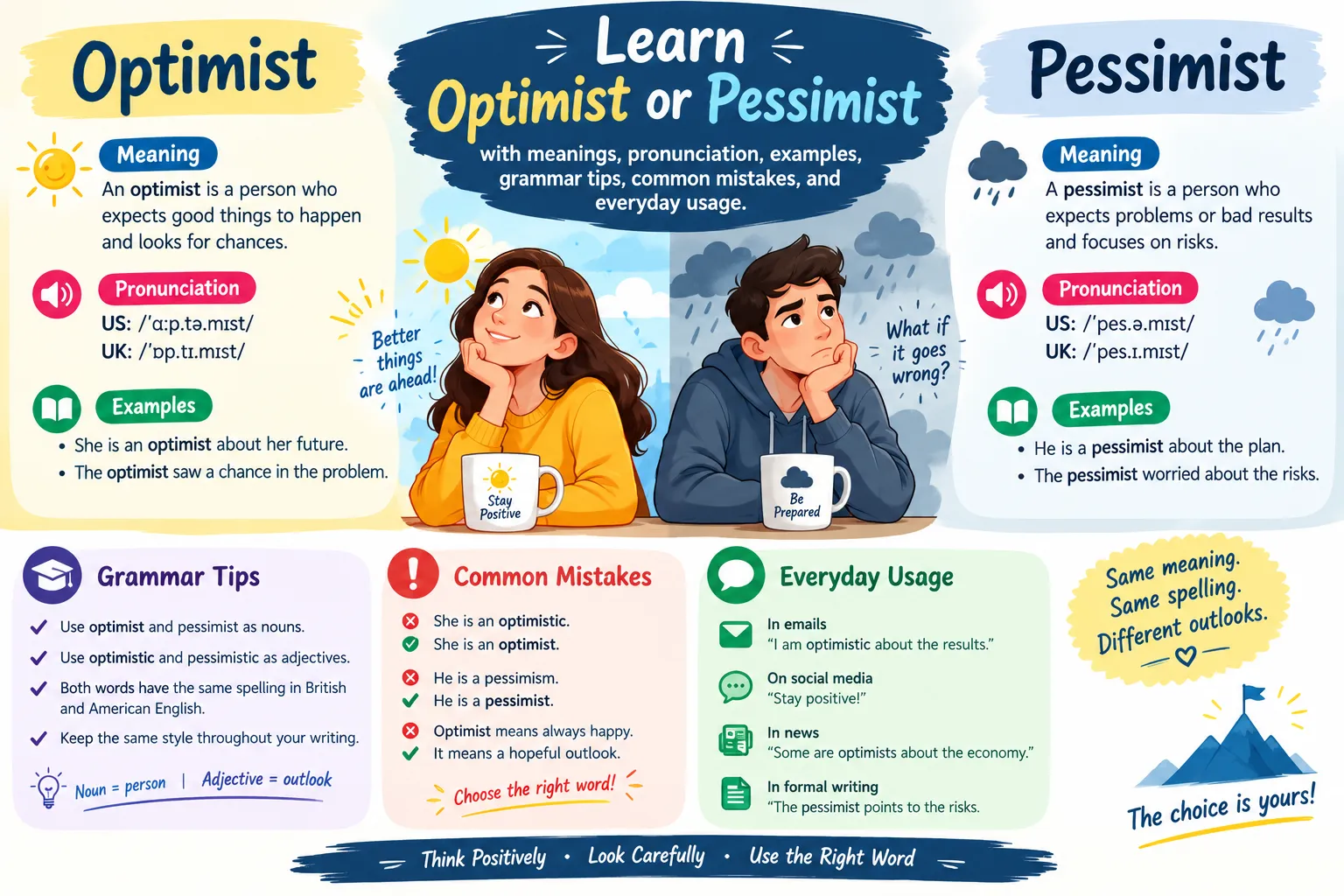
An optimist expects good things to happen, while a pessimist expects bad things or problems.
Imagine two friends are waiting for their exam results. One says, “I think we did well.” The other says, “I think we failed.” Both friends face the same situation, but they see it in different ways.
The first friend shows an optimistic view. The second shows a pessimistic view. An optimist tends to focus on hope and good results. A pessimist tends to focus on risks, problems, or poor results. These words describe common ways people look at life. They do not mean that a person always thinks the same way.
People often search for optimist or pessimist because the words look alike but have opposite meanings. They may want to describe a friend, understand their own thinking, or use the right word in an essay. The words can also cause confusion because both describe a person’s outlook on life.
In this guide, you will learn their meanings, pronunciation, grammar, examples, history, and common uses. You will also see when to use each word in daily life. The goal is simple: help you choose the right word with ease.
Pronunciation
Both words have similar endings, but their first sounds differ.
- Optimist — US: /ˈɑːp.tə.mɪst/
- Optimist — UK: /ˈɒp.tɪ.mɪst/
- Pessimist — US: /ˈpes.ə.mɪst/
- Pessimist — UK: /ˈpes.ɪ.mɪst/
Difference Between Optimist and Pessimist
1. Basic Meaning
An optimist expects good results. A pessimist expects bad results or trouble.
Examples:
- The optimist believed the team could win.
- The pessimist thought the team would lose.
2. View of the Future
An optimist looks ahead with hope. A pessimist often expects things to go wrong.
Examples:
- Maya is an optimist who looks forward to the new year.
- Ben is a pessimist who fears the year will bring problems.
3. View of Problems
An optimist looks for ways to solve a problem. A pessimist may focus first on what could go wrong.
Examples:
- The optimist searched for a way to fix the broken bike.
- The pessimist thought the bike could not be fixed.
4. Reaction to Failure
An optimist may see failure as a chance to learn. A pessimist may see it as a sign of more trouble.
Examples:
- The optimist learned from the lost game.
- The pessimist felt the next game would also be lost.
5. Reaction to Success
An optimist may expect success or feel hopeful after it. A pessimist may worry that success will not last.
Examples:
- The optimist felt proud of the good result.
- The pessimist worried that the next result would be poor.
6. Daily Speech
An optimist often uses hopeful words. A pessimist may use words that show doubt or worry.
Examples:
- “We can do this!” said the optimist.
- “This will never work,” said the pessimist.
7. Planning
An optimist may plan for a good result while working toward it. A pessimist may plan for risks and possible problems.
Examples:
- The optimist packed for a fun day out.
- The pessimist packed extra items in case the weather changed.
8. View of Other People
An optimist may expect others to help or do well. A pessimist may expect people to let them down.
Examples:
- The optimist trusted the team to finish the task.
- The pessimist feared the team would miss the deadline.
9. Main Focus
An optimist often notices chances and good points. A pessimist often notices risks and weak points.
Examples:
- The optimist saw a chance to learn a new skill.
- The pessimist saw the risk of making mistakes.
10. Use in Sentences
Both words are nouns. They name a person with a certain outlook.
Examples:
- My sister is an optimist.
- My brother is a pessimist.
You May Also Like https://orchoice.com/bordeaux-or-burgund/
Nature and Behaviour of Optimist and Pessimist
Optimist
An optimist often expects good things to happen. This person may look for chances, focus on solutions, and keep trying after a setback.
For example, an optimist who fails a test may study harder and try again. This does not mean the person ignores every risk. A thoughtful optimist can still plan for problems.
Pessimist
A pessimist often expects trouble or poor results. This person may look for risks and prepare for things that could go wrong.
For example, a pessimist may worry about rain before a trip and pack an umbrella. This way of thinking can help people prepare, but too much worry can make it hard to see good chances.
Neither word tells us everything about a person. People can change their outlook as their lives and situations change.
Why People Get Confused About Optimist and Pessimist
People get confused because both words describe a person’s way of thinking. They also have a similar sound and the same ending.
The key difference is their outlook:
- An optimist expects good results.
- A pessimist expects bad results or problems.
Some people also think an optimist is always happy or that a pessimist is always sad. This is not true. These words describe common expectations, not every feeling a person has.
For example, an optimist can feel sad after a loss. A pessimist can feel happy after good news. The words describe a general pattern, not a rule for every moment.
Comparison Table
| Feature | Optimist | Pessimist |
| Meaning | A person who expects good results | A person who expects bad results or trouble |
| Outlook | Hopeful | Doubtful or worried |
| Main focus | Chances and good points | Risks and problems |
| View of the future | Expects things may go well | Expects things may go badly |
| Reaction to a setback | Looks for a way forward | May expect more problems |
| Planning style | Plans for goals and chances | Often plans for risks |
| Part of speech | Noun | Noun |
| Adjective | Optimistic | Pessimistic |
| Opposite word | Pessimist | Optimist |
| Example | She is an optimist. | He is a pessimist. |
The Origin of Optimist and Pessimist
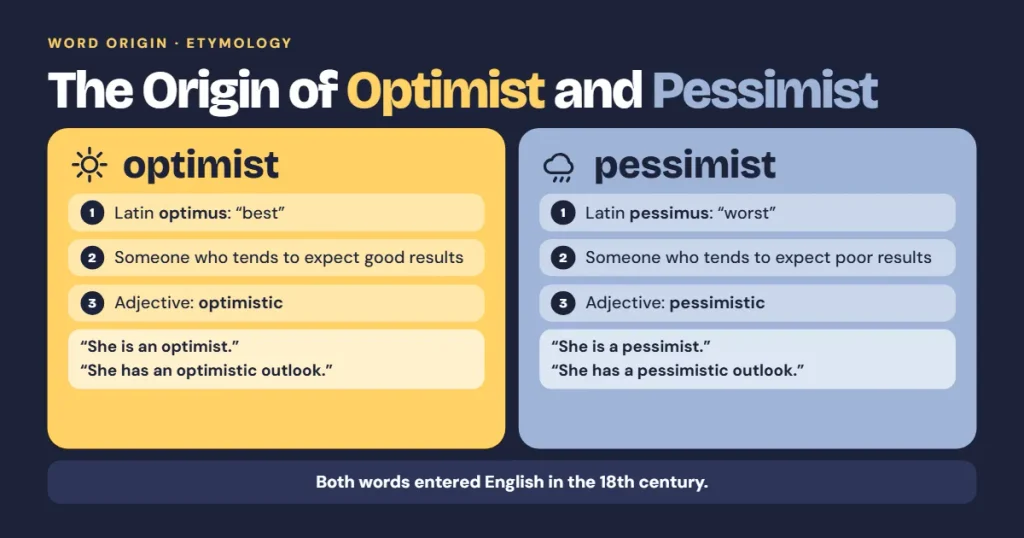
The word optimist comes from the Latin word optimus, meaning “best.” It entered English in the 18th century. It describes someone who tends to expect good results.
The word pessimist comes from the Latin word pessimus, meaning “worst.” It also entered English in the 18th century. It describes someone who tends to expect poor results.
Both words are linked to ways of thinking about life and the future. Over time, they became common in everyday speech, books, news, and talks about human behaviour.
The related adjectives are optimistic and pessimistic. For example, you can say, “She is an optimist,” or “She has an optimistic outlook.” Both sentences describe hope, but they use different forms of the word.
British vs American English
There is no spelling difference between optimist and pessimist in British and American English. Both forms are used in the UK and the US.
| British English | American English |
| Optimist | Optimist |
| Pessimist | Pessimist |
| Optimistic | Optimistic |
| Pessimistic | Pessimistic |
The main difference may be in pronunciation. Some vowel sounds vary between British and American accents, but the spelling and meaning remain the same.
Examples:
- UK: She is an optimist about the future.
- US: She is an optimist about the future.
- UK: He is a pessimist about the plan.
- US: He is a pessimist about the plan.
Which One Should You Use?
Use optimist when you mean a person who tends to expect good results. Use pessimist when you mean a person who tends to expect bad results or problems.
- For a hopeful view: “She is an optimist.”
- For a doubtful view: “He is a pessimist.”
- For a person’s attitude: Use optimistic or pessimistic.
- For school or work: Choose the word that matches the person’s outlook in that situation.
- For global readers: Both words are standard in British and American English.
Try not to use pessimist as an insult. A person may notice risks because they want to be careful. In the same way, an optimist is not always right just because they feel hopeful. The best word depends on the meaning you want to share.
Common Mistakes
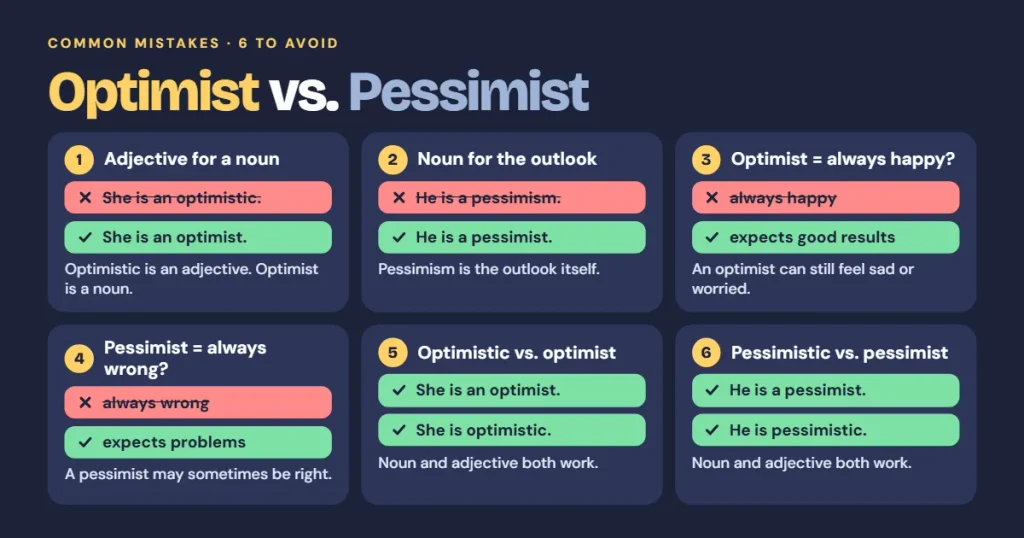
- Mistake: “She is an optimistic.”
Correct: “She is an optimist.”
Optimistic is an adjective; optimist is a noun. - Mistake: “He is a pessimism.”
Correct: “He is a pessimist.”
Pessimism is a noun for the outlook itself. - Mistake: Using optimist to mean a person who is always happy.
Correct: An optimist tends to expect good results, but can still feel sad or worried. - Mistake: Using pessimist to mean a person who is always wrong.
Correct: A pessimist tends to expect problems, but may sometimes be right. - Mistake: Mixing up optimistic and optimist.
Correct: “She is an optimist.” / “She is optimistic.” - Mistake: Mixing up pessimistic and pessimist.
Correct: “He is a pessimist.” / “He is pessimistic.”
Everyday Usage Examples
In Emails
- Optimist: “I am optimistic that we can finish the work by Friday.”
- Pessimist: “I am worried that we may not finish the work by Friday.”
On Social Media
- Optimist: “I believe better days are ahead!”
- Pessimist: “I fear things may get worse before they get better.”
In News Reports
- Optimist: “The optimist expects the new plan to create jobs.”
- Pessimist: “The pessimist fears the plan may fail.”
In Formal Writing
- Optimist: “The optimist expects the project to succeed.”
- Pessimist: “The pessimist points to risks in the project.”
These examples show how each word can describe a person’s view of the same event.
Usage Trends
Both words are used around the world in books, news, schoolwork, and daily talk. They are common when people discuss the future, work, money, health, or personal goals.
You may see optimist in stories about hope, progress, or plans for success. You may see pessimist in talks about risk, fear, or possible failure.
The words are also used in psychology and social studies. In these fields, writers may study how people expect events to turn out. The words can describe a general outlook, but they do not tell the full story of a person’s thoughts or feelings.
Metaphors and Similes
Writers often use images to show the difference between hope and doubt.
Metaphors
- “An optimist sees a door in every wall.”
This means the person looks for a way forward. - “A pessimist sees a wall in every door.”
This means the person expects barriers or trouble.
These are creative sayings, not fixed definitions.
Similes
- “The optimist was like a lamp in a dark room.”
This suggests hope during a hard time. - “The pessimist was like a cloud before a storm.”
This suggests worry or a fear of trouble.
Connotative Meaning
The words can carry feelings beyond their basic meanings. Their tone depends on the sentence.
Positive Meaning
Optimist often has a positive tone. It can suggest hope, courage, and a wish to keep trying.
- “She is an optimist who helps the team stay hopeful.”
- “The optimist believed the town could rebuild.”
Negative Meaning
Pessimist can have a negative tone when it suggests too much doubt or a lack of hope.
- “The pessimist rejected every idea before trying it.”
- “He sounded like a pessimist when he said the plan could never work.”
Neutral Meaning
Both words can also be neutral. They can simply describe how someone views a situation.
- “The optimist expected sales to rise.”
- “The pessimist expected sales to fall.”
Idioms and Proverbs
These common sayings relate to hope, doubt, and the way people see life.
“Every cloud has a silver lining.”
Meaning: Something good may come from a hard event.
Example: The optimist believed that every cloud has a silver lining after the team lost.
“Look on the bright side.”
Meaning: Try to notice the good part of a situation.
Example: Her friend told her to look on the bright side after a poor test result.
“Hope for the best, prepare for the worst.”
Meaning: Stay hopeful, but get ready for problems.
Example: The optimist and pessimist agreed to hope for the best and prepare for the worst before the trip.
These sayings can help show different outlooks in daily life.
Literature and Movies
Optimism and pessimism appear in many stories. Writers use them to show how people react to hope, fear, and hard times.
Literature
Candide by Voltaire, first published in 1759, is a satirical work that explores optimism and suffering. Its main character faces many troubles while ideas about the best possible world are tested.
Winnie-the-Pooh by A. A. Milne, published in 1926, includes characters with different outlooks. Tigger is often lively and hopeful, while Eeyore often expects little to go well. These characters offer simple examples of different ways to view life.
Movies
Inside Out (2015), an American animated film, explores emotions and how they shape our view of events. It shows that sadness and joy both have a place in life.
The Pursuit of Happyness (2006), an American drama, follows a father who faces many problems while working toward a better future. His story shows how hope can help a person keep going during hard times.
Why This Difference Matters
Knowing the difference helps you describe people and ideas more clearly. If you call someone an optimist, you mean they tend to expect good results. If you call someone a pessimist, you mean they tend to expect trouble or poor results.
This can matter in school essays, stories, work talks, and daily conversations. The wrong word may change the message you want to share.
It is also useful to remember that both outlooks can have value. Hope can help people keep trying. Careful doubt can help people spot risks and make plans. Problems can arise when a person ignores facts or expects only the worst.
For English learners, the main rule is simple: optimist is the hopeful person, and pessimist is the person who expects problems. The related adjectives are optimistic and pessimistic. With these words, you can explain a person’s outlook in a clear and fair way.
Usefulness in Daily Life
These words can help you talk about people, plans, and events.
- At school: “I am an optimist about my exam.”
- At work: “The pessimist thinks the plan may fail.”
- With friends: “My friend is an optimist who always looks for a solution.”
- In the news: “Some people are optimists about the economy.”
- In personal goals: “Try to stay optimistic while you learn a new skill.”
Situational Preference
Use optimist when someone expects good results or looks for hope. It fits stories about goals, recovery, new plans, and chances to improve. Use pessimist when someone expects trouble or focuses on what may go wrong. It can fit a discussion about risks, delays, or possible loss. In real life, people may show both outlooks. Someone may feel optimistic about a new job but pessimistic about the cost of moving. Choose the word that best matches the person’s view in that moment. Do not use either word as a judgment of their worth.
Common Questions and Answers
1. What is the main difference between an optimist and a pessimist?
An optimist tends to expect good results. A pessimist tends to expect bad results or problems.
2. Can a person be both an optimist and a pessimist?
Yes. A person may be hopeful about one part of life and worried about another.
3. Is being an optimist always good?
Not always. Hope can help, but people should still notice risks and facts.
4. Is being a pessimist always bad?
No. Looking for risks can help people prepare. Too much doubt, however, can make it hard to act.
5. What is the adjective form of optimist?
The adjective is optimistic. For example, “She has an optimistic view.”
6. What is the adjective form of pessimist?
The adjective is pessimistic. For example, “He is pessimistic about the result.”
7. Are optimist and pessimist spelled differently in British and American English?
No. Both spellings are the same in British and American English.
Conclusion
Optimist and pessimist describe two different ways of looking at the future. An optimist expects good results and looks for chances, while a pessimist expects problems and focuses on risks. Use optimist for a hopeful person and pessimist for someone who expects things to go badly. Use optimistic or pessimistic to describe a person’s outlook. These words have the same meanings and spellings in British and American English. Remember that no one feels hopeful or doubtful all the time. An optimist can worry, and a pessimist can feel happy. Hope can help people keep trying, while careful thinking helps them prepare for problems. By understanding these differences, you can choose the right word and use both words with confidence.

I’m Samia Jamshaid, an English language specialist, SEO specialist, digital publisher, and researcher. I create clear, accurate, and well-researched content on English grammar, vocabulary, word meanings, and language comparisons, helping readers understand and use English with confidence.





1 thought on “Optimist or Pessimist: Differences in Attitude and Thinking”