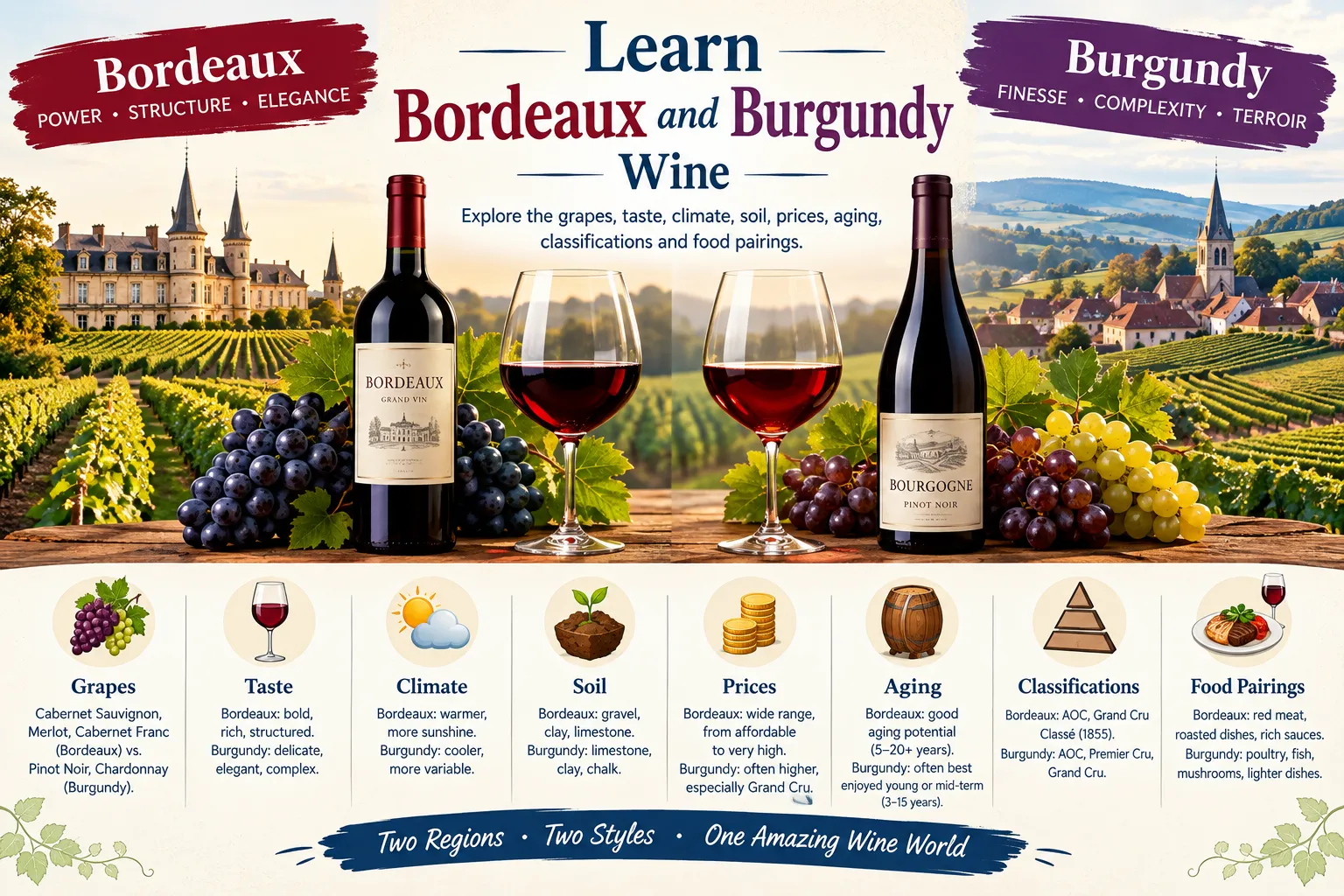
Bordeaux and Burgundy are two famous wine regions in France. Both make high-quality wines, but their wines can taste quite different.
Bordeaux is best known for red wines made from blends of grapes. Burgundy is famous for red wines made from Pinot Noir and white wines made from Chardonnay. These grapes give each region its own style.
But grapes are only part of the story. Climate, soil, and winemaking also affect how a wine tastes. The regions also use different systems to name and rank their wines.
In this guide, you will learn the main differences between Bordeaux and Burgundy. We will look at their grapes, flavors, climate, soil, prices, and food pairings. By the end, you will have a better idea of which wine may suit your taste.
Bordeaux vs Burgundy: Comparison
| Feature | Bordeaux | Burgundy |
| Location | Southwestern France | Eastern France |
| Famous red grapes | Cabernet Sauvignon and Merlot | Pinot Noir |
| Famous white grapes | Sauvignon Blanc and Sémillon | Chardonnay |
| Common red wine taste | Dark fruit, spice, and cedar | Red fruit, flowers, and earthy notes |
| Common red wine style | Often full and firm | Often lighter and smoother |
| Main focus | Blending grapes and estate style | Showing the character of each vineyard |
| Common soil types | Gravel, clay, and limestone | Limestone, clay, and marl |
| Price | From affordable to very expensive | From affordable to very expensive |
| Aging | Some wines age for many years | Some wines age for many years |
1. Where Are Bordeaux and Burgundy?
Bordeaux: Southwestern France
Bordeaux is in southwestern France, near the Atlantic Ocean. Rivers run through the region and connect with the Gironde estuary. These waterways helped Bordeaux become an important wine-trading center.
Bordeaux has several famous wine areas. The Médoc and Graves are on the Left Bank. Saint-Émilion and Pomerol are on the Right Bank.
The wines from these areas can differ in taste. Left Bank reds often use more Cabernet Sauvignon. Right Bank reds often use more Merlot.
Burgundy: Eastern France
Burgundy is in eastern France. Its French name is Bourgogne. The region is famous for its vineyards and long history of winemaking.
Some vineyards are very close to each other but produce different wines. Soil, slope, sunlight, and weather can affect the grapes. This makes the exact place where the grapes grow very important.
The key difference: Bordeaux is famous for its wine estates and blends. Burgundy is famous for wines that show the character of their vineyards.
2. Climate and Soil
Climate and soil help shape a wine’s taste. They affect how grapes grow and ripen.
Bordeaux’s Climate and Soil
Bordeaux has a maritime climate. This means the nearby ocean affects its weather. The region often has mild conditions, but rain and changes in weather can affect each harvest.
Bordeaux has several soil types:
- Gravel: Helps water drain away.
- Clay: Holds more water.
- Limestone: Can affect water flow and vine growth.
Different soils suit different grape varieties. For example, gravelly soils are common in parts of the Left Bank, while clay and limestone are important in parts of the Right Bank.
Burgundy’s Climate and Soil
Burgundy has a continental climate. It often has warm summers and cold winters. Spring frost and rain can affect the grapes.
Many Burgundy vineyards have limestone, clay, and marl. The mix of these soils can change from one vineyard to another.
The land also matters. A slope may get more sunlight than a flat area. This can affect how the grapes ripen.
Why does this matter? Climate and soil help shape the wine, but they do not decide its taste alone. The grape, weather each year, and winemaking choices also matter.
3. Grape Varieties: Bordeaux vs Burgundy
Bordeaux: Famous for Blended Wines
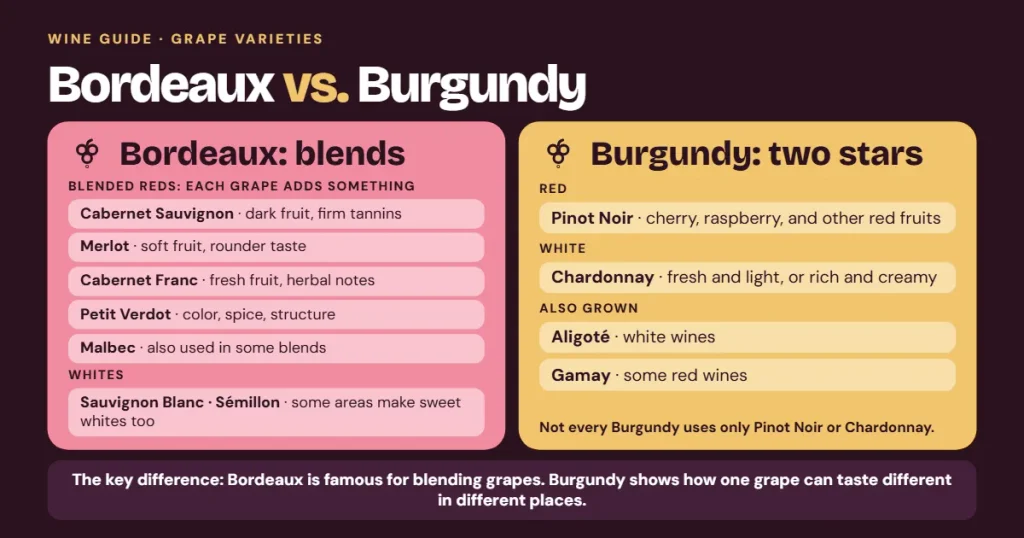
Many Bordeaux red wines use more than one type of grape. This is called blending. Each grape adds something different.
- Cabernet Sauvignon: Often adds dark fruit and firm tannins.
- Merlot: Often adds soft fruit and a rounder taste.
- Cabernet Franc: Can add fresh fruit and herbal notes.
- Petit Verdot: Can add color, spice, and structure.
- Malbec: Is also used in some Bordeaux wines.
Tannins are natural parts of grapes that can make wine feel dry in the mouth.
Many Left Bank wines use more Cabernet Sauvignon. Many Right Bank wines use more Merlot. However, the exact blend depends on the producer and the year.
Bordeaux also makes white wines. Sauvignon Blanc and Sémillon are two important grapes. Some Bordeaux areas also make sweet white wines.
Burgundy: Famous for Pinot Noir and Chardonnay
Burgundy is best known for two grapes.
Pinot Noir is used for many famous red Burgundy wines. It can produce flavors of cherry, raspberry, and other red fruits.
Chardonnay is the main grape for white Burgundy. It can make fresh, light wines or rich, creamy ones.
Burgundy also grows other grapes. Aligoté is used for white wines, while Gamay is used in some red wines.
So, it is not correct to say that every Burgundy wine uses only Pinot Noir or Chardonnay.
The key difference: Bordeaux is famous for blending grapes. Burgundy is famous for showing how one grape can taste different in different places.
You May Also Like https://orchoice.com/creak-or-creek/
4. What Does Bordeaux Wine Taste Like?
Red Bordeaux
Many red Bordeaux wines have a full taste and firm tannins. They often have flavors of dark fruit.
You may notice:
- Blackcurrant
- Blackberry
- Plum
- Cedar
- Tobacco
- Spice
Cabernet Sauvignon-led wines often feel firm and strong. Merlot-led wines may taste rounder and softer.
Some Bordeaux wines are aged in oak barrels. This can add notes of vanilla, toast, or spice. However, not every Bordeaux wine has a strong oak taste.
With age, some red Bordeaux wines develop new flavors. These may include leather, dried fruit, and earthy notes.
Not every Bordeaux wine needs years of aging. Many simple bottles are made to drink while young.
White Bordeaux
White Bordeaux often uses Sauvignon Blanc and Sémillon. These wines may taste of lemon, fresh herbs, and other fruits.
Some white Bordeaux wines are aged in oak barrels. This can give them a richer taste.
Bordeaux also makes sweet white wines. Sauternes is famous for this style. These wines can taste rich, sweet, and honey-like.
5. What Does Burgundy Wine Taste Like?
Red Burgundy
Red Burgundy is usually made from Pinot Noir. It often has a lighter color than red Bordeaux.
Its common flavors include:
- Cherry
- Raspberry
- Strawberry
- Flowers
- Earth
- Mushroom
Some red Burgundy wines taste light and fresh. Others have more body and can age for many years.
The taste depends on the vineyard, producer, and year. A light color does not mean the wine lacks flavor.
White Burgundy
White Burgundy is mainly made from Chardonnay. Its taste can range from fresh and light to rich and creamy.
Some bottles have notes of lemon, green apple, and fresh minerals. Others may taste of pear, nuts, or butter.
Chablis is a famous area in northern Burgundy. Its white wines often have fresh acidity and a clean taste.
Other Burgundy white wines can be richer and rounder. So, not all white Burgundy tastes the same.
6. Main Taste Differences
| Feature | Bordeaux Red | Burgundy Red |
| Main grapes | Often Cabernet Sauvignon and Merlot blends | Usually Pinot Noir |
| Body | Often medium to full | Often light to medium |
| Fruit flavors | Blackcurrant, blackberry, and plum | Cherry, raspberry, and strawberry |
| Other flavors | Cedar, tobacco, and spice | Flowers, earth, and mushroom |
| Tannins | Often firm | Often finer, but can still be firm |
| Aging | Many top wines age well | Many top wines also age well |
7. How Are Bordeaux and Burgundy Wines Ranked?
Wine labels can be confusing because the two regions use different systems.
Bordeaux’s Classification System
Bordeaux has several classification systems. One famous system began in 1855. It ranks certain estates, mainly in the Médoc. It also covers some sweet wines from Sauternes and Barsac.
Other Bordeaux areas have their own systems. Saint-Émilion, for example, has a separate classification.
A château is a wine estate or producer name. An appellation is a legally defined area where wine is made.
A wine from an estate outside the famous rankings can still be very good. The ranking is useful, but it does not tell the whole story.
Burgundy’s Classification System
Burgundy places great importance on where the grapes grow. Its main levels include:
- Regional wine: Comes from a wider part of Burgundy.
- Village wine: Comes from a named village area.
- Premier Cru: Comes from a special, ranked vineyard site.
- Grand Cru: Comes from one of Burgundy’s highest-ranked vineyard sites.
8. Which Region Is More Expensive?
Both Bordeaux and Burgundy make wines at many price levels. You can find everyday bottles and very expensive wines in both regions.
Some famous Burgundy vineyards are very small. They produce limited amounts of wine. High demand can make these bottles extremely expensive.
Bordeaux also has costly wines from famous estates and strong harvest years. But it also has areas that offer good value, such as Fronsac, Moulis, and Listrac.
To compare prices, look at the producer, year, and exact wine. Do not choose only by the region name.
9. Which Wine Ages Better?
Both regions can make wines that improve with age. Neither region always ages better than the other.
Many top Bordeaux reds have firm tannins and enough structure to age for years. As they mature, their flavors may become softer and more complex.
Top Burgundy reds can also age for many years. Some develop earthy and savory flavors over time. Some white Burgundy wines age well, too.
However, many everyday wines from both regions are best enjoyed young.
A wine’s aging potential depends on the producer, year, storage, and style. If you plan to keep a bottle, ask the seller when it may be best to drink.
10. What Food Goes Best with Each Wine?
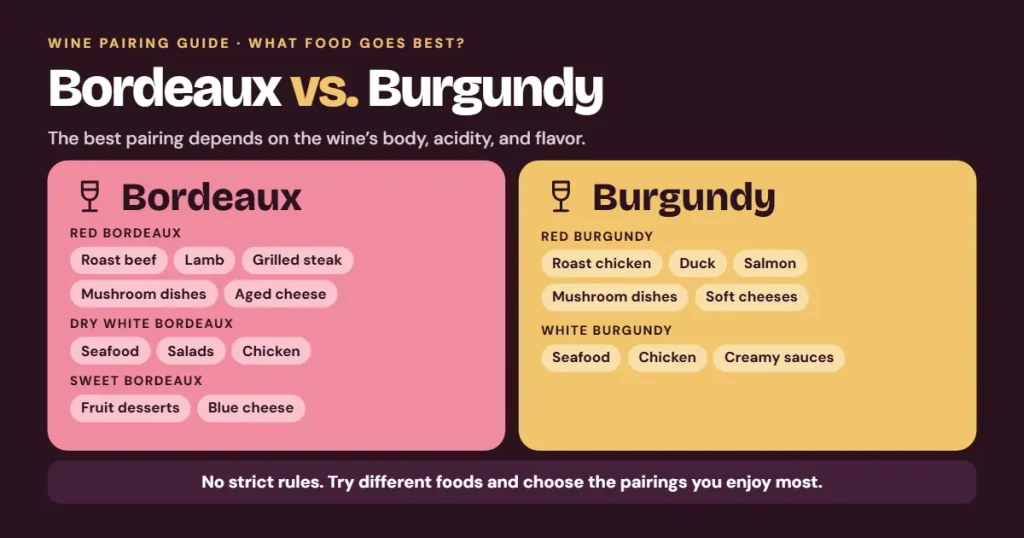
The best food pairing depends on the wine’s body, acidity, and flavor. These ideas are good starting points.
Food Pairings for Bordeaux
Red Bordeaux often pairs well with:
- Roast beef
- Lamb
- Grilled steak
- Mushroom dishes
- Aged cheese
Dry white Bordeaux can go well with seafood, salads, and chicken. Sweet Bordeaux wines may pair well with fruit desserts or blue cheese.
Food Pairings for Burgundy
Red Burgundy often pairs well with:
- Roast chicken
- Duck
- Salmon
- Mushroom dishes
- Soft cheeses
White Burgundy can work well with seafood, chicken, and creamy sauces.You do not need to follow strict rules. Try different foods and choose the pairings you enjoy most.
11. Which Should You Choose?
Choose Bordeaux if you enjoy red wines with dark fruit, firm tannins, and a strong structure. Many Bordeaux reds go well with red meat. Some are also good choices for long-term aging.
Choose Burgundy if you enjoy red wines with cherry, raspberry, and earthy notes. Burgundy Chardonnay is also a good option if you like white wines that range from fresh and light to rich and creamy.
Your budget matters, too. Both regions offer good wines at different prices. Compare the exact bottle instead of choosing by region alone.
If possible, try one Bordeaux and one Burgundy side by side. Choose bottles with similar prices. Notice their fruit flavors, body, acidity, and tannins.
This is one of the easiest ways to learn the difference. You may find that you enjoy both styles for different reasons.
Possible Asked Questions
1. What is the main difference between Bordeaux and Burgundy?
Bordeaux is famous for blended wines and wine estates. Burgundy is famous for Pinot Noir, Chardonnay, and wines that show the character of each vineyard.
2. Is Bordeaux stronger than Burgundy?
Not always. Many Bordeaux reds have more body and firmer tannins. Many Burgundy reds are lighter and fresher. The exact style depends on the bottle.
3. Is Burgundy always made from Pinot Noir or Chardonnay?
No. These are Burgundy’s best-known grapes, but the region also grows Aligoté, Gamay, and other varieties.
4. Is Bordeaux always a blend?
No. Many Bordeaux wines are blends, but not every bottle uses several grapes. The grape mix depends on the wine and the rules of its area.
5. Which is more expensive, Bordeaux or Burgundy?
Neither is always more expensive. Both regions have affordable wines and rare, costly bottles. The producer, year, and vineyard can affect the price.
6. Which wine is better for beginners?
It depends on what you like. If you enjoy dark fruit and firm reds, try Bordeaux. If you prefer lighter reds with red-fruit flavors, try Burgundy.
7. What do Premier Cru and Grand Cru mean?
They are levels in Burgundy’s vineyard ranking system. Grand Cru is the highest level, followed by Premier Cru, then village and regional wines.
8. Which region is better for aging wine?
Both can make wines that age well. Some Bordeaux and Burgundy wines can develop for many years. Others are best enjoyed young.
Conclusion
Bordeaux or Burgundy are two great wine regions in France, but they have different styles. Bordeaux is famous for red blends, dark fruit, and firm tannins. Burgundy is known for Pinot Noir, Chardonnay, and wines that show the character of each vineyard. Yet both regions make many types of wine, and not every bottle tastes the same. Their prices also range from affordable to very high. The best choice depends on your taste, budget, and meal. If you like bold reds, try Bordeaux. If you prefer fresh reds or a range of Chardonnay styles, try Burgundy. You do not have to pick only one. Try wines from both regions and see which ones you enjoy most.

I’m Samia Jamshaid, an English language specialist, SEO specialist, digital publisher, and researcher. I create clear, accurate, and well-researched content on English grammar, vocabulary, word meanings, and language comparisons, helping readers understand and use English with confidence.












1 thought on “Bordeaux or Burgundy: Taste, Grapes, Price, and Key Differences”