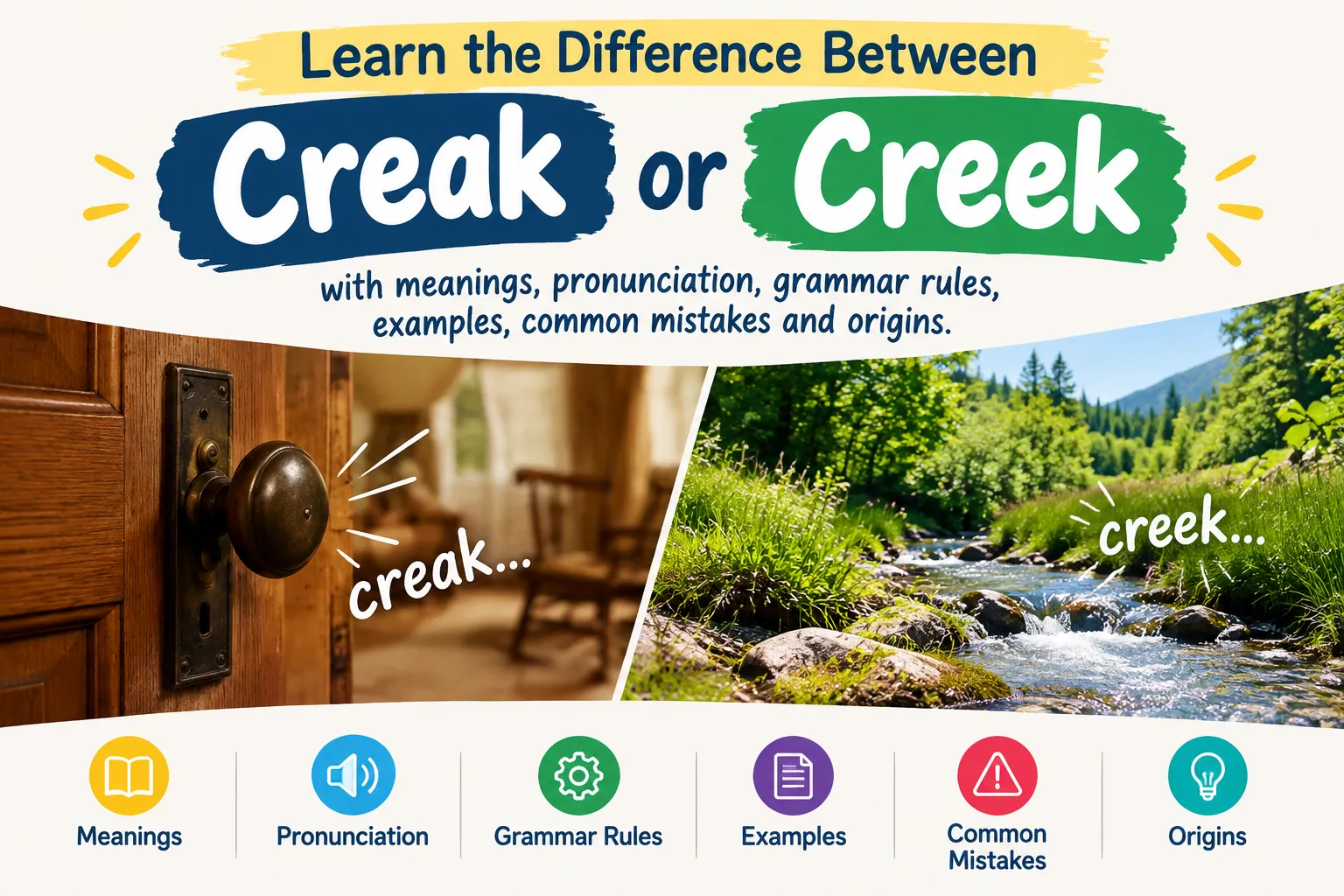
Have you ever wondered whether to write creak or creek? These words sound the same, but they have different meanings. A creak is a squeaky sound made when something moves. A creek is a small stream of water. For example, an old door may creak when you open it, while a creek may flow through a forest. Both words are called homophones because they have the same pronunciation but different spellings and meanings. This can make them confusing, especially for English learners and writers. The good news is that the difference is easy to learn. Once you know what each word means, you can choose the right spelling with confidence. In this guide, you will learn their meanings, grammar rules, pronunciation, examples, common mistakes, and word origins. You will also find simple tips to help you remember the difference.
Answer: Creak vs. Creek
- Creak: A squeaky or harsh sound made by something moving.
- Creek: A small stream of water.
Examples:
- The old door began to creak.
- We walked beside the creek.
Easy memory trick: If it squeaks, it is a creak. If water flows through it, it is a creek.
Meaning of Creak
Creak means to make a long, squeaky, or rough sound. This sound often comes from wood, doors, stairs, chairs, or hinges. It may happen when something moves or carries weight.
Creak as a noun
As a noun, creak means the sound itself.
Examples:
- I heard a loud creak from the stairs.
- The creak of the old door woke me up.
Creak as a verb
As a verb, creak means to make that sound.
Examples:
- The wooden floor creaks when I walk on it.
- The gate creaked as Dad opened it.
The word can also describe something that seems weak under pressure.
Example: The old system began to creak under the heavy workload.
Here, creak is used in a figurative way. It means the system is struggling, not making a real sound.
Meaning of Creek
A creek is a small stream of water. It may flow through a forest, field, valley, or village. Some creeks flow into larger rivers. In some places, the word can also describe a narrow waterway or a small inlet along a coast.
Creek as a noun
Creek is mainly used as a noun. It names a place where water flows.
Examples:
- The children played beside the creek.
- A small bridge crosses the creek.
- Heavy rain caused the creek to rise.
Creak vs. Creek: Pronunciation
Both words are pronounced the same in standard English.
- Creak: /kriːk/
- Creek: /kriːk/
Each word has one syllable. The vowel sound is the long “ee” sound, as in see.
Creak vs. Creek: Comparison Table
| Feature | Creak | Creek |
| Meaning | A squeaky sound | A small stream of water |
| Part of speech | Noun or verb | Mainly a noun |
| Related idea | Sound and movement | Water and nature |
| Pronunciation | /kriːk/ | /kriːk/ |
| Example | The floor began to creak. | The creek runs behind our house. |
| Memory clue | A sound you hear | Water you can see |
10 Key Differences Between Creak and Creek
1. Their meanings are different
Creak refers to a sound. Creek refers to a waterway.
- The chair made a creak when I sat down.
- We found a small creek near the campsite.
2. They have different parts of speech
Creak can be a noun or a verb. Creek is mainly a noun.
- I heard a creak in the hallway.
- The old floorboards creak at night.
- The creek flows through the park.
- The creek is full after the rain.
3. They belong to different settings
Creak often appears in homes, buildings, and stories. Creek often appears in descriptions of nature.
- The old house gave a loud creak.
- Birds gathered near the creek.
4. One is heard, while the other is often seen
You hear a creak. You can see a creek and its flowing water.
- I heard a creak behind me.
- We watched the water flow through the creek.
5. They use different grammar patterns
Creak can change form to show tense. Creek usually takes a plural form when talking about more than one stream.
- The door creaks every morning.
- The door creaked last night.
- Several creeks cross the valley.
- The creek flows past the farm.
6. They create different pictures in the reader’s mind
Creak may make a reader imagine an old door or floor. Creek may bring to mind water, stones, and trees.
- A strange creak came from the attic.
- Clear water flowed through the creek.
7. They fit different sentences
Use creak when the sentence is about a sound. Use creek when it is about a stream or waterway.
- The stairs creak under my feet.
- We crossed the creek using a wooden bridge.
8. They can appear in different types of writing
Creak is useful in stories that describe sounds. Creek is useful in writing about nature, travel, and places.
- The door gave a slow creak in the dark.
- The map shows a creek near the village.
9. They can have different forms in a sentence
The verb creak can become creaks, creaked, or creaking. The noun creek can become creeks.
- The old gate was creaking in the wind.
- Three creeks meet near the forest.
10. Their spelling gives a useful memory clue
The spelling creak is linked to the idea of a sound. The spelling creek can remind you of water.
- The old door began to creak.
- We sat beside the creek.
You May Also Like https://orchoice.com/sapphire-or-saphire/
Correct and Incorrect Examples
These examples show how the wrong spelling can change a sentence’s meaning.
| Incorrect sentence | Correct sentence |
| The door began to creek. | The door began to creak. |
| I heard a creek from the stairs. | I heard a creak from the stairs. |
| We walked beside the creak. | We walked beside the creek. |
| The creek made a loud noise as the chair moved. | The chair made a loud creak as it moved. |
| The children played near the creak. | The children played near the creek. |
Why Do People Confuse Creak and Creek?
People often confuse these words because they sound exactly the same. Their spellings are also very similar. Only one vowel letter changes.
When people write quickly, they may choose the wrong word without checking its meaning. English learners may also find the words difficult because pronunciation alone does not help them choose the correct spelling.
For example:
- “The old floor made a creek.” This uses the wrong word for a sound.
- “We sat beside the creak.” This uses the wrong word for a stream.
Common Mistakes to Avoid
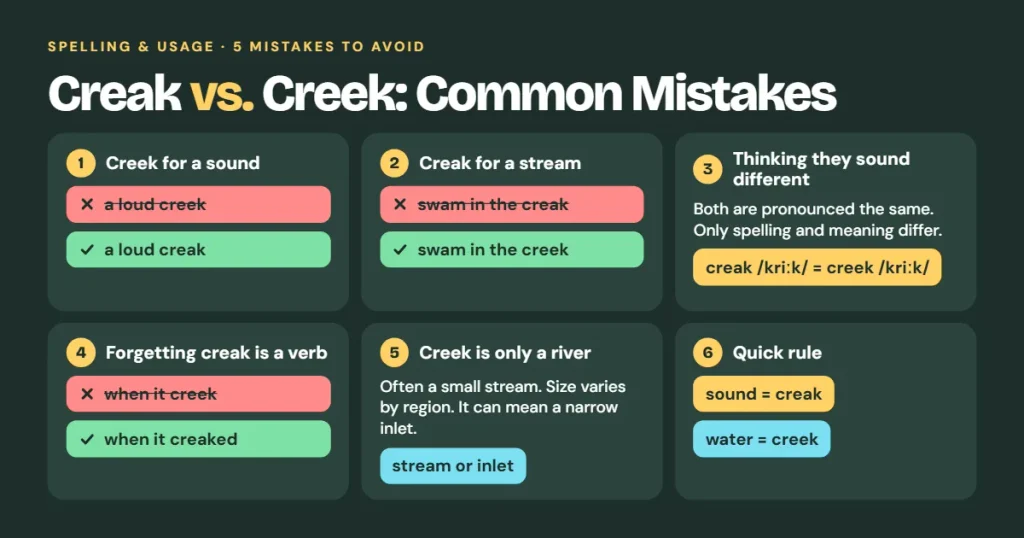
Mistake 1: Using creek for a sound
Incorrect: The door made a loud creek.
Correct: The door made a loud creak.
Why? The sentence describes a sound made by a door.
Mistake 2: Using creak for a stream
Incorrect: We swam in the creak.
Correct: We swam in the creek.
Why? The sentence describes a body of water.
Mistake 3: Thinking the words sound different
Both words have the same pronunciation: /kriːk/. The difference is in their spelling and meaning.
Mistake 4: Forgetting that creak can be a verb
Incorrect: The door made a sound when it creek.
Correct: The door made a sound when it creaked.
Why? The sentence needs the past form of the verb creak.
Mistake 5: Treating creek only as a river
A creek is often a small stream, but its exact size and form can vary by region. In some places, it can also mean a narrow inlet or waterway.
Word Origins: Where Do Creak and Creek Come From?
The words have different histories, even though they sound alike today.
Origin of creak
Creak has roots in older forms of English. It is linked to words used to describe a harsh or squeaky sound. Today, it is used for sounds made by doors, floors, chairs, and other objects. It can also describe a person, system, or plan that struggles under pressure.
Origin of creek
Creek came into English through older forms of the word, including Middle English creke. Its deeper origin is uncertain. Today, it often means a small stream, especially in North America and other English-speaking regions.
These histories help explain why the words have different meanings. Their similar sounds do not mean they share the same use.
British vs. American English
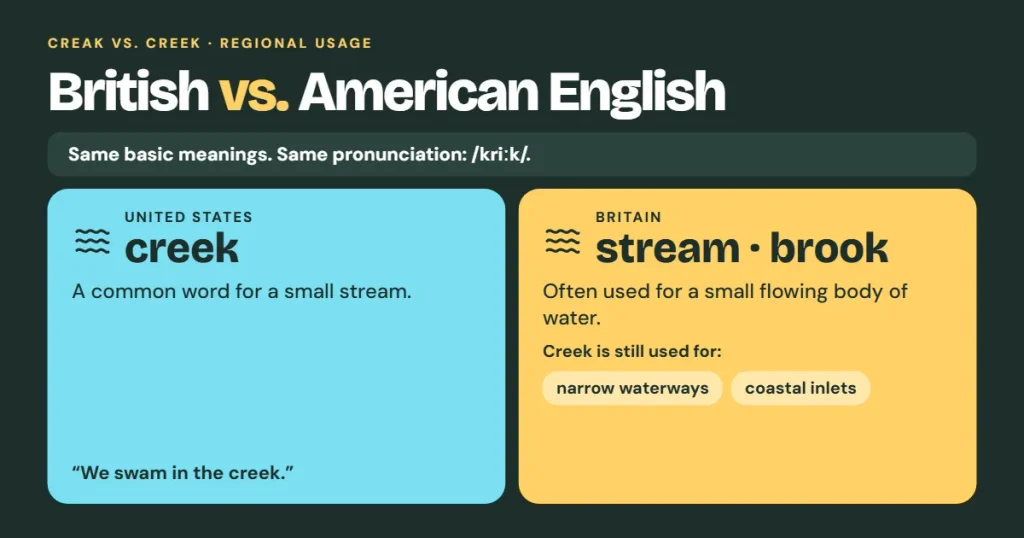
The words creak and creek have the same basic meanings in both British and American English. Their pronunciation is also the same in standard usage.
There can be a difference in how people use creek to describe water. In the United States, creek is a common word for a small stream. In British English, people may use stream or brook more often for a small flowing body of water. The word creek is still used in Britain, especially for certain narrow waterways or coastal inlets.
Everyday Examples of Creak and Creek
Here are some examples from daily life.
Creak in everyday sentences
- The wooden stairs creak when someone walks upstairs.
- I heard a creak as the old gate opened.
- My chair creaked when I leaned back.
- The door was creaking in the wind.
- The old floorboards gave a soft creak.
Creek in everyday sentences
- A small creek runs behind our house.
- We stopped to rest beside the creek.
- The creek rose after two days of rain.
- A wooden bridge crosses the creek.
- The children watched fish swim in the creek.
Decision Guide
If you are unsure which word to use, follow these steps:
- Check the meaning. Is the sentence about a sound or water?
- Choose the word. Use creak for a squeaky sound and creek for a stream.
- Read the sentence again. Make sure the chosen word makes sense.
For example, “The door began to ___.” The correct word is creak because the door makes a sound.
Now try: “We sat beside the ___.” The correct word is creek because it refers to a place with water.
Common Questions About
1. What is the difference between creak and creek?
Creak means a squeaky or harsh sound. Creek usually means a small stream of water.
2. Are creak and creek pronounced the same?
Yes. Both words are pronounced /kriːk/ in standard English. They are homophones.
3. Is creak a noun or a verb?
Creak can be both. As a noun, it means a squeaky sound. As a verb, it means to make that sound.
Examples: “I heard a creak.” “The door may creak.”
4. Is creek a noun or a verb?
Creek is mainly a noun. It names a small stream or a narrow waterway.
Example: “The creek flows through the woods.”
5. Can creek mean a sound?
No, not in its usual meaning. A squeaky sound is called a creak.
6. Can creak mean water?
No. Creak refers to a sound or the act of making that sound. A small stream is a creek.
7. How can I remember the difference?
Remember this sentence: “The door can creak beside the creek.” The door makes a sound, while the creek holds flowing water.
8. Is creek always smaller than a river?
A creek is often smaller than a river, but the exact meaning can vary by place. In some regions, it can also refer to a narrow inlet or waterway.
Conclusion
The difference between creak and creek is simple once you know what each word means. A creak is a squeaky sound made when something moves. A creek is a small stream of water. Both words sound the same, so you must use the meaning of the sentence to choose the right spelling. Remember that creak can be a noun or a verb, while creek is mainly a noun. You may hear a door creak, or you may walk beside a creek. If you are unsure, ask yourself whether the sentence describes a sound or a waterway. This small check can help you avoid spelling mistakes in schoolwork, emails, stories, and everyday writing. Keep the memory tip in mind: if it squeaks, it’s a creak; if it flows, it’s a creek.

I’m Samia Jamshaid, an English language specialist, SEO specialist, digital publisher, and researcher. I create clear, accurate, and well-researched content on English grammar, vocabulary, word meanings, and language comparisons, helping readers understand and use English with confidence.












1 thought on “Creak or Creek: How to Use Each Word Correctly 2026”