
Analyser is the British English spelling, while analyzer is the American English spelling. Both words mean the same thing.
Imagine you are writing a school report about a tool that checks data. You type “analyzer,” but your teacher prefers British English. Should you change it to “analyser”? The answer depends on your audience and the style of English you use.
Both spellings are correct. Neither is more accurate than the other. They refer to a person, tool, or computer program that examines something carefully. For example, a data analyzer studies information, while a gas analyser checks the parts of a gas sample.
People search for analyser or analyzer because English uses different spellings in different countries. This can cause confusion in schoolwork, business reports, websites, and technical documents. The good news is that the rule is simple: use analyser in British English and analyzer in American English. Once you choose a style, keep it the same throughout your writing.
Pronunciation
Both words have the same pronunciation in standard English. The spelling changes, but the meaning and sound stay the same.
- Analyser — UK: /ˈæn.ə.laɪ.zə/
- Analyzer — US: /ˈæn.ə.laɪ.zɚ/
The main stress falls on the first part of the word. In American English, the final sound often includes a clear “r.” In many British accents, the final “r” is not pronounced.
Difference Between Analyser and Analyzer
1. British and American Spelling
The main difference is the spelling. British English often uses -s-, while American English uses -z- in this word.
Examples:
- UK: The scientist used a gas analyser.
- US: The scientist used a gas analyzer.
2. Meaning
Both words have the same meaning. They describe a person or tool that examines something.
Examples:
- The analyser checked the sample.
- The analyzer checked the sample.
3. Grammar
Both words are nouns. They name a person, device, or program that studies information or materials.
Examples:
- The analyser found a problem.
- The analyzer found a problem.
4. Use in British Writing
Use analyser when writing for a British audience. It is also common in many other places that follow British spelling.
Examples:
- The lab needs a new analyser.
- Our analyser checks the quality of the water.
5. Use in American Writing
Use analyzer when writing for an American audience. This spelling is standard in the United States.
Examples:
- The lab bought a new analyzer.
- This analyzer checks the quality of the water.
6. Use in Science
Both spellings are used in science. The right choice depends on the country or style guide.
Examples:
- The British lab tested the sample with an analyser.
- The American lab tested the sample with an analyzer.
7. Use in Technology
Both words can describe software or devices that study data, systems, or signals.
Examples:
- The code analyser found an error.
- The code analyzer found an error.
8. Use in Formal Writing
Both spellings are correct in formal writing. The key is to follow the spelling style required by your school, workplace, or publisher.
Examples:
- The report describes the analyser’s results.
- The report describes the analyzer’s results.
9. Search and Online Content
Search engines can understand both spellings. However, using the spelling your readers expect can make your content feel more natural.
Examples:
- A UK website may use “best analyser for labs.”
- A US website may use “best analyzer for labs.”
10. Consistency
Do not switch between the two spellings without a reason. Choose one style and use it throughout your work.
Examples:
- Consistent UK style: The analyser checked the data.
- Consistent US style: The analyzer checked the data.
You May Also Like https://orchoice.com/optimist-or-pessimist/
Nature and Behaviour of Analyser and Analyzer
Analyser
Analyser is the British English form. It is used in the UK and in writing that follows British spelling rules. It can refer to a person, device, or program that examines something.
Examples:
- The analyser measured the chemical levels.
- The data analyser helped us find the trend.
Analyzer
Analyzer is the American English form. It is common in the United States and in writing that follows American spelling rules. Its meaning and use are the same as those of analyser.
Examples:
- The analyzer measured the chemical levels.
- The data analyzer helped us find the trend.
Why People Get Confused About Analyser and Analyzer
People get confused because both spellings look correct—and they are. The difference comes from British and American spelling habits.
Some British words use -ise, while their American forms often use -ize. The same spelling pattern appears in analyser and analyzer.
The words also sound almost the same in many accents. When people hear them, they may not know which spelling to write.
The best way to avoid confusion is to check your audience. If you are writing for readers in the UK, choose analyser. If you are writing for readers in the US, choose analyzer.
Comparison Table
| Feature | Analyser | Analyzer |
| English style | British | American |
| Part of speech | Noun | Noun |
| Meaning | A person or tool that examines something | A person or tool that examines something |
| Pronunciation | Same basic word sound | Same basic word sound |
| Common use | UK and British-style writing | US and American-style writing |
| Science | Correct | Correct |
| Technology | Correct | Correct |
| Formal writing | Correct | Correct |
| Plural | Analysers | Analyzers |
| Correctness | Correct in its style | Correct in its style |
The Origin of Analyser and Analyzer
Both words come from the verb analyse or analyze. These verbs mean to study something carefully by looking at its parts.
The word analysis comes from Greek roots linked to breaking something into parts. Over time, English developed words such as analyse, analyze, analysis, and analyser/analyzer.
British English generally keeps the spelling analyse and uses analyser. American English commonly uses analyze and analyzer.
The difference grew from wider spelling differences between British and American English. Neither form is new or incorrect. Each belongs to a standard spelling tradition.
British vs American English
British and American English often use different spellings for the same word. Analyser and analyzer are one example.
| British English | American English |
| Analyser | Analyzer |
| Analyse | Analyze |
| Organise | Organize |
| Recognise | Recognize |
| Realise | Realize |
Examples:
- British: The analyser will analyse the results.
- American: The analyzer will analyze the results.
Which One Should You Use?
Your choice depends on who will read your writing.
- For the UK: Use analyser.
- For the US: Use analyzer.
- For international readers: Choose the spelling used by your organization or the main audience for your content.
- For school or university work: Follow your teacher’s or institution’s style guide.
- For websites: Use the spelling that matches your target audience, and keep it consistent.
Common Mistakes
Here are common errors to avoid.
Mistake: Using analyser in a document that follows American spelling. Better: Use analyzer for a consistent American style.
Mistake: Using analyzer in a document that follows British spelling. Better: Use analyser for a consistent British style.
Mistake: Thinking one spelling is wrong. Better: Both are correct in their regional styles.
Mistake: Changing spelling halfway through a report. Better: Pick one style and keep it throughout.
Mistake: Thinking the two words have different meanings. Better: They mean the same thing.
Mistake: Confusing the noun with the verb. Better: Analyser/analyzer is a noun. Analyse/analyze is a verb.
Everyday Usage Examples
In Emails
- British: Please send the results from the analyser.
- American: Please send the results from the analyzer.
On Social Media
- British: This new data analyser saves me time.
- American: This new data analyzer saves me time.
In News Reports
- British: The laboratory installed a new analyser to test samples.
- American: The laboratory installed a new analyzer to test samples.
In Formal Writing
- British: The analyser was used to measure the sample.
- American: The analyzer was used to measure the sample.
Usage Trends
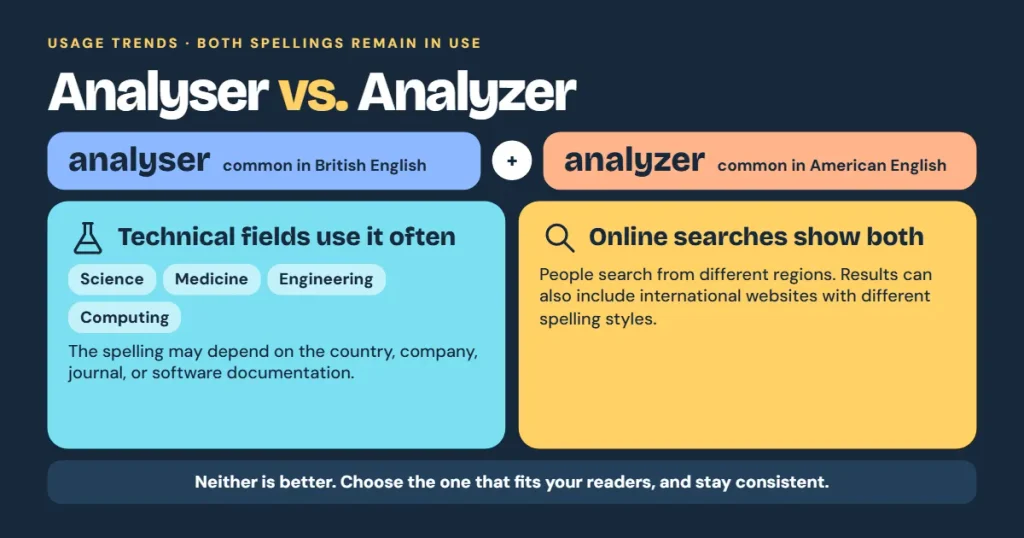
Both spellings remain in use today. Analyser is common in British English, while analyzer is common in American English.
Technical fields such as science, medicine, engineering, and computing use the word often. The spelling may depend on the country, company, journal, or software documentation.
Online searches may show both forms because people search from different regions. Search results can also include international websites that use different spelling styles.
There is no need to treat one spelling as better than the other. The best choice is the one that fits your readers and stays consistent.
Metaphors and Similes
Analyser and analyzer are usually literal words. They name a person, device, or program that examines something. They are not common parts of everyday idioms.
However, writers can use them in creative ways.
Metaphor: “Her mind is an analyzer.”
This means she studies things carefully before making a choice.
Simile: “He worked like an analyzer, checking every small detail.”
This compares a person to a tool that examines information.
Metaphor: “The software became an analyser of human habits.”
This means the software studied patterns in people’s actions.
These are creative uses, not fixed expressions. The spelling still depends on the English style you follow.
Connotative Meaning
Both words have a neutral meaning. They do not usually show a positive or negative feeling on their own.
Positive Meaning
They may suggest care, skill, or accuracy in a suitable context.
- The analyzer helped the team find the answer.
- The analyser gave the doctor useful results.
Negative Meaning
They may suggest too much checking when used in a critical or creative way.
- He acted like an analyzer and questioned every small detail.
- She became an analyser of every word her friend said.
These examples show the writer’s attitude. The words themselves are not negative.
Neutral Meaning
In science and technology, both words usually have a simple, factual meaning.
- The analyzer measured the gas.
- The analyser checked the data.
Idioms and Proverbs
There are no widely used English idioms or proverbs built around analyser or analyzer. Still, related sayings can explain why careful study matters.
“Look before you leap.”
Meaning: Think before you act.
Example: The team checked the analyzer’s results before making a decision.
“The devil is in the details.”
Meaning: Small details can cause problems.
Example: The analyser found a small error that others had missed.
Literature and Movies
The words analyser and analyzer are mainly used in science, technology, and technical writing. They are not known as the main subjects of famous books or films.
However, the idea of analyzing evidence appears in many stories.
Literature
In detective fiction, characters often study clues and facts to solve a mystery. For example, The Hound of the Baskervilles by Arthur Conan Doyle was published in 1902. Sherlock Holmes examines evidence to understand what happened.
Movies
The film The Imitation Game (2014), a British-American historical drama, shows codebreaking and careful analysis during World War II. It illustrates the value of studying patterns and information.
Why This Difference Matters
Correct spelling helps readers understand your writing and trust your work. If you write for a British audience, analyser will usually look more familiar. For American readers, analyzer is the usual choice.
This matters in school essays, research papers, company reports, websites, and technical guides. A spelling change does not alter the meaning, but it can make a document look inconsistent.
The difference also teaches an important lesson about English: more than one spelling can be correct. English has regional forms, and writers should understand them instead of treating one as an error.
For learners, the easiest rule is to match the spelling to the audience. Then use that style throughout the text.
Usefulness in Daily Life
You may see these words in many everyday settings:
- At school: A student may use an analyzer to study data.
- At work: A team may use an analyser to check product quality.
- In science: A lab may use one to test a sample.
- In computing: A code analyzer can help find errors.
- In healthcare: Some devices analyze samples or body measurements.
- Online: A website may offer a tool that analyzes text or website traffic.
Situational Preference
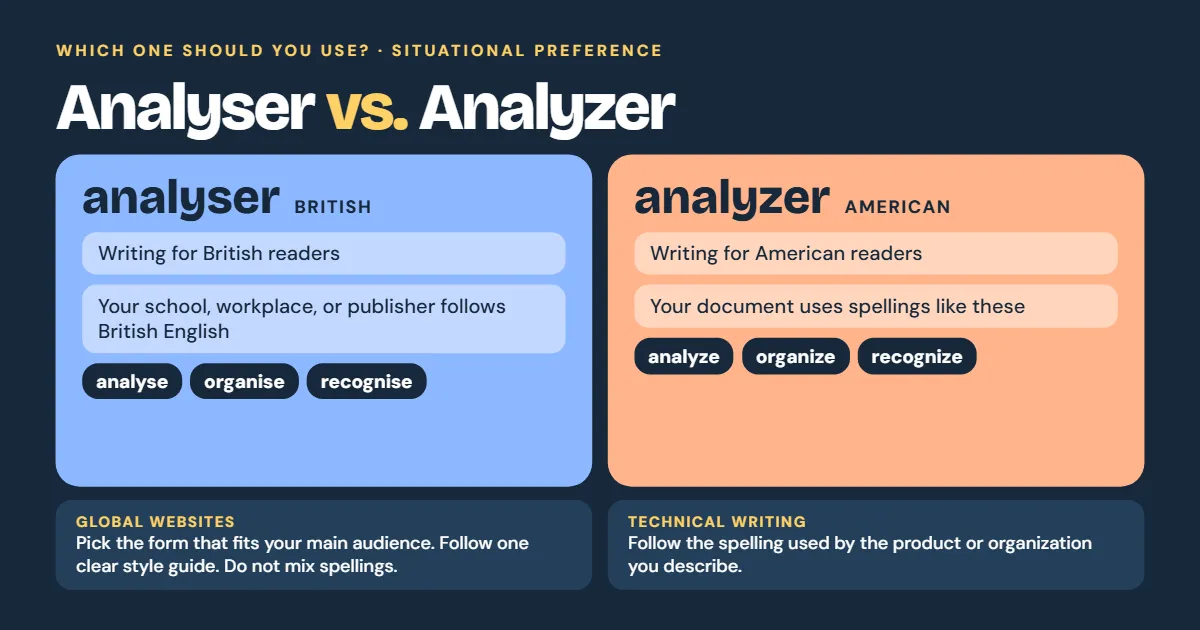
Use analyser when writing for British readers, or when your school, workplace, or publisher follows British English. It also fits documents that use spellings such as analyse, organise, and recognise.
Use analyzer when writing for American readers. It fits documents that use analyze, organize, and recognize.
For global websites, choose the form that best fits your main audience. If your readers come from many countries, follow one clear style guide. Do not change spellings just to use both forms. In technical writing, also follow the spelling used by the product or organization you are describing.
What People Ask About Analyser or Analyzer
1. Is analyser or analyzer correct?
Both are correct. Analyser is the standard British spelling, while analyzer is the standard American spelling.
2. Do analyser and analyzer mean the same thing?
Yes. Both refer to a person, tool, or program that examines something.
3. How do you pronounce analyser and analyzer?
They have the same basic pronunciation. Regional accents may change the final sound, especially the “r.”
4. Which spelling should I use in the UK?
Use analyser in British English unless a specific style guide says otherwise.
5. Which spelling should I use in the US?
Use analyzer in American English.
6. What is the plural of analyser and analyzer?
The British plural is analysers. The American plural is analyzers.
7. Is analyzer a noun or a verb?
Analyzer is a noun. The related verb is analyze in American English and analyse in British English.
Conclusion
Analyser and analyzer have the same meaning but different spellings. Analyser is the standard spelling in British English, while analyzer is the standard spelling in American English. Both words describe a person, tool, or program that examines something carefully. You may see them in science, medicine, computing, research, and daily work. When choosing between these words, think about your readers and follow the spelling style they expect. Use analyser for British English and analyzer for American English. Remember that neither spelling is wrong. The most important rule is to stay consistent throughout your writing. This simple habit helps make your schoolwork, business reports, and website articles clear and professional.

I’m Samia Jamshaid, an English language specialist, SEO specialist, digital publisher, and researcher. I create clear, accurate, and well-researched content on English grammar, vocabulary, word meanings, and language comparisons, helping readers understand and use English with confidence.











1 thought on “Analyser or Analyzer: Meaning, Spelling, and Examples”