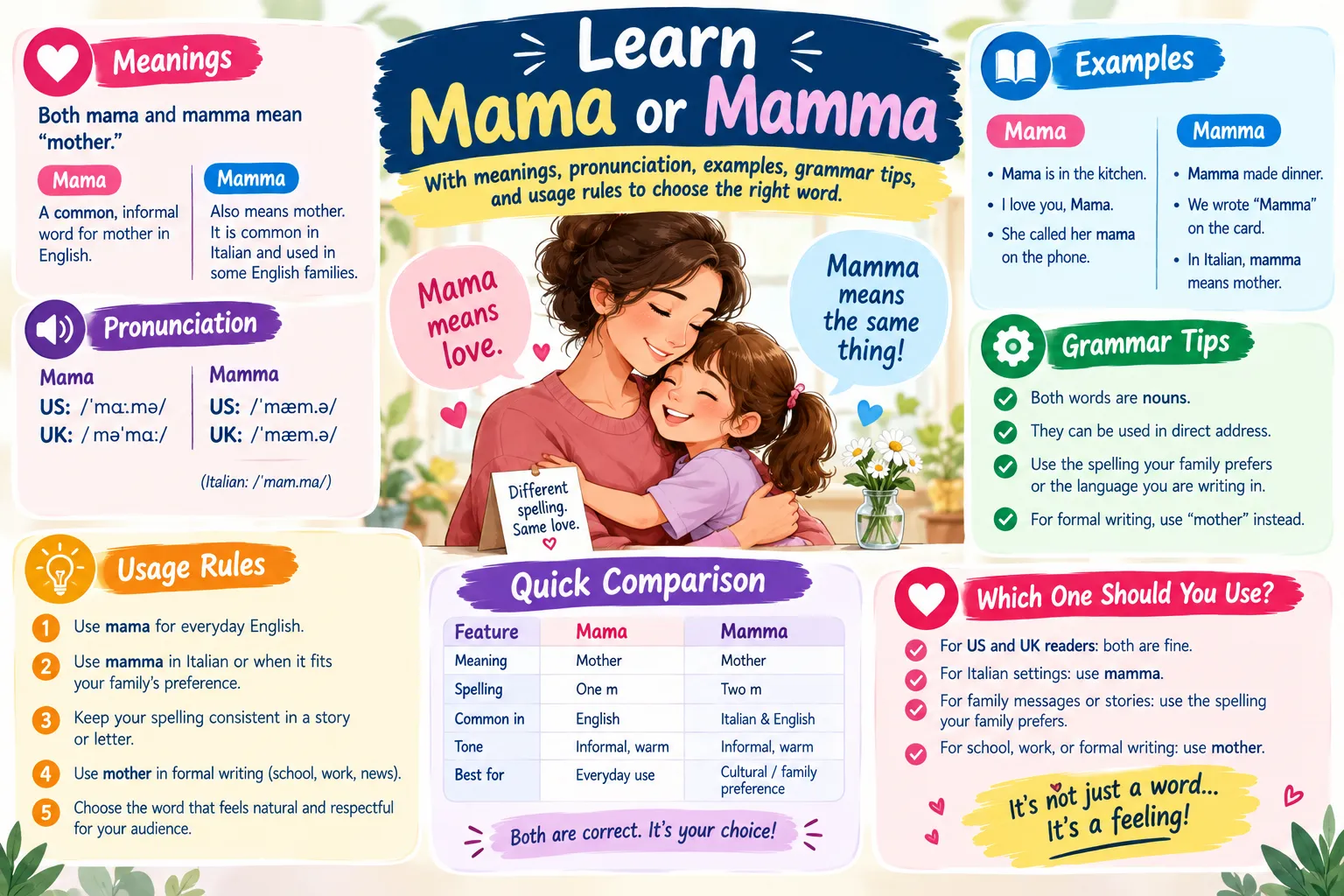
Mama and mamma both mean mother, but their spelling and use can vary by family, language, and place.
Imagine a small child calling for their mother after waking up. The child may say, “Mama, where are you?” Another child may write “Mamma” in a card for Mother’s Day. Both forms can express love and closeness.
People often search for “mama or mamma” because the words look almost the same. They want to know which spelling is correct and which one they should use. The answer depends on the setting. Mama is a widely used informal word for mother in English. Mamma is also an accepted form, and it is common in some languages and communities, including Italian.
Both words can sound warm, caring, and personal. They are often used by children, parents, and family members. You may see them in stories, songs, messages, and everyday talks. However, a family may prefer one spelling over the other.
This guide explains the meaning, pronunciation, grammar, and use of both words. It also gives simple examples to help you choose the right form.
Pronunciation
The exact sound can vary by accent and language. These are common English pronunciations.
- Mama — US: /ˈmɑː.mə/ or /ˈmæm.ə/
- Mama — UK: /məˈmɑː/ or /ˈmæm.ə/
- Mamma — US: Often /ˈmæm.ə/
- Mamma — UK: Often /ˈmæm.ə/
Difference Between Mama and Mamma
1. Spelling
Mama has one m in the middle. Mamma has two. Both forms are accepted, but the preferred form depends on the language and setting.
Examples:
- Mama, can you help me?
- Mamma, I made you a card.
2. Meaning
Both words can mean “mother.” They are often used in a loving or informal way.
Examples:
- My mama makes the best soup.
- Her mamma came to visit.
3. Common Use
Mama is widely used in English-speaking families. Mamma is also used in English, but it is especially familiar in Italian and some other language settings.
Examples:
- The baby called for mama.
- In Italian, a child may call their mother “mamma.”
4. Family Preference
Some families choose mama. Others prefer mamma. A family’s choice may come from culture, language, or habit.
Examples:
- I have called her Mama since I was young.
- We write Mamma on our family cards.
5. Use in Direct Speech
Both words can be used when speaking directly to a mother. The choice depends on the speaker’s normal word for her.
Examples:
- Mama, look at my drawing!
- Mamma, please read this story.
6. Use in Writing
Both forms appear in stories, poems, letters, and personal messages. Writers often choose the form that fits the character or family.
Examples:
- “Mama is waiting for us,” said the child.
- “Mamma will be home soon,” she told her brother.
7. Cultural Links
Mama is used in many countries and languages. Mamma has a strong link with Italian and is also used by some English-speaking families.
Examples:
- The child called her mother Mama.
- The Italian word for mother is mamma.
8. Tone and Feeling
Both words can sound loving and familiar. Neither word is always more loving than the other.
Examples:
- Mama gave me a warm hug.
- Mamma held the baby close.
9. Use in Formal Writing
Neither word is usually the best choice for formal reports or academic writing. In those settings, mother is often more suitable.
Examples:
- Informal: Mama is picking me up.
- Formal: My mother will pick me up.
10. Which Spelling Should You Choose?
Choose the form used by your family, the language you are writing in, or the style of your story. If you have no special reason to use mamma, mama is a widely understood choice in English.
Examples:
- Use Mama if that is the name your family prefers.
- Use Mamma when it fits an Italian setting or a family’s chosen spelling.
You May Also Like https://orchoice.com/analyser-or-analyzer/
Nature and Behaviour of Mama and Mamma
Mama
Mama is a noun. It is an informal word for mother. It can also be used as a name when speaking directly to her.
Examples:
- Mama is making dinner.
- I love you, Mama.
The word often sounds friendly and close. However, its exact feeling depends on the speaker and situation.
Mamma
Mamma is also a noun. It means mother in some English-speaking settings and is the usual Italian word for mother.
Examples:
- Mamma is waiting outside.
- Buona festa della mamma means “Happy Mother’s Day” in Italian.
In English writing, mamma may be used to show a family’s preference, a cultural setting, or a character’s background.
Why People Get Confused About Mama and Mamma
People get confused because the two words look and sound very similar. Both can mean mother, and both can be used in loving family talk.
The extra m in mamma makes the spelling look different, but it does not always create a clear difference in English meaning. Some people learn mama at home, while others learn mamma from family members or another language.
People may also see both spellings in books, films, songs, and online posts. This can make them wonder if one is wrong.
The simple rule is to check the language and setting. Both can be correct. Use the spelling that matches your family, audience, or writing style.
Comparison Table
| Feature | Mama | Mamma |
| Meaning | Mother | Mother |
| Part of speech | Noun | Noun |
| Spelling | One middle “m” | Double middle “m” |
| English use | Widely used | Used in some communities |
| Italian use | Not the standard Italian spelling | Standard Italian word |
| Tone | Often warm and informal | Often warm and informal |
| Direct address | Yes | Yes |
| Formal writing | Usually use “mother” instead | Usually use “mother” instead |
| Family preference | Accepted | Accepted |
| Best choice | When it suits the setting | When it suits the setting |
The Origin of Mama and Mamma
Words like mama and mamma are linked to the simple sounds babies often make when they begin to speak. The sounds m and a are easy for many young children to produce. Similar forms for mother appear in many languages around the world.
Mama is used in many languages and cultures. It has become a common informal word for mother in English. It can appear in family talk, children’s stories, songs, and personal writing.
Mamma is the standard Italian word for mother. It is also used by some English speakers, often because of family tradition or cultural influence. In Italian, the double m is part of the normal spelling and pronunciation.
The two words have related sounds and meanings, but they do not have one single spelling rule across all languages. The language and community help decide which form is most natural.
British vs American English
Both mama and mamma can appear in British and American English. There is no simple rule that says one spelling belongs only to the UK and the other only to the US.
In both places, mama is widely understood as an informal word for mother. Mamma may appear in family writing, cultural settings, or references to Italian.
Examples:
- US English: Mama is waiting by the door.
- UK English: Mama is waiting by the door.
- Italian setting: La mamma è a casa. (“Mum is at home.”)
In formal British or American writing, mother is often the safer choice. In a personal message or a story, either mama or mamma may fit.
Which One Should You Use?
Choose the word that fits your audience and setting.
- For everyday English: Mama is a widely understood choice.
- For an Italian setting: Use mamma when writing in Italian.
- For family messages: Follow the spelling your family uses.
- For stories: Choose the form that fits the character’s background and voice.
- For school or work: Use mother if you need a more formal tone.
If you are writing for readers around the world, mama is a clear and familiar choice. But mamma is not automatically wrong. It can be the better choice when it reflects a family’s tradition or the language being used.
Common Mistakes
Mistake 1: Thinking Mamma Is Always Wrong
Incorrect idea: “Mamma is never correct.”
Better: Both spellings are used. Mamma is the standard Italian word for mother.
Mistake 2: Thinking the Words Always Have Different Meanings
Incorrect idea: “Mama means one thing, but mamma means something else.”
Better: In many English settings, both mean mother.
Mistake 3: Using Either Word in Every Formal Document
Less suitable: “My mama will attend the meeting.”
More formal: “My mother will attend the meeting.”
Mistake 4: Ignoring Family Preference
If someone writes “Mamma” on a card or in a message, do not change it without a reason. It may be the spelling they prefer.
Mistake 5: Mixing Spellings Without a Reason
If you are writing a story, keep the spelling consistent unless the change has a purpose.
Example:
- Consistent: Mama called me home. Mama made dinner.
- Also consistent: Mamma called me home. Mamma made dinner.
Everyday Usage Examples
In Emails
- Hi, Mama. I will call you tonight.
- Dear Mamma, thank you for your kind letter.
For a work email, mother is usually more suitable.
On Social Media
- Happy Mother’s Day to my amazing mama!
- A special day with Mamma and the whole family.
In News and Articles
Writers usually use mother in news reports unless Mama or Mamma is part of a name, quote, or story.
Examples:
- The mother spoke to reporters after the event.
- The child called out, “Mama!”
In Formal Writing
- Informal: My mama taught me to cook.
- Formal: My mother taught me to cook.
Both informal forms can be correct in personal writing. The best choice depends on the purpose and audience.
Usage Trends
Mama is widely understood in many parts of the world. It appears in family messages, songs, children’s books, and popular culture. It is also used in several languages.
Mamma remains common in Italian and in some families and cultural settings. English writers may use it to show a character’s background or to keep a family’s name.
Online searches for “mama or mamma” often come from people checking spelling. Others want to know which word sounds more natural in a message or story.
There is no single spelling that every family must use. The best choice depends on the language, culture, and person being addressed.
Metaphors and Similes
Mama and mamma are names for a mother, but they can also appear in warm, figurative writing. The meaning comes from the sentence, not from a special rule about the spelling.
Examples
- “Mama is my safe harbor.” This compares a mother to a place of safety.
- “Mamma is the heart of our home.” This suggests that she brings the family together.
- “Her voice was like a warm blanket.” This simile compares her voice to something comforting.
Connotative Meaning
Both words can carry feelings beyond the basic meaning of “mother.” Their tone depends on the speaker and situation.
Positive Meaning
They may suggest love, comfort, care, and trust.
Examples:
- Mama always listens to me.
- Mamma made me feel safe.
Negative Meaning
The words themselves are not usually negative. However, they can appear in a sad or angry sentence.
Examples:
- He shouted for Mama when he felt afraid.
- She missed Mamma after their goodbye.
The feeling comes from the event, not from the spelling.
Neutral Meaning
Both can simply identify a mother or show how someone addresses her.
Examples:
- Mama is in the kitchen.
- Mamma will arrive at six.
Idioms and Proverbs
There are no major English idioms that depend on choosing mama over mamma. However, several common sayings relate to mothers and family care.
Like Mother, Like Daughter
This means a daughter may act like her mother.
Example: “They both love gardening. Like mother, like daughter.”
A Mother’s Love
This phrase describes the care and love a mother gives.
Example: “She cared for every child with a mother’s love.”
Home Is Where the Heart Is
This means that home is where you feel love and belonging.
Example: “I feel at peace with Mama. Home is where the heart is.”
These sayings can work in writing about family life. They do not require one spelling over the other.
Literature and Movies
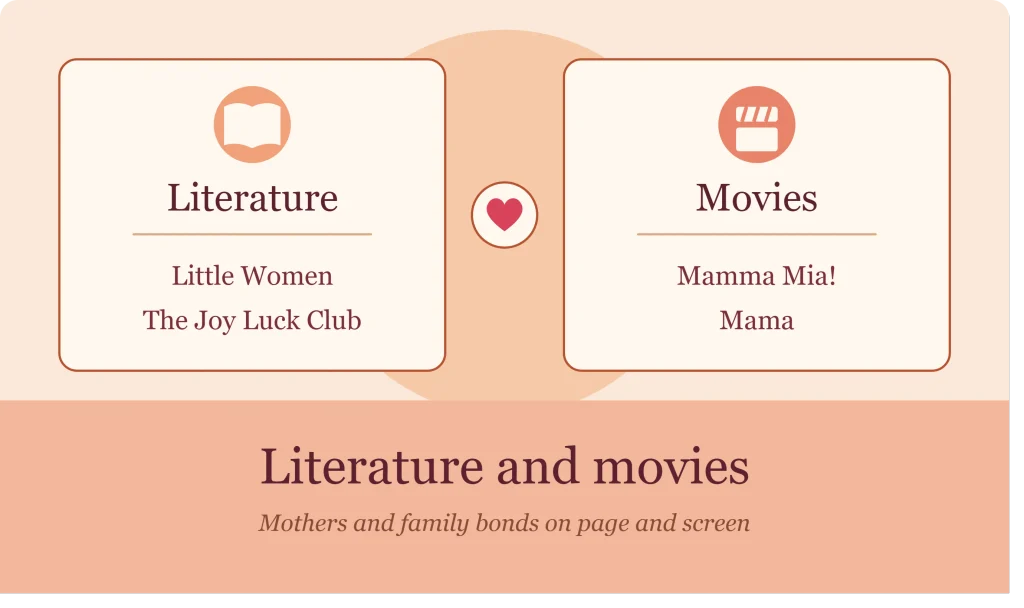
Mothers and family bonds appear in many books and films. The words mama and mamma may appear in dialogue, song titles, or character names.
Literature
- Little Women — Louisa May Alcott, 1868–1869: This classic novel follows four sisters and their family life. It often explores care, love, and growing up.
- The Joy Luck Club — Amy Tan, 1989: This novel explores the bonds between Chinese American mothers and daughters. It shows how language and culture shape family life.
Movies
- Mamma Mia! (2008, United Kingdom and United States): This musical film uses the Italian spelling mamma in its title.
- Mama (2013, Canada and Spain): This horror film uses Mama in its title.
Why This Difference Matters
Knowing the difference helps you write in a clear and respectful way. A person may have a strong connection to the name they use for their mother. Changing that spelling may make a message feel less personal.
For English learners, both words are useful examples of how language can vary by culture and family. The spelling difference does not always change the meaning. It can show a language choice, a family tradition, or a writer’s style.
This matters in stories, greeting cards, social media posts, and translations. In formal writing, mother is often the clearest choice. In personal writing, mama and mamma can both work.
The main lesson is simple: check the setting, respect the preferred spelling, and keep your writing consistent.
Usefulness in Daily Life
You may use mama or mamma when talking to your mother, writing a card, sending a message, or telling a family story. The word you choose can reflect the name you use at home.
For example, you might write, “Mama, thank you for helping me.” Another person might write, “Mamma, I miss you.” Both messages are easy to understand.
When writing for school or work, use mother if you need a more formal tone. When writing a story, use the spelling that fits the character and setting.
Situational Preference
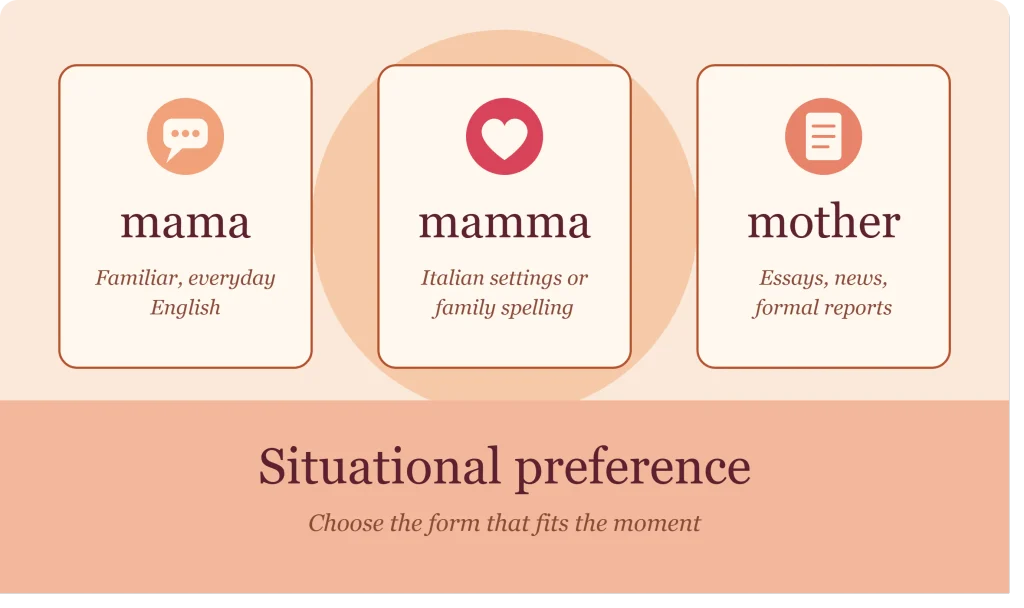
Use mama when you want a familiar and widely understood informal word for mother in English. Use mamma when it is your family’s preferred spelling or when you are writing in an Italian setting. In a story, choose the form that fits the character’s background. In a greeting card or personal message, either form may work if it feels natural to the person receiving it. For school essays, news, and formal reports, mother is often better. The most important rule is to respect personal choice and use the spelling that suits the situation.
Common Questions and Answers
1. Is mama or mamma correct?
Both are accepted forms. Mama is widely used in English, while mamma is also used in English and is the standard Italian word for mother.
2. Do mama and mamma mean the same thing?
In many English settings, yes. Both can mean mother. The preferred spelling depends on the family, language, and context.
3. Is mamma an Italian word?
Yes. Mamma is the standard Italian word for mother. It is commonly used in Italian family life.
4. Is mama more common in American English?
Mama is widely understood and used in American English, but usage varies by family and region. It is not limited to the United States.
5. Which word should I use in a formal essay?
Use mother in most formal essays. Use mama or mamma when the informal tone is important or when the word appears in a quote or title.
6. Can I write “I love you, Mamma”?
Yes. It is correct if Mamma is the name or form of address you use. Capitalize it when using it like a name.
7. Should I use mama or mamma in a Mother’s Day card?
Use the spelling your mother prefers. Both can work in a personal card, and the message matters more than the choice between the two spellings.
Conclusion
Mama and mamma are both used to mean mother, but the best choice depends on the language, family, and setting. Mama is a widely understood informal word in English. Mamma is also accepted and is the standard Italian word for mother. Both can express love, care, and closeness. Neither spelling is always better than the other.
If you are writing a personal message, card, or story, choose the form that feels natural and respects the person’s preference. If you are writing in Italian, use mamma. For a school essay, news report, or formal document, mother is often the better choice. The words may look different, but in many English settings, their meaning is the same. Remember that spelling can reflect culture and family tradition. By checking the context and keeping your choice consistent, you can use both words with confidence. The simple rule is to choose the spelling that fits your audience and purpose.

I’m Samia Jamshaid, an English language specialist, SEO specialist, digital publisher, and researcher. I create clear, accurate, and well-researched content on English grammar, vocabulary, word meanings, and language comparisons, helping readers understand and use English with confidence.


1 thought on “Mama or Mamma: Meaning and Key Differences”