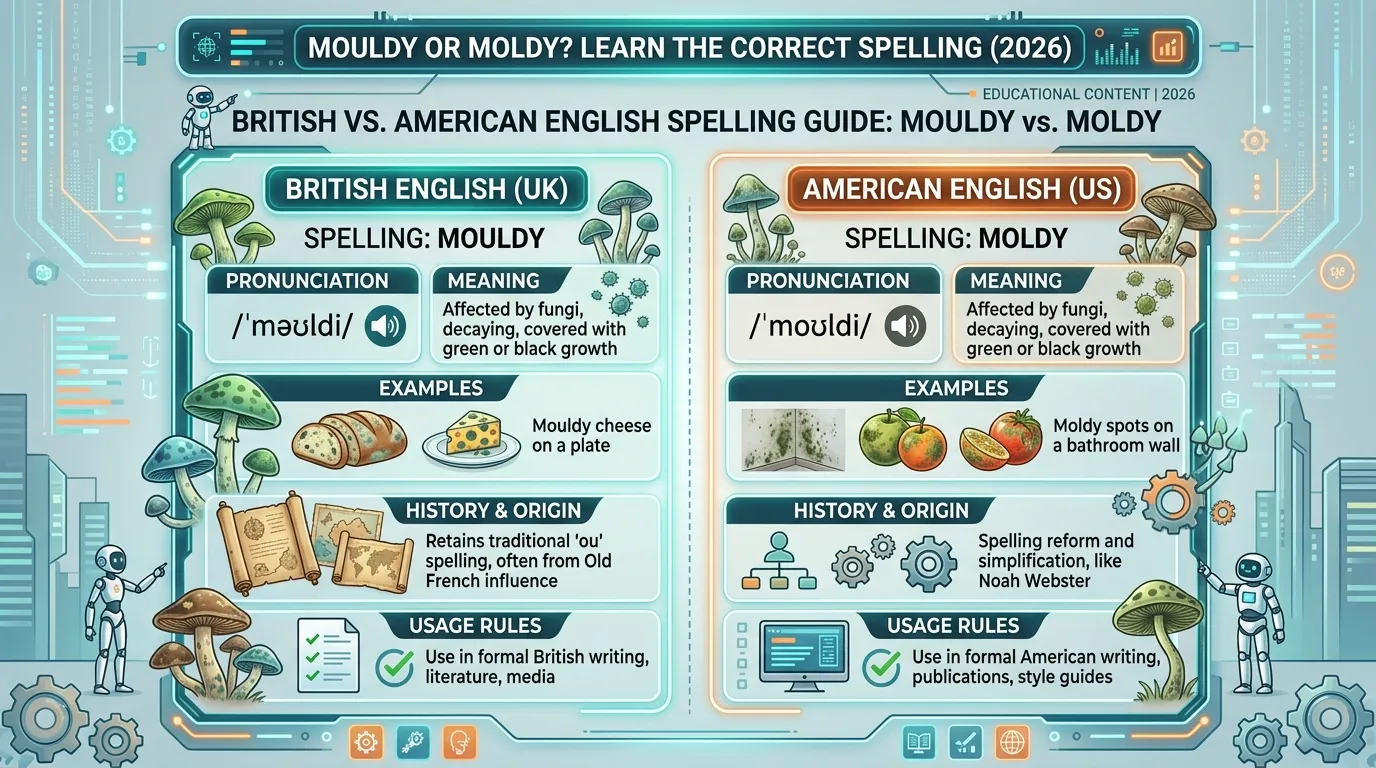
Mouldy and moldy are both correct spellings, but mouldy is more common in British English, while moldy is more common in American English.
Imagine opening a loaf of bread and seeing green spots on it. You might say, “The bread is mouldy.” If you are in the United States, you would usually write, “The bread is moldy.” This small spelling difference can make English learners wonder which word is correct.
So, is it mouldy or moldy? The answer depends mainly on the type of English you are using. Both words have the same basic meaning. They describe something that has mould or mold growing on it. You may use the word for bread, cheese, walls, clothes, books, or other damp items.
The difference becomes easier when you remember the related nouns. British English usually uses mould, while American English usually uses mold. Their adjective forms are mouldy and moldy.
In this guide, we will explain mouldy or moldy, their meanings, spelling, pronunciation, history, common mistakes, and everyday use.
Mouldy or Moldy?
Both mouldy and moldy are correct.
- Mouldy is the usual British spelling.
- Moldy is the usual American spelling.
- Both mean affected by or covered with mould/mold.
- The meaning does not change because of the spelling.
British English: mould → mouldy
American English: mold → moldy
Pronunciation
The two words sound almost the same, but the vowel sound can differ by accent.
| Word | British English | American English | Syllables |
| Mouldy | /ˈməʊldi/ | — | 2 |
| Moldy | — | /ˈmoʊldi/ | 2 |
What Does Mouldy Mean?
Mouldy means covered with or affected by mould.
Mould is a type of fungus. It can grow in warm, damp, or wet places. It may appear on food, walls, clothes, books, and other materials.
Examples
- The bread is mouldy.
- We found mouldy food in the fridge.
- The old book had a mouldy smell.
- The bathroom wall became mouldy.
What Does Moldy Mean?
Moldy has the same meaning as mouldy.
It is the usual American spelling of the word.
Examples
- The bread is moldy.
- We found moldy food in the fridge.
- The old book had a moldy smell.
- The bathroom wall became moldy.
Difference Between Mouldy and Moldy
1. Spelling
The main difference is the spelling.
- British English: mouldy
- American English: moldy
Examples:
- The cheese is mouldy.
- The cheese is moldy.
2. British English
Mouldy is the usual spelling in British English.
Examples:
- The bread has gone mouldy.
- The damp room smells mouldy.
3. American English
Moldy is the usual spelling in American English.
Examples:
- The bread has gone moldy.
- The damp room smells moldy.
4. The meaning is the same
Both words describe something affected by mould or mold.
Examples:
- The mouldy cheese was thrown away.
- The moldy cheese was thrown away.
5. The noun changes too
The noun also has two common spellings.
- British: mould
- American: mold
Examples:
- There was mould on the wall.
- There was mold on the wall.
6. Other related words change too
The spelling difference appears in related words.
| British English | American English |
| mould | mold |
| mouldy | moldy |
| moulding | molding |
| moulds | molds |
Examples:
- The wall has mould.
- The wall has mold.
7. It can describe food
Both words are often used for food that has fungus growing on it.
Examples:
- The bread is mouldy.
- The bread is moldy.
8. It can describe buildings
Mould or mold can grow in damp rooms.
Examples:
- The bathroom ceiling is mouldy.
- The bathroom ceiling is moldy.
9. It can describe old items
Books, clothes, and other old items can become mouldy or moldy when stored in damp places.
Examples:
- The old clothes smelled mouldy.
- The old books smelled moldy.
10. Neither spelling is wrong
The correct choice depends on your audience.
Examples:
- For a UK reader, write mouldy.
- For a US reader, write moldy.
Explore Related Topics https://orchoice.com/eminent-or-imminent/
Nature and Behaviour of Mouldy and Moldy
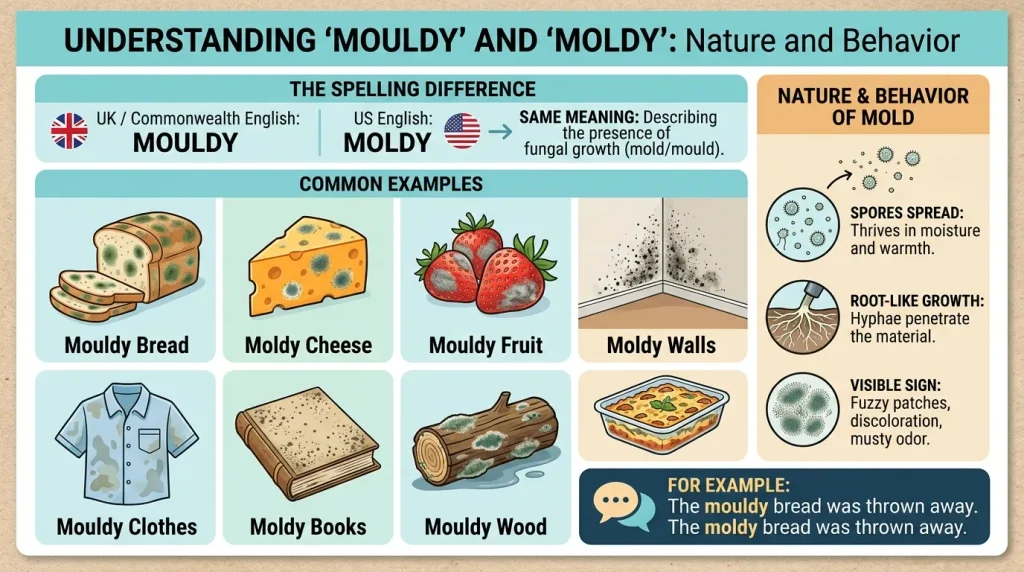
Mouldy and moldy are adjectives.
They describe the condition of something.
They are often used with things such as:
- bread
- cheese
- fruit
- walls
- clothes
- books
- wood
- food
For example:
- The mouldy bread was thrown away.
- The moldy bread was thrown away.
Why Are People Confused?
People often get confused because mould and mold are both correct words.
The problem is the extra u.
British English keeps the spelling mould.
American English normally uses the shorter spelling mold.
The same pattern appears in other words, such as:
- colour / color
- favour / favor
- behaviour / behavior
There is also another reason for confusion. Mold/mould has more than one meaning. It can refer to fungus, but it can also mean a form used to shape something.
Comparison Table
| Feature | Mouldy | Moldy |
| Main use | British English | American English |
| Word type | Adjective | Adjective |
| Meaning | Affected by mould | Affected by mold |
| Related noun | mould | mold |
| Related form | moulding | molding |
| Syllables | 2 | 2 |
| Pronunciation | /ˈməʊldi/ | /ˈmoʊldi/ |
| Meaning difference | None | None |
| Best choice for US readers | No | Yes |
| Best choice for UK readers | Yes | No |
The Origin of Mouldy
Mouldy is formed from the noun mould and the suffix -y.
The suffix -y helps make an adjective. It can show that something has a certain quality or condition.
The Oxford English Dictionary records an early use of this adjective from 1572. This shows that mouldy has been part of English for more than 450 years.
In modern English, mouldy is mainly linked with British spelling, while moldy is the usual American form.
British vs American English
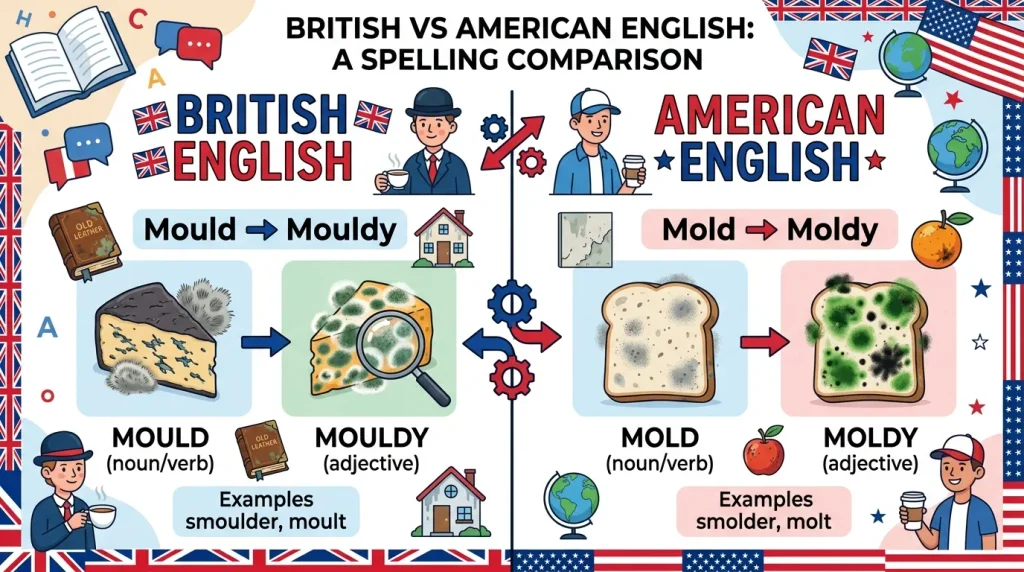
The main difference is simple:
British English:
mould → mouldy
American English:
mold → moldy
The same regional spelling pattern applies to related words.
| British | American |
| mould | mold |
| mouldy | moldy |
| moulding | molding |
| moulds | molds |
If you are writing for one country, try to stay consistent.
For example, a British article should normally use mould and mouldy. An American article should normally use mold and moldy.
Which One Should You Use?
Choose the spelling based on your readers.
Use Mouldy When:
- You are writing for a British audience.
- Your website uses British English.
- You are writing for many Australian or New Zealand readers.
- You want to follow British spelling.
Example:
The old bread became mouldy.
Use Moldy When:
- You are writing for an American audience.
- Your website uses American English.
- You want to follow standard US spelling.
Example:
The old bread became moldy.
The most important rule is be consistent.
Common Mistakes
Mistake 1: Thinking one spelling is wrong
Incorrect idea: “Mouldy is wrong because moldy is the correct spelling.”
Correct: Both are correct. The usual spelling depends on the variety of English.
Mistake 2: Using the spelling based on meaning
Incorrect idea: “Mould is for fungus, but mold is for a shape.”
Correct: Both mould and mold can have both meanings.
Mistake 3: Mixing spelling styles
For example, using mould, moldy, and moulding in the same British English article can look inconsistent.
Try to use one spelling style throughout.
Mistake 4: Thinking mouldy and moldy have different meanings
They do not have a basic meaning difference.
Mouldy and moldy both mean affected by mould or mold.
Everyday Usage Examples
Food
- The bread is mouldy.
- The bread is moldy.
- Throw away the mouldy cheese.
- Throw away the moldy cheese.
Home
- There is mould on the bathroom wall.
- There is mold on the bathroom wall.
- The room smells mouldy.
- The room smells moldy.
Books and Clothes
- The old book became mouldy.
- The old book became moldy.
- These clothes smell mouldy.
- These clothes smell moldy.
Mould and Mold Can Have Other Meanings
The words mould and mold are not only about fungus.
They can also mean a form used to shape something.
For example:
- Pour the mixture into the mould.
- Pour the mixture into the mold.
As verbs, mould and mold can mean to shape something.
For example:
- The artist moulded the clay.
- The artist molded the clay.
They can also be used in a figurative way.
For example:
- Her teachers helped mould her character.
- Her teachers helped mold her character.
Usage Trends
The choice between mouldy and moldy mainly follows regional English.
Mouldy is strongly associated with British English.
Moldy is strongly associated with American English.
Other English-speaking countries may show a mix of spelling styles. This is especially important when discussing countries such as Canada, where British and American spelling patterns can both appear.
Metaphors and Similes
The word mould/mold can also appear in figurative language.
For example:
He is in the mold of his father.
This means he is similar to his father in style or character.
In British English, the sentence may be written:
He is in the mould of his father.
Here, mold/mould does not mean fungus. It refers to a particular type, form, or character.
Connotative Meaning
Mouldy and moldy usually have a negative feeling.
They can suggest:
- poor condition
- dampness
- age
- dirt
- decay
- something that should be removed
For example:
The moldy bread looked unsafe to eat.
The word can also be used in a figurative way to describe something old or stale.
Idioms and Common Expressions
The noun mold/mould appears in several expressions.
Break the Mold
Break the mold means to do something in a new or unusual way.
British English may use:
Break the mould
Fit the Mold
Fit the mold means to match a usual type or pattern.
British English may use:
Fit the mould
In the Mold of
This means similar to a person or style.
American:
She is a leader in the mold of her mother.
British:
She is a leader in the mould of her mother.
Literature and Movies
The word mold/mould can appear in books, films, news stories, and everyday speech.
Writers may use it in two ways:
- To describe real fungal growth.
- To describe a type, pattern, or style.
Why This Difference Matters
Knowing the difference helps you write for the right audience.
If you write for readers in the United States, moldy will look natural.
If you write for readers in the United Kingdom, mouldy will look natural.
Using the wrong regional form is usually not a serious grammar error. However, consistent spelling makes your writing look cleaner and more professional.
This is especially useful for:
- blogs
- school work
- business writing
- websites
- books
- marketing content
Usefulness in Daily Life
You may see mouldy or moldy when reading about:
- food
- cleaning
- bathrooms
- damp homes
- old buildings
- books
- clothes
- storage
- home repairs
You may also see mould/mold when reading about cooking or manufacturing because a mould or mold can be used to shape an item.
Situational Preference
Your audience should guide your choice. If you write mainly for people in the United States, use moldy. If you write for British readers, use mouldy. Australian and New Zealand English also commonly use mouldy. In Canada, spelling can vary, so check the style used by your audience or publication. Most importantly, stay consistent. Do not switch between mouldy and moldy without a reason. Both forms are correct, so you do not need to worry about choosing a “wrong” word. You only need to choose the spelling that fits your type of English.
What People Ask About Mouldy or moldy
1. Is mouldy or moldy correct?
Both are correct. Mouldy is the usual British spelling, while moldy is the usual American spelling.
2. Is mouldy British or American?
Mouldy is the usual British spelling.
3. Is moldy American spelling?
Yes. Moldy is the usual American spelling.
4. Do mouldy and moldy mean the same thing?
Yes. Both mean affected by or covered with mould or mold.
5. Is mould the same as mold?
Yes. Mould and mold can refer to the same fungus. They can also have other meanings, such as a form used for shaping something.
6. Which spelling should I use in the US?
Use moldy for standard American English.
7. Which spelling should I use in the UK?
Use mouldy for standard British English.
Conclusion
Mouldy or moldy are both correct spellings. The main difference is regional. Mouldy is the usual British form, while moldy is the usual American form. Both words describe something affected by mould or mold, such as bread, cheese, walls, books, or clothes. The same spelling pattern appears in related words, such as mould/mold and moulding/molding. It is also important to remember that mould and mold can have other meanings. They can refer to a form used to shape something or to the act of shaping something. The meaning does not decide the spelling. Your audience does. Use mouldy for British-style English and moldy for American English. If you are writing for a mixed audience, choose one style and use it consistently.

I’m Samia Jamshaid, an English language specialist, SEO specialist, digital publisher, and researcher. I create clear, accurate, and well-researched content on English grammar, vocabulary, word meanings, and language comparisons, helping readers understand and use English with confidence.







1 thought on “Mouldy or Moldy: British vs American Spelling Explained 2026”