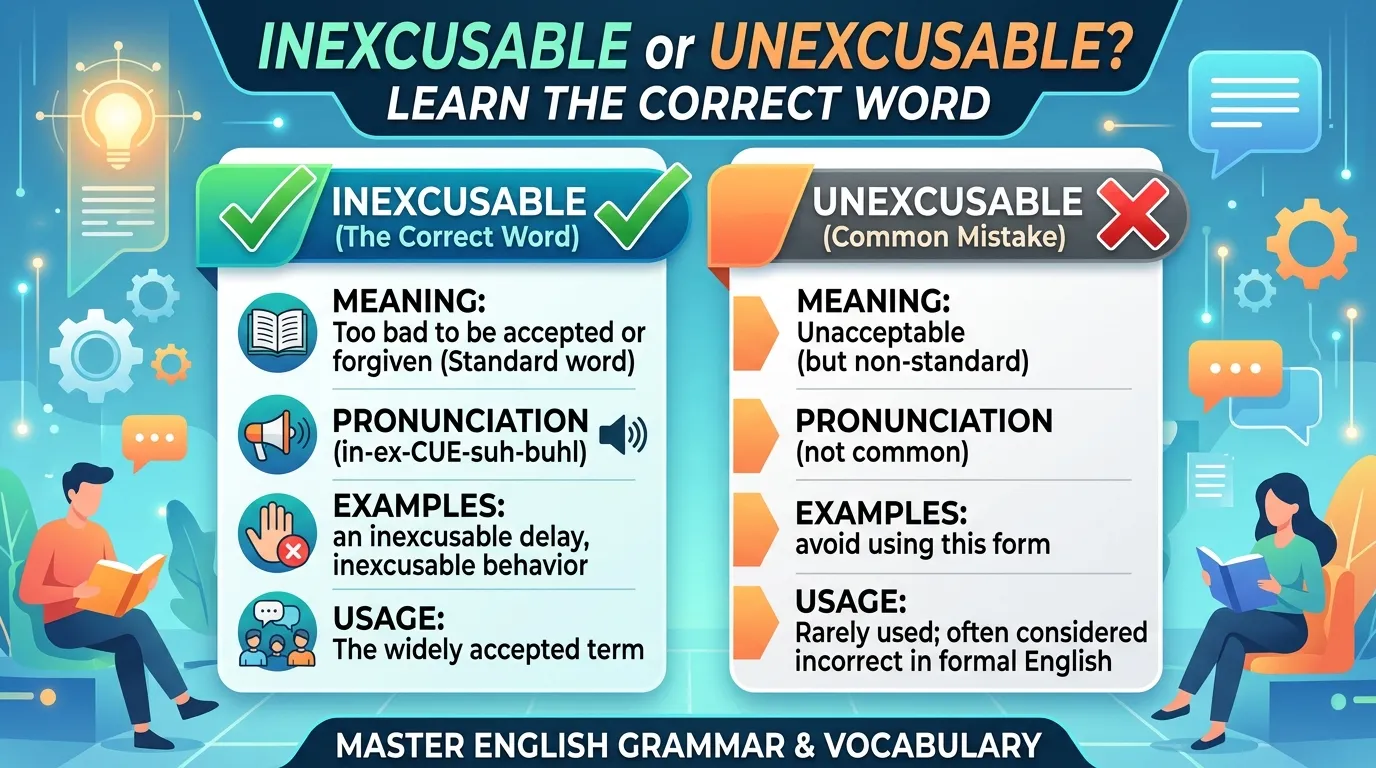
Quick answer: Inexcusable is the standard and much more common word. Unexcusable is rare but can mean the same thing.
Imagine someone makes a serious mistake at work. Your manager says, “That behavior is inexcusable.” You may later wonder if unexcusable would also be correct. Both words can appear in English, but they are not used equally often.
Inexcusable means something is too bad to accept, forgive, or justify. It is the normal choice in modern English. Unexcusable has the same basic meaning, but it is uncommon and may sound unusual to many readers.
So, if you are writing an email, school paper, report, or website, inexcusable is the safer choice. This guide explains the difference between inexcusable or unexcusable, their meanings, grammar, history, examples, and common mistakes.
Pronunciation of Inexcusable and Unexcusable
| Word | US Pronunciation | UK Pronunciation | Syllables |
| Inexcusable | /ˌɪnɪkˈskjuːzəbl/ | /ˌɪnɪkˈskjuːzəbl/ | 5 |
| Unexcusable | /ˌʌnɪkˈskjuːzəbl/ | /ˌʌnɪkˈskjuːzəbl/ | 5 |
The main stress in inexcusable falls on the third syllable.
Difference Between Inexcusable or Unexcusable
The main difference is common usage, not basic meaning.
1. Inexcusable is the standard form
Inexcusable is the normal word used in modern English.
Examples:
- His rude behavior was inexcusable.
- Being late without a reason was inexcusable.
2. Unexcusable is very uncommon
Unexcusable exists, but people rarely use it today.
Examples:
- The error was described as unexcusable.
- Such behavior may seem unexcusable to some people.
3. Their basic meanings are the same
Both words can describe something that cannot be excused or justified.
Examples:
- The insult was inexcusable.
- The insult was unexcusable.
The first sentence sounds much more natural to most modern readers.
4. Inexcusable is better for formal writing
Use inexcusable in school, work, news, and professional writing.
Examples:
- The delay was inexcusable.
- The report called the mistake inexcusable.
5. Unexcusable may sound unusual
A reader may understand unexcusable, but it may feel strange because it is rarely used.
Examples:
- The conduct was inexcusable.
- The conduct was unexcusable.
The first sentence is the better choice.
6. Inexcusable is much more common
Modern English strongly favors inexcusable.
Examples:
- The manager called the mistake inexcusable.
- The teacher said the behavior was inexcusable.
7. Both are adjectives
Both words can describe a person, action, mistake, behavior, or event.
Examples:
- It was an inexcusable mistake.
- It was an unexcusable mistake.
Again, inexcusable is the natural choice.
8. Inexcusable has common related forms
You may also see:
- inexcusably — in a way that cannot be excused
- inexcusableness — the quality of being inexcusable
Examples:
- He acted inexcusably.
- The inexcusableness of the act was clear.
9. Unexcusable is not the same as unexcused
This is an important difference.
Unexcused is a common word. It often describes an absence without an accepted reason.
Examples:
- She had an unexcused absence.
- He received a warning for unexcused leave.
Do not use unexcusable when you mean unexcused.
10. Choose inexcusable in most cases
If you are unsure which word to use, choose inexcusable.
Examples:
- His actions were inexcusable.
- Such treatment is completely inexcusable.
Keep exploring https://orchoice.com/mouldy-or-moldy/
Nature and Behaviour of the Words
Inexcusable has a strong meaning. It says that something cannot reasonably be forgiven or justified.
It is often used for:
- rude behavior
- serious mistakes
- unfair treatment
- harmful actions
- poor conduct
- serious failures
Unexcusable has the same basic idea, but it is much less common.
Why Are Inexcusable and Unexcusable Confused?
The confusion comes from the prefixes in- and un-.
Both prefixes can make a word negative.
For example:
- possible → impossible
- happy → unhappy
- correct → incorrect
- fair → unfair
Because of this pattern, some people naturally create unexcusable from excusable.
However, inexcusable became the standard form in modern English.
Comparison Table
| Feature | Inexcusable | Unexcusable |
| Part of speech | Adjective | Adjective |
| Meaning | Cannot be excused or justified | Cannot be excused or justified |
| Common today? | Yes | Rare |
| Standard modern choice? | Yes | No |
| Formal writing | Recommended | Usually avoid |
| Everyday English | Common | Uncommon |
| US English | Inexcusable | Rare |
| UK English | Inexcusable | Rare |
| Related adverb | Inexcusably | Rare |
| Best choice | Yes | Usually no |
Origin of Inexcusable
Inexcusable comes from excuse with the negative prefix in-.
The word excuse has roots in Latin. It entered English through French and developed into the word we use today.
The prefix in- gives the word a negative meaning.
So, in simple terms:
excusable → inexcusable
This means something that cannot be excused.
British vs American English
There is no major spelling difference between British and American English here.
Both usually use:
inexcusable
For example:
- British English: That behavior was inexcusable.
- American English: That behavior was inexcusable.
The word has the same basic meaning in both forms of English.
Which One Should You Use?
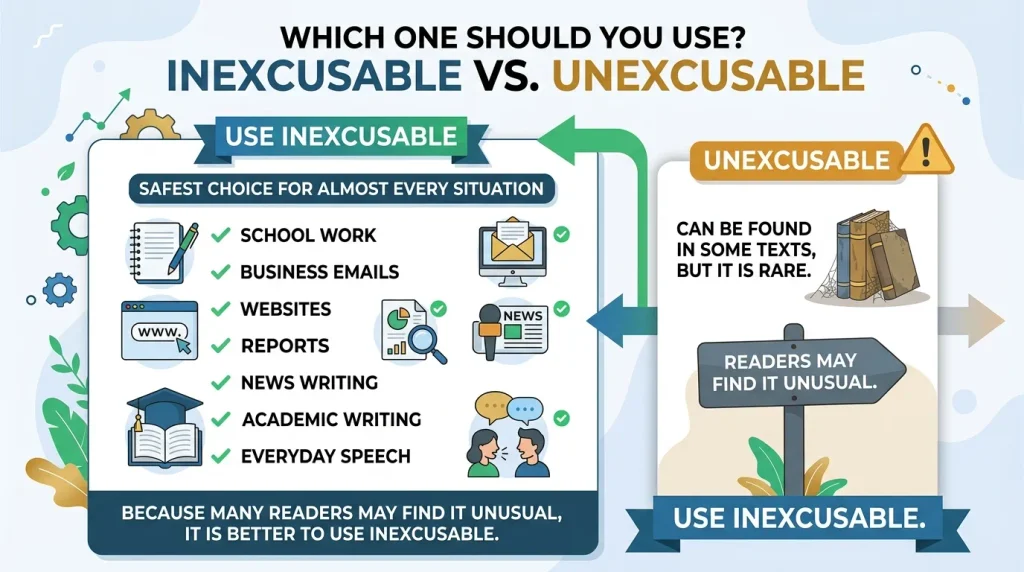
Use inexcusable in almost every modern writing situation.
It is the safest choice for:
- school work
- business emails
- websites
- reports
- news writing
- academic writing
- everyday speech
Unexcusable can be found in some texts, but it is rare. Because many readers may find it unusual, it is better to use inexcusable.
Common Mistakes
Incorrect:
His rude behavior was unexcusable.
Better:
His rude behavior was inexcusable.
Incorrect:
The student had an inexcusable absence.
If you mean the student was absent without permission, use unexcused.
Correct:
The student had an unexcused absence.
Spelling mistake:
inexcuseable
Correct:
inexcusable
There is no extra e after excuse.
Everyday Usage Examples
Here are some simple examples of inexcusable:
- His rude comment was inexcusable.
- The delay was inexcusable.
- Cheating in an exam is inexcusable.
- The company called the error inexcusable.
- Her treatment of the staff was inexcusable.
- It is inexcusable to treat people that way.
- The mistake was serious but not intentional.
- The coach said the player’s behavior was inexcusable.
Usage Trends
Inexcusable is far more common than unexcusable in modern English.
You are much more likely to see inexcusable in books, newspapers, websites, school work, and everyday speech.
Unexcusable may appear in older writing or rare modern use. It is not the usual choice for most readers.
This is why inexcusable should be your default word.
Metaphors and Similes
Inexcusable is sometimes used in strong comparisons.
Examples:
- His behavior was as clear as a red warning sign and completely inexcusable.
- The mistake stood out like a broken rule and seemed inexcusable.
Connotative Meaning
Inexcusable has a strong negative feeling.
It does more than say that something is wrong. It says that there is no good reason to forgive or accept it.
For example:
- The delay was disappointing.
This is fairly mild.
- The delay was inexcusable.
This is much stronger.
So, use inexcusable when you want to show serious disapproval.
Idioms and Common Phrases
There are several common phrases with inexcusable.
Inexcusable behavior
Means behavior that cannot be accepted.
His inexcusable behavior upset everyone.
Inexcusable mistake
Means a mistake that should not have happened.
The company called it an inexcusable mistake.
Completely inexcusable
Used to make the criticism stronger.
The way he treated her was completely inexcusable.
Absolutely inexcusable
Another strong form.
The delay was absolutely inexcusable.
In Literature and Movies
Inexcusable often appears when a character strongly judges an action.
It can describe:
- betrayal
- cruelty
- lies
- unfair treatment
- serious mistakes
- harmful choices
Writers use it because the word quickly shows strong disapproval.
Unexcusable is much less likely to appear in modern popular writing.
Why This Difference Matters
Choosing the right word helps your writing sound natural.
If you use inexcusable, most English readers will understand your meaning at once. It is the normal modern form.
If you use unexcusable, readers may understand you, but some may think it is a mistake or unusual wording.
This matters most in formal writing. A school paper, business report, or professional email should use familiar words.
When there is no need to use the rare form, inexcusable is the better choice.
Usefulness in Daily Life
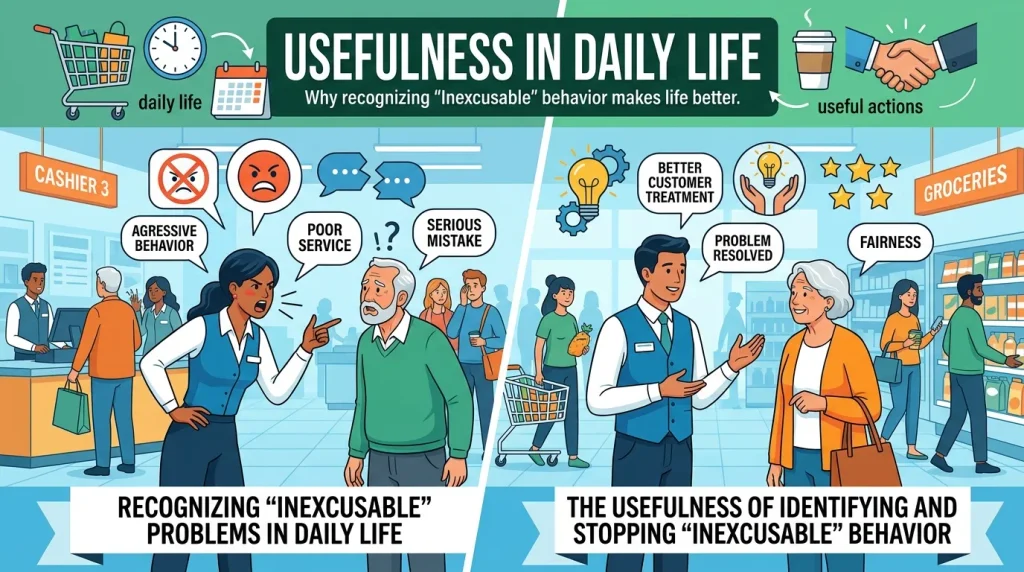
You may use inexcusable when talking about serious problems or behavior.
For example, you might say:
- That kind of behavior is inexcusable.
- The mistake was inexcusable.
- It is inexcusable to lie about this.
- His treatment of the customer was inexcusable.
Situational Preference
Use inexcusable when you want a clear and strong word for something that cannot be forgiven or justified. It works well in daily speech, school writing, business writing, and formal documents. Use unexcusable only when you have a reason to keep an unusual or historical form. Most readers will find inexcusable more natural. Also remember that unexcused is different. Use unexcused for things such as an absence without permission. When you mean “too bad to forgive,” inexcusable is the best choice.
Common Questions About Inexcusable or Unexcusable
1. Is inexcusable or unexcusable correct?
Inexcusable is the standard and much more common form. Unexcusable is rare but can carry the same basic meaning.
2. Is unexcusable a real word?
Yes, unexcusable is an attested word. However, it is uncommon in modern English.
3. What does inexcusable mean?
Inexcusable means too bad to accept, forgive, or justify.
4. Is inexcusable used in American English?
Yes. Inexcusable is used in both American and British English.
5. What is the opposite of inexcusable?
The direct opposite is excusable. Depending on the context, justifiable may also work.
6. What is the adverb of inexcusable?
The adverb is inexcusably.
Example: He acted inexcusably.
7. Is unexcusable the same as unexcused?
No. Unexcusable can mean “not excusable,” while unexcused often means “without an accepted reason,” especially for an absence.
Conclusion
Inexcusable or unexcusable can confuse English learners because both forms can express the idea of something that cannot be excused. However, inexcusable is the standard and much more common word in modern English. It means too bad to accept, forgive, or justify. Unexcusable is an attested but uncommon form, so it may sound unusual to many readers. For school work, business writing, websites, reports, and everyday English, inexcusable is the best choice. Also, do not confuse unexcusable with unexcused, which is a common word used for things such as an absence without an accepted reason. When you want a clear, natural, and widely accepted word, remember the simple rule: excusable → inexcusable.

I’m Samia Jamshaid, an English language specialist, SEO specialist, digital publisher, and researcher. I create clear, accurate, and well-researched content on English grammar, vocabulary, word meanings, and language comparisons, helping readers understand and use English with confidence.







1 thought on “Inexcusable or Unexcusable: Meaning, Spelling & Examples 2026”