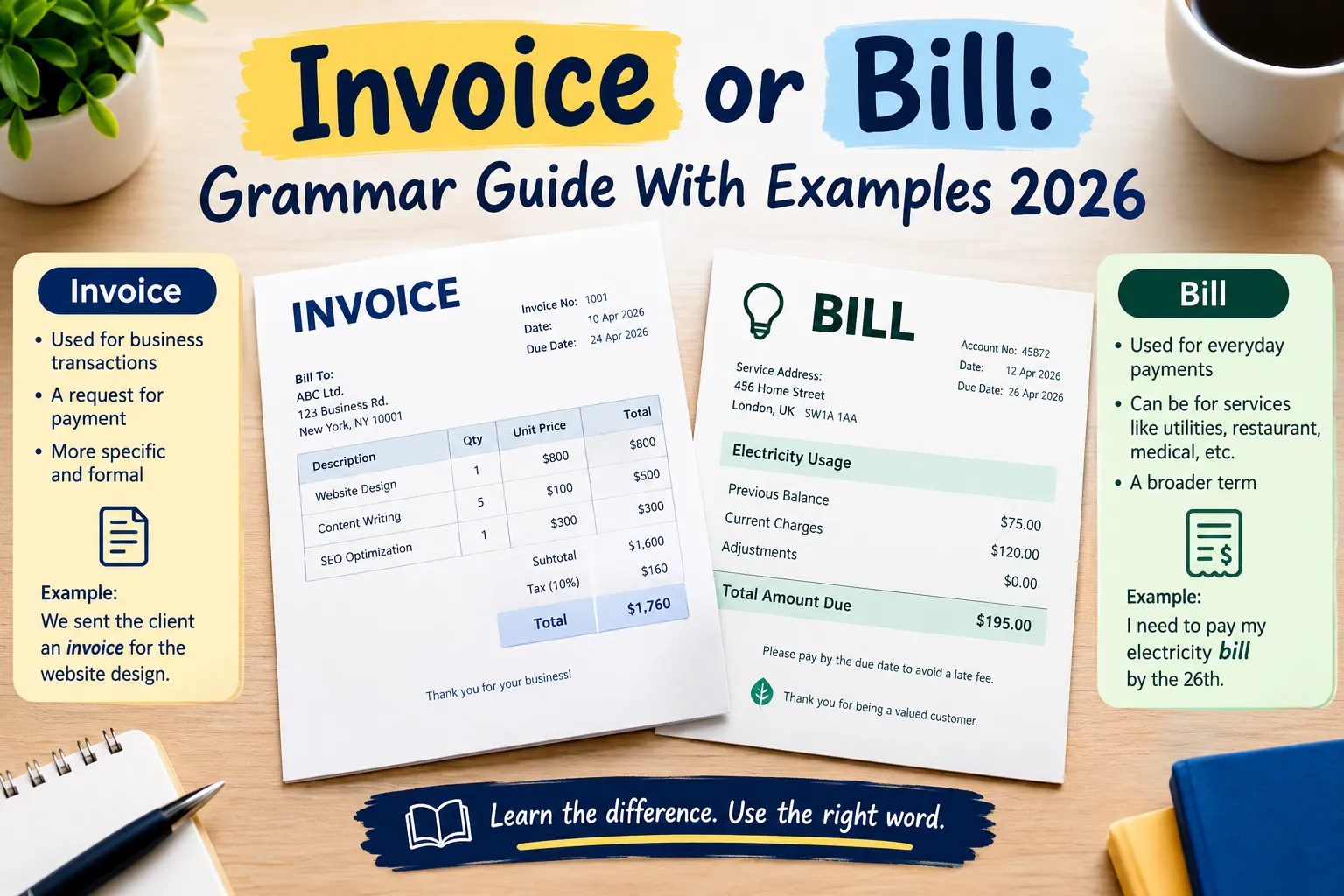
An invoice is usually a detailed payment document used in business, while a bill is a more general request for payment.
Imagine that you hire a designer to make a website for your small business. After the work is finished, the designer sends you a document with the service, price, date, and payment details. This is an invoice. Now imagine that you eat at a restaurant and ask for the amount you owe. You usually ask for the bill. Both words are linked to payment, so it is easy to wonder about invoice or bill.
An invoice lists goods or services and their costs and asks for payment. A bill can also show what you owe for goods or services, but it is a broader everyday word. Cambridge defines an invoice as a list of goods or work and their cost, while a bill can be a request for payment or the document showing that request.
People search for invoice or bill because both words can describe money that a customer must pay. The right choice often depends on the setting, the level of detail, and the type of transaction.
Pronunciation
| Word | US Pronunciation | UK Pronunciation |
| invoice | /ˈɪn.vɔɪs/ | /ˈɪn.vɔɪs/ |
| bill | /bɪl/ | /bɪl/ |
Difference Between Invoice and Bill
1. Business use
Invoice is strongly linked to business transactions. A company may send an invoice to a customer after providing goods or services.
Bill is also correct in business, but it is more general.
Examples:
- The designer sent an invoice for the website.
- The supplier sent an invoice to the company.
2. Everyday use
Bill is very common in everyday life. People talk about phone bills, electricity bills, restaurant bills, and medical bills.
Invoice sounds more business-focused.
Examples:
- I need to pay my phone bill.
- The waiter brought us the bill.
3. Level of detail
An invoice often gives detailed information about the transaction. It may list products, services, prices, dates, taxes, and payment terms.
A bill may be much simpler.
Examples:
- The invoice lists each service separately.
- The restaurant bill shows the meal total and service charge.
4. Freelancers and clients
Freelancers often use invoice when asking clients for payment.
Bill is possible, but invoice is more common in this setting.
Examples:
- The writer sent an invoice for the article.
- The photographer sent an invoice after the event.
5. Restaurants
In restaurants, bill is a very common word.
In British English, customers often say:
Could we have the bill, please?
Examples:
- Could we have the bill, please?
- The waiter brought the bill.
6. Utilities
People normally use bill for regular household services.
Common examples include:
- electricity bill
- gas bill
- phone bill
- water bill
- internet bill
Examples:
- I paid my electricity bill.
- Our phone bill was higher this month.
7. Payment terms
An invoice often includes payment terms.
For example, a business may state that payment is due within 30 days.
Examples:
- The invoice says payment is due in 30 days.
- Please pay the invoice by the due date.
8. Record keeping
An invoice is commonly kept as a business record.
Businesses may use invoices to track sales, payments, customers, and accounts.
Examples:
- Please keep a copy of the invoice.
- The accountant checked the unpaid invoices.
Examples:
- I keep my electricity bills.
- The company recorded all repair bills.
9. Who sends it
A seller or service provider usually sends an invoice to a customer or client.
A business, service provider, restaurant, doctor, or utility company can send a bill.
Examples:
- The web developer sent an invoice to the client.
- The hospital sent a bill to the patient.
10. Formal vs everyday language
Invoice often sounds more formal and professional.
Bill is shorter and more natural in everyday conversation.
Examples:
- Please find the attached invoice.
- I need to pay this bill.
You may also like https://orchoice.com/scepter-or-sceptre/
Nature and Behaviour of Invoice and Bill
Nature of “Invoice”
An invoice is mainly a business payment document.
It normally connects:
- a seller or service provider
- a customer or client
- goods or services
- a price
- payment information
An invoice can be sent by email or as a paper document.
For example:
The marketing agency sent an invoice for its monthly services.
An invoice can also be used as a business record. Cambridge describes an invoice as a document that lists goods or work, gives their cost, and asks for payment.
Nature of “Bill”
A bill has a wider meaning.
It can mean a request for payment for:
- food
- electricity
- gas
- telephone service
- medical care
- repairs
- goods
- other services
Examples:
I paid the electricity bill.
We asked for the restaurant bill.
Why People Get Confused About Invoice and Bill
People confuse invoice and bill because both can describe a document or request that tells someone how much money they owe.
In some business settings, the words can overlap.
For example:
The company sent me an invoice.
and
The company sent me a bill.
Both can communicate that money is owed.
The difference is often about context and common usage rather than a completely different type of payment.
Invoice is more specific and business-focused.
Bill is broader and more common in everyday situations.
Comparison Table
| Feature | Invoice | Bill |
| Main meaning | Detailed request for payment | General request for payment |
| Business use | Very common | Common |
| Everyday use | Less common | Very common |
| Restaurant | Less common | Very common |
| Utilities | Less common | Very common |
| Freelancers | Very common | Possible |
| Client work | Very common | Possible |
| Payment terms | Often included | May be included |
| Itemized details | Often detailed | Can be detailed or simple |
| Business record | Common | Also possible |
| Formal business writing | Common | Also possible |
| American English | Common | Common |
| British English | Common | Common |
| Other meanings | Few common meanings | Many other meanings |
Similarity Between Invoice and Bill
Both can:
- show an amount owed
- relate to goods or services
- ask for payment
- include payment information
- be sent electronically or on paper
The Origin of Invoice and Bill
Origin of “Invoice”
The word invoice entered English in the 16th century. Etymonline traces the noun to the 1550s and connects it with French envoi, meaning a sending or dispatch of goods. The modern business sense developed around a written account of goods and their prices. The verb invoice appeared later, in the late 17th century.
Today, invoice is closely connected with business records and payment requests.
Origin of “Bill”
Bill has a much older and wider history. It developed into English with several meanings, including a written statement or document. Over time, it became widely used for a written request for payment.
For example:
- a bill for food
- a bill for electricity
- a bill in Parliament or Congress
- a dollar bill
- a bird’s bill
British vs American English
The words invoice and bill are used in both British and American English.
The main difference is often the situation in which bill is used.
Restaurant use
In British English:
Could we have the bill, please?
In American English:
Could we have the check, please?
Business use
Both British and American English use invoice for business payment documents.
Examples:
British English:
Please send the invoice by Friday.
American English:
Please send the invoice by Friday.
Utility payments
Both varieties commonly use bill:
I paid my electricity bill.
I paid my electricity bill.
Spelling
There is no standard US/UK spelling difference between invoice and bill.
Which One Should You Use?
| Use “Invoice” for | Use “Bill” for |
|---|---|
| Sending a client a payment request | Restaurants |
| Charging for freelance work | Electricity |
| Listing products or services | Gas |
| Giving payment terms | Phone services |
| Keeping a sales record | Medical costs |
| Formal business transactions | Everyday expenses |
Common Mistakes
Mistake 1: Using “invoice” for every payment
Incorrect: I need to pay my electricity invoice.
Correct: I need to pay my electricity bill.
Bill is more natural for a regular household utility payment.
Mistake 2: Thinking “invoice” and “receipt” mean the same thing
Incorrect: I sent the customer a receipt before asking for payment.
Correct: I sent the customer an invoice before asking for payment.
An invoice asks for payment.
A receipt normally confirms that payment has been made.
The UK government also clearly distinguishes an invoice from a receipt: an invoice asks for payment, while a receipt acknowledges payment.
Mistake 3: Using “bill” when a business document is meant
This is not always grammatically wrong, but invoice may be clearer.
Better:
Please send your invoice to our accounts department.
Mistake 4: Confusing a restaurant bill with an invoice
In normal restaurant conversation, bill is more natural.
Could we have the bill, please?
In American English, check is also common.
Mistake 5: Thinking a bill is always informal
Bill is also used in formal business contexts.
For example:
The company received a large repair bill.
Cambridge Business English uses bill for a document showing how much is owed for goods or services.
Everyday Usage Examples
In Emails
Invoice:
Please find attached our invoice for the services provided in March.
Bill:
Please let me know if you have any questions about the bill.
In Social Media
Bill:
My phone bill was much higher this month!
Invoice:
I finally sent my first freelance invoice.
In News
Bill:
The company faces a large bill for repairs.
Invoice:
The business reviewed the invoices before making payment.
In Formal Writing
Invoice:
Payment must be made within 30 days of the invoice date.
Bill:
The customer must settle the outstanding bill.
Usage Trends
The two words continue to have different common uses.
Bill is strongly connected with everyday payments. People often talk about:
- phone bills
- electricity bills
- medical bills
- restaurant bills
- repair bills
Invoice is strongly connected with business transactions. It is common in:
- accounting
- freelance work
- sales
- consulting
- business services
- online business
- supplier payments
Digital business has also made invoice common in phrases such as electronic invoice, online invoice, and invoice management.
At the same time, bill remains a broad everyday word. Cambridge lists both everyday and business uses for the word.
There is no single global rule that says one word must replace the other. Usage depends on the type of payment and the English variety.
Metaphors and Similes
Both invoice and bill can appear in figurative language.
“Foot the bill”
This means to pay for something.
The company agreed to foot the bill for the event.
Here, bill does not simply mean a piece of paper. It means the cost that someone must pay.
“A bill for happiness”
The word invoice can also be used creatively to describe an unusual cost.
Jonas Karlsson’s novel The Invoice uses an enormous invoice as part of its story about happiness and the cost of life.
Simile example
A writer might say:
The repair bill was like a mountain.
This is a simile. It compares the large cost to a mountain.
Another example
The invoice arrived like a storm.
This gives the invoice an emotional effect. It suggests sudden trouble.
Connotative Meaning
Invoice: neutral or professional
Invoice usually has a neutral or professional tone.
Please review the invoice.
It sounds organized and businesslike.
Bill: neutral or negative
Bill can be neutral:
I paid the electricity bill.
But it can sound negative when the amount is large:
We received a huge repair bill.
The negative feeling comes from the cost, not from the word bill itself.
Positive meaning
Neither word is normally positive by itself.
However, receiving a correct invoice can suggest that a business transaction is clear and organized.
Neutral meaning
Both words can simply describe a payment request.
The invoice is due on Friday.
The bill is due next week.
Idioms and Proverbs
Foot the bill
Meaning: Pay for something.
The company will foot the bill for the repairs.
Pick up the bill
Meaning: Pay the cost, often for a group.
Her father offered to pick up the bill.
Send someone the bill
This can be literal or figurative.
The company sent us the bill for the repairs.
The bill comes due
This phrase means that payment is now required.
We enjoyed the service, but now the bill has come due.
These expressions show why bill is much more common in everyday idioms than invoice.
Literature and Movies
Literature: The Invoice
Jonas Karlsson’s The Invoice is a work of literary fiction. The English edition was published in 2016. The story follows a man who receives an enormous invoice from a mysterious organization. The invoice becomes a way to explore happiness, money, and the value people place on life.
The book is a useful modern literary example because invoice is part of the central idea, not just a passing word.
Movie: The Pursuit of Happyness
The American film The Pursuit of Happyness was released in 2006. It follows Chris Gardner as he struggles with money, work, housing, and family responsibilities. Bills are part of the financial pressure shown in the story. Contemporary film coverage also describes bills piling up during Gardner’s difficult period.
Why This Difference Matters
Knowing the difference between invoice and bill helps you choose words that fit the situation.
A freelancer should know how to talk about an invoice when asking a client for payment.
A customer should know that a restaurant bill tells them how much they owe.
A person paying for electricity will usually talk about an electricity bill.
The distinction also matters in business writing. An invoice can contain important transaction details and payment terms. Using the right word can make an email or document sound clearer and more professional.
Usefulness in Daily Life
| Bill | Invoice |
|---|---|
| Phone bill | Business payment request |
| Water bill | Freelancer payment |
| Electricity bill | Professional services |
| Medical bill | Product sales |
| Restaurant bill | Service charges |
| Repair bill | Supplier transactions |
| Everyday expenses | Account management |
Situational Preference
Use invoice when you are talking about a formal business payment document. It works well for freelancers, companies, suppliers, consultants, and service providers. Use bill for common everyday payments, such as electricity, phone, medical, repair, and restaurant costs. In British English, bill is normal when asking for payment at a restaurant. In American English, check is also common in that setting. If you are writing a professional business email and asking a client to pay for completed work, invoice is usually the clearer choice. If you are simply talking about money you owe for a service, bill may sound more natural.
Common Questions About Invoice and bill
1. Is an invoice the same as a bill?
They can overlap. Both can refer to a request for payment. However, invoice is more specific and is strongly associated with business transactions, while bill is a broader everyday term.
2. Which is better: invoice or bill?
Neither word is always better. Use invoice for a formal business payment document. Use bill for many everyday payments, such as restaurant, utility, medical, and repair costs.
3. Is a restaurant payment called an invoice or a bill?
Bill is the normal word in British English. In American English, check is also very common.
4. Is an invoice proof of payment?
No. An invoice normally asks for payment. A receipt confirms that payment has been made.
5. Can I use “bill” for business?
Yes. Bill is also used in business and finance. However, invoice can be more precise when you mean a detailed business payment document.
6. Is “invoice” more formal than “bill”?
Usually, yes in business contexts. Invoice often sounds more professional and specific. Bill is more common in everyday speech.
7. Do British and American English use invoice differently?
Both use invoice for business payment documents. The bigger difference is the word used for restaurant payments: British English commonly uses bill, while American English commonly uses check.
Conclusion
Invoice and bill is mainly about context and level of specificity. An invoice is usually a detailed payment document used in business. It can list goods or services, prices, dates, taxes, payment terms, and the total amount owed. A bill is a broader word for money that someone owes and is very common in everyday situations, such as electricity bills, phone bills, medical bills, repair bills, and restaurant bills. Both words can overlap, especially in business, so the choice is not always a strict grammar rule. For professional business writing, invoice is often the clearer choice when asking a client or customer to pay for goods or services. For everyday payments, bill is often more natural. In British English, people commonly ask for the restaurant bill, while Americans often ask for the check.

I’m Samia Jamshaid, an English language specialist, SEO specialist, digital publisher, and researcher. I create clear, accurate, and well-researched content on English grammar, vocabulary, word meanings, and language comparisons, helping readers understand and use English with confidence.




1 thought on “Invoice or Bill: Grammar Guide With Examples 2026”