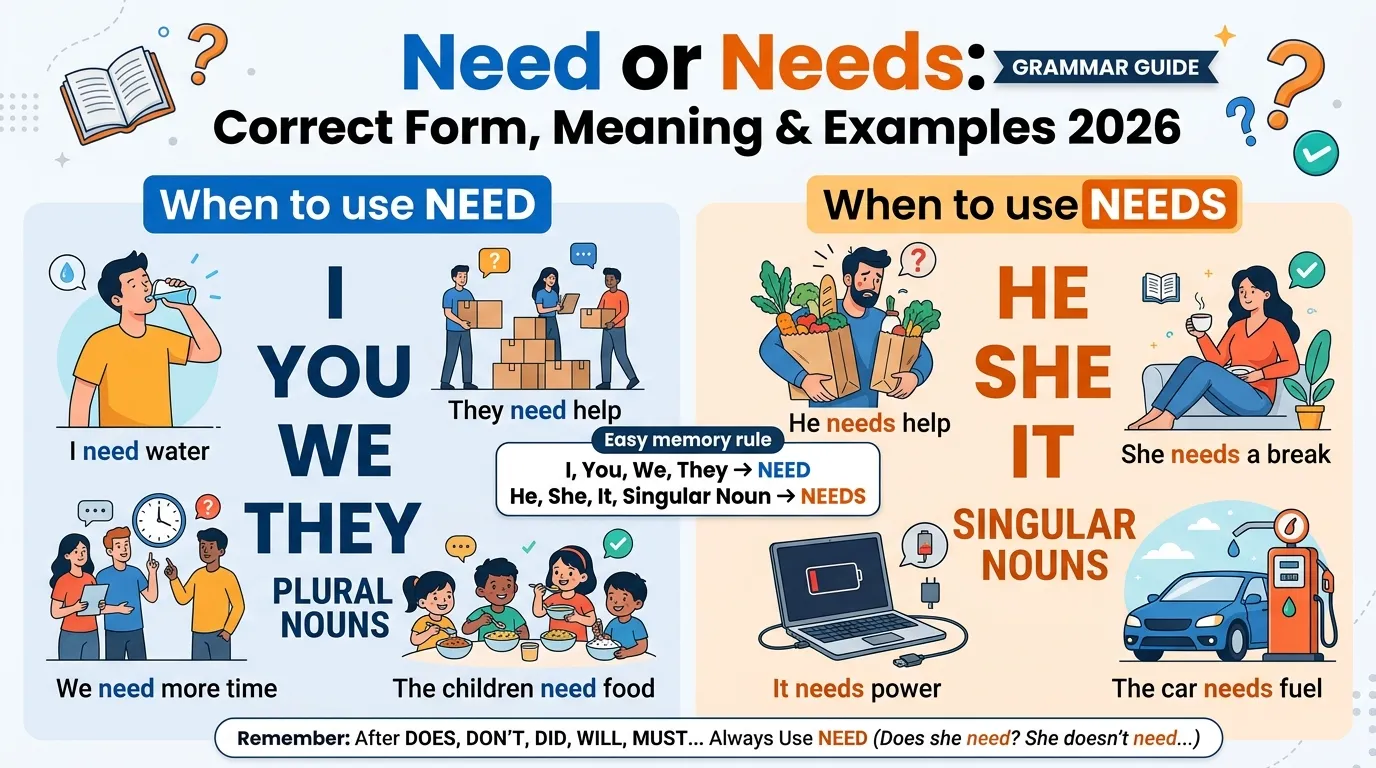
Need or needs? The correct choice depends on the subject of the sentence. Use need with I, you, we, and they. Use needs with he, she, it, and singular nouns in the simple present tense.
For example:
- I need more time.
- They need help.
- She needs more time.
- The car needs fuel.
The difference between need and needs is only one letter, but it can change the grammar of a sentence. This is why English learners often search for “need or needs,” “need vs needs,” and “when to use need or needs.”
In this guide, you will learn the meaning of need and needs, the main grammar rules, common mistakes, pronunciation, examples, British and American English usage, and useful expressions.
Need or Needs: Quick Answer
The basic need or needs grammar rule is easy:
| Subject | Correct Form | Example |
| I | need | I need help. |
| You | need | You need rest. |
| We | need | We need more time. |
| They | need | They need a car. |
| He | needs | He needs help. |
| She | needs | She needs rest. |
| It | needs | It needs power. |
| Singular noun | needs | The child needs food. |
| Plural noun | need | The children need food. |
Easy rule to remember
I, You, We, They → need
He, She, It → needs
What Does “Need” Mean?
Need means that something is necessary or required.
It can be used as a verb or a noun.
Need as a verb
As a verb, need means to require something.
Examples:
- I need water.
- We need more time.
- They need help.
- You need to study.
With he, she, or it, the verb changes to needs:
- He needs water.
- She needs help.
- The computer needs an update.
Need as a noun
As a noun, need means something that is necessary.
Examples:
- There is a need for more teachers.
- Food is a basic need.
- We have no need for extra chairs.
The plural form is needs:
- Children have different needs.
- The company understands its customers’ needs.
What Does “Needs” Mean?
It has two main uses in English.
Needs as a verb
Needs is the third-person singular form of need in the simple present.
Examples:
- She needs a break.
- He needs more information.
- The car needs fuel.
- The house needs repair.
Needs as a plural noun
Needs can also be the plural form of the noun need.
Examples:
- Everyone has different needs.
- We should understand our customers’ needs.
- The children’s needs are important.
Compare these two sentences:
The baby needs milk.
Here, needs is a verb.
The baby’s needs are simple.
Here, needs is a plural noun.
Need vs Needs: Main Difference
The main difference between need and needs is their grammatical form.
Need is used with:
- I
- you
- we
- they
- plural nouns
Needs is used with:
- he
- she
- it
- singular nouns
Examples:
- I need a pen.
- You need more practice.
- We need a plan.
- They need help.
- He needs a pen.
- She needs more practice.
- The student needs help.
- The students need help.
When to Use “Need”
Use need with I, you, we, and they in the simple present.
Through I
- I need some water.
- I need a new book.
- I need to leave.
With you
- You need more practice.
- You need a ticket.
- You need to be careful.
By using we
- We need more time.
- We need a better plan.
- We need to talk.
With they
- They need help.
- They need new computers.
- They need to work together.
When to Use “Needs”
Use needs with he, she, it, and singular nouns in the simple present.
With he
- He needs help.
- He needs a break.
- He needs to study.
With she
- She needs more time.
- She needs a new phone.
- She needs to rest.
Through it
- It needs water.
- It needs more power.
- It needs to be cleaned.
Through a singular noun
- The child needs food.
- My brother needs help.
- The car needs fuel.
- This computer needs an update.
Explore related topics https://orchoice.com/preferred-or-prefered/
Need or Needs After Does and Doesn’t
This is one of the most important rules when learning need or needs grammar.
After does or doesn’t, use need, not needs.
Correct:
- Does she need help?
- Does he need more time?
- She doesn’t need help.
- He doesn’t need to leave.
Incorrect:
- Does she needs help?
- He doesn’t needs help.
Why?
The word does already carries the third-person singular form. The main verb stays in its base form.
Compare:
Positive:
She needs help.
Question:
Does she need help?
Negative:
She doesn’t need help.
This same rule applies to did and didn’t:
- Did he need help?
- They didn’t need more time.
Not:
- Did he needed help?
- They didn’t needed more time.
Need After Modal Verbs
After modal verbs, use the base form need.
Common modal verbs include:
- will
- would
- may
- might
- could
- should
- must
Examples:
- She will need more time.
- They may need help.
- You might need a jacket.
- He could need more information.
- We will need another room.
Do not add -s after the modal:
❌ She will needs help.
✅ She will need help.
❌ They might needs more time.
✅ They might need more time.
Need to or Needs to?
Both need to and needs to are correct. The subject decides which form you use.
Use need to with I, you, we, and they:
- I need to study.
- You need to leave.
- We need to talk.
- They need to work.
Use needs to with he, she, and it:
- He needs to study.
- She needs to leave.
- It needs to be cleaned.
A simple pattern is:
I/You/We/They + need to + verb
He/She/It + needs to + verb
Need and Needs as Nouns
Many learners focus only on need as a verb. However, need can also be a noun.
Singular noun: Need
Examples:
- There is a need for more workers.
- Everyone has a basic need for food.
- There is no need to worry.
Plural noun: Needs
Examples:
- People have different needs.
- We must consider their needs.
- The child’s needs are important.
This means needs does not always mean “a verb used with he, she, or it.”
For example:
The company needs workers.
Here, needs is a verb.
The company understands its workers’ needs.
Here, needs is a noun.
Need vs Needs Examples
Here are simple need and needs examples for everyday English:
| Sentence | Why? |
| I need help. | I → need |
| You need water. | You → need |
| We need more time. | We → need |
| They need a car. | They → need |
| He needs help. | He → needs |
| She needs water. | She → needs |
| It needs power. | It → needs |
| The dog needs food. | Singular noun → needs |
| The dogs need food. | Plural noun → need |
| Does she need help? | After does → need |
Need or Needs in Questions
When asking a question with do, does, or did, use need.
Examples:
- Do you need help?
- Do they need more time?
- Does she need a ride?
- Does he need anything?
- Did you need my help?
- Did they need more information?
The important pattern is:
Does + subject + need
Not:
Does + subject + needs
Need or Needs in Negative Sentences
Use don’t need with I, you, we, and they.
Examples:
- I don’t need help.
- You don’t need to wait.
- We don’t need more chairs.
- They don’t need to stay.
Use doesn’t need with he, she, and it.
Examples:
- He doesn’t need help.
- She doesn’t need to leave.
- It doesn’t need more power.
Remember:
❌ She doesn’t needs help.
✅ She doesn’t need help.
Need vs Needs Pronunciation
| Word | US Pronunciation | UK Pronunciation | Syllables |
| need | /niːd/ | /niːd/ | 1 |
| needs | /niːdz/ | /niːdz/ | 1 |
The words have the same main vowel sound.
The key difference is the final sound:
- need → /niːd/
- needs → /niːdz/
Both words have one syllable.
Origin and Etymology of Need
The word need has Old English roots. It is related to Old English nēd, meaning necessity, need, or distress, and nēodian, meaning to need or be necessary.
The word developed over many centuries and became the modern English need.
Today, need is used in many common expressions and sentence patterns, including need help, need time, need to go, and in need.
Need or Needs in American and British English
The basic grammar rule is the same in standard American and British English.
Both varieties use:
- I need
- You need
- We need
- They need
- He needs
- She needs
- It needs
For example:
American English:
She needs more time.
British English:
She needs more time.
There is no standard spelling difference between American and British English for need and needs.
Advanced Use of Need
In some formal English, need can work as a semi-modal verb.
You may see:
- You needn’t worry.
- We needn’t leave yet.
- Need I say more?
- Need we wait any longer?
These structures are correct, but they can sound more formal than everyday alternatives.
For example:
You needn’t worry.
can also be written as:
You don’t need to worry.
The second version is very common in everyday English.
Needn’t Have
Another advanced structure is:
needn’t have + past participle
Example:
You needn’t have bought so much food.
This means the person bought the food, but it was not necessary to buy it.
For most everyday writing, however, learners can use the simpler don’t need to structure.
Common Mistakes With Need or Needs
Mistake 1: “I needs”
Incorrect: I needs help.
Correct: I need help.
Mistake 2: “She need”
Incorrect: She need help.
Correct: She needs help.
Mistake 3: “Does she needs?”
Incorrect: Does she needs help?
Correct: Does she need help?
Mistake 4: “He will needs”
Incorrect: He will needs more time.
Correct: He will need more time.
Mistake 5: “They needs”
Incorrect: They needs help.
Correct: They need help.
Mistake 6: “She needs study”
Incorrect: She needs study.
Correct: She needs to study.
Mistake 7: Confusing the Verb and Noun
Incorrect: Her need are important.
Correct: Her needs are important.
Need vs Want
Need and want are related, but they do not mean the same thing.
It means something is necessary.
I need water.
Want means you desire something.
I want a new phone.
You can want something without needing it.
For example:
I want a new laptop, but I don’t need one.
Need vs Require
First word and require can have similar meanings, but require is often more formal.
Need
I need more time.
Require
The job requires experience.
Both can describe something necessary, but need is much more common in everyday speech.
Useful Expressions With Need
In need
This means requiring help or something necessary.
The family is in need of food.
No need
This means something is not necessary.
There is no need to worry.
In need of
This means requiring something.
The house is in need of repair.
If need be
This means if necessary.
We can stay longer if need be.
Need I say more?
This is a rhetorical expression used when something is already clear.
The results were excellent. Need I say more?
Need or Needs in Everyday English
You will see need and needs in many common situations.
In home
- I need some water.
- She needs a new pillow.
- The kitchen needs cleaning.
- We need more chairs.
In school
- Students need practice.
- He needs help with math.
- I need to finish my homework.
- The teacher needs more books.
At work
- We need more time.
- The manager needs the report.
- The company needs new employees.
- They need to check the numbers.
In emails and messages
- I need your answer today.
- Do you need anything?
- She needs to call me.
- We don’t need to hurry.
Why Do People Confuse Need and Needs?
The confusion happens because both words come from the same verb.
The main difference is the subject:
They need help.
She needs help.
Learners may also make mistakes because need changes to needs in positive simple-present sentences with he, she, it, but it changes back to need after does.
Compare:
She needs help.
Does she need help?
Understanding this pattern makes the difference much easier to remember.
Need or Needs: Easy Memory Trick
Use this simple sentence:
I, You, We, They need.
He, She, It needs.
Then remember:
After does, did, or a modal verb → need.
Examples:
- Does she need help?
- Did he need help?
- She will need help.
- They might need help.
Short Questions About Need or Needs
1. Is it “I need” or “I needs”?
The correct form is I need.
Example:
I need more time.
2. Is it “She need” or “She needs”?
The correct form is She needs.
Example:
She needs more time.
3. Is it “They need” or “They needs”?
The correct form is They need.
Example:
They need more time.
4. Is “needs” a verb or a noun?
It can be either.
She needs help. → verb
Her needs are important. → plural noun
5. Is “Does she need” correct?
Yes.
Does she need help?
Do not use does she needs.
6. Should I say “need to” or “needs to”?
Both can be correct. It depends on the subject.
I need to go.
She needs to go.
7. Is “needn’t” correct?
Yes. Needn’t is a correct form, especially in formal English and in some varieties of British English.
You needn’t worry.
In everyday English, You don’t need to worry is also very common.
Conclusion
Need or needs is mainly based on the subject and the role of the word in the sentence. Use need with I, you, we, they, and plural subjects, while needs is used with he, she, it, and singular nouns in the simple present. Remember that needs can also be a plural noun, as in “People have different needs.” After does, doesn’t, did, didn’t, will, may, might, and other modal verbs, use the base form need, not needs. For example, say “Does she need help?” and “They will need more time.” Once you learn these simple patterns, you can use need or needs correctly in everyday conversations, schoolwork, emails, and professional writing.

I’m Samia Jamshaid, an English language specialist, SEO specialist, digital publisher, and researcher. I create clear, accurate, and well-researched content on English grammar, vocabulary, word meanings, and language comparisons, helping readers understand and use English with confidence.