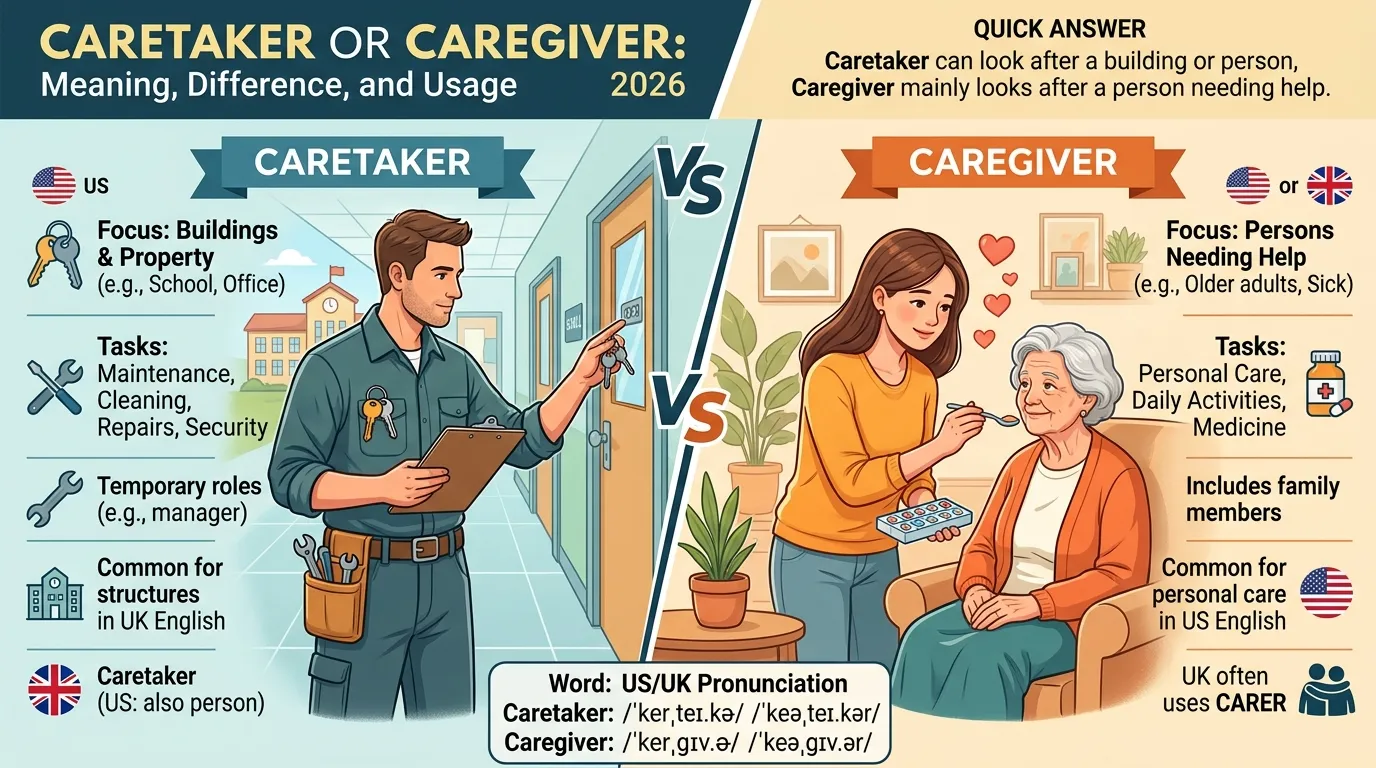
Quick answer: A caretaker can look after a building, place, or person, while a caregiver mainly looks after a person who needs help.
Imagine a school with a person who checks the rooms, fixes small problems, and keeps the building in order. That person may be called a caretaker. Now imagine someone who helps an older parent eat, take medicine, or move around the house. That person is usually a caregiver. The two words can have a similar meaning, but they are not always used in the same way.
People often search for caretaker or caregiver because both words include the idea of giving care. The main difference is the thing or person being cared for. In US English, caretaker can also mean someone who cares for a person. Caregiver is mainly used for a person who needs care. In the UK, carer is often used for this meaning instead of caregiver.
Understanding caretaker or caregiver helps you choose the right word in work, family, school, health, and everyday writing.
Pronunciation
| Word | US Pronunciation | UK Pronunciation |
| Caretaker | /ˈkerˌteɪ.kɚ/ | /ˈkeəˌteɪ.kər/ |
| Caregiver | /ˈkerˌɡɪv.ɚ/ | /ˈkeəˌɡɪv.ər/ |
Both words have three syllables.
Transition: Now let us look at the main differences with simple examples.
Difference Between Caretaker or Caregiver
1. Main meaning
A caretaker is someone who takes care of something or someone. It can mean a person who looks after a building.
A caregiver is someone who looks after a person who needs care.
Examples:
- The school hired a caretaker.
- Her mother is her main caregiver.
2. What they care for
A caretaker can care for a building, property, place, animal, or person.
A caregiver mainly cares for a person.
Examples:
- The caretaker checks the school every morning.
- The caregiver helps the patient get dressed.
3. Building care
Caretaker is common for a person who looks after a building, especially in British English.
This can include cleaning, repairs, and basic maintenance.
Examples:
- The caretaker cleaned the school yard.
- The apartment caretaker fixed the broken door.
4. Personal care
Caregiver is strongly linked with personal care.
The person may be young, old, sick, or disabled.
Examples:
- The caregiver helped the older people.
- She became a caregiver for her father.
5. Family use
A family member can be a caregiver.
The person does not have to be a paid worker.
Examples:
- John is a caregiver for his wife.
- Her daughter became her main caregiver.
6. Paid work
Both words can describe paid work.
However, the job is different depending on the setting.
Examples:
- The caretaker works at the school.
- The caregiver works at a care home.
7. US English
In the US, caretaker can mean a person who looks after a building or a person.
Caregiver is also common for someone who looks after a person.
Examples:
- The caretaker looks after the property.
- The caregiver helps older adults.
8. UK English
In the UK, caretaker often means someone who looks after a building.
For personal care, carer is usually more common than caregiver.
Examples:
- The school has a full-time caretaker.
- She is a carer for her father.
9. Job focus
A caretaker may focus on maintenance and protection.
A caregiver focuses more on a person’s daily needs and well-being.
Examples:
- The caretaker repaired the school gate.
- The caregiver prepared the patient’s meal.
10. Wider meaning
Caretaker has a wider meaning.
It can also describe a temporary person or group that runs something until a permanent person takes over. For example, English uses caretaker government and caretaker manager.
Examples:
- A caretaker manager took charge of the team.
- A caretaker government ran the country until the election.
Explore related words https://orchoice.com/invoice-or-bill/
Nature and Behaviour of Caretaker or Caregiver
Nature of a Caretaker
A caretaker is often practical and responsible. The job may involve checking a building, making small repairs, cleaning, protecting property, or watching a place.
A caretaker may work alone and handle many small tasks.
Example:
The caretaker checks every classroom before the school opens.
Nature of a Caregiver
A caregiver focuses on a person’s needs. The work may include helping with food, clothing, movement, medicine routines, or daily activities.
Example:
The caregiver helps an older woman with her morning routine.
Why People Get Confused About Caretaker or Caregiver
The confusion comes from the word care.
Both words describe someone who looks after something or someone. Also, caretaker can mean caregiver in US English.
The setting usually makes the meaning clear. If the topic is a school building, caretaker may be the natural word. If the topic is an older or sick person, caregiver is often clearer in American English. In British English, carer is often used for personal care.
Comparison Table
| Point | Caretaker | Caregiver |
| Main idea | Looks after something or someone | Looks after a person |
| Building use | Very common | Not normally used |
| Personal care | Possible, especially US | Very common |
| Property care | Common | Uncommon |
| Family care | Possible | Very common |
| Medical setting | Possible | Common |
| US English | Common | Common |
| UK English | Common for buildings | Less common; carer is often used |
| Repairs | Often part of the job | Usually not the main role |
| Daily personal help | Possible | Main focus |
The Origin of Caretaker or Caregiver
The two words have simple word parts.
Caretaker comes from care + take + -er. The Online Etymology Dictionary dates the noun to 1769, with the sense of a person who takes care of something.
Caregiver comes from care + giver. The word is recorded from 1974 for someone who looks after the physical needs of sick, older, or disabled people at home.
The word care itself is much older. It comes from Old English caru and cearu. Its meanings developed over time and included concern, attention, and protection.
British vs American English
The words are used differently in the two varieties of English.
American English
In American English, caretaker can mean someone who looks after property or a person.
Caregiver is a common word for someone who looks after a person who needs help.
Examples:
- The caretaker looks after the house.
- Maria is her mother’s caregiver.
British English
In British English, caretaker commonly refers to someone who looks after a building.
For a person who needs care, carer is usually the more common term.
Examples:
- The school caretaker repaired the window.
- Her husband is her carer.
Simple rule
Building → caretaker
Person needing care → caregiver in US English
Person needing care → carer in UK English
Which One Should You Use?
In the US
Use caretaker for a person who looks after a building, property, or sometimes a person.
Use caregiver when the focus is a person who needs care.
In the UK
Use caretaker for someone who looks after a building.
Use carer for someone who looks after a person.
For global English
Choose the word that makes your meaning clear.
If you write for an international audience, caregiver clearly points to personal care. If you mean building maintenance, caretaker is usually clearer.
Common Mistakes
Mistake 1: Calling every caretaker a caregiver
Incorrect:
The school caregiver repaired the classroom door.
Better:
The school caretaker repaired the classroom door.
Mistake 2: Using caretaker for medical care in every country
Better:
Use caregiver in American English and carer in common British usage when talking about personal care.
Mistake 3: Thinking the words are always exact synonyms
They overlap, but their usual uses are different.
Mistake 4: Forgetting the building meaning
A caretaker can look after a school, office, apartment, or other property.
Mistake 5: Thinking caregiver means only a paid worker
A family member or friend can also be a caregiver.
Everyday Usage Examples
In Emails
Caretaker:
Please contact the school caretaker about the broken window.
Caregiver:
Please tell the caregiver about the patient’s new schedule.
On Social Media
My sister has been a wonderful caregiver for our father.
The caretaker keeps our old building in great shape.
In News
The caretaker manager will lead the team for the rest of the season.
Family caregivers often provide daily support at home.
In Formal Writing
The building caretaker is responsible for basic maintenance.
The caregiver provides daily support to the patient.
Usage Trends
The two words remain useful, but their common settings differ.
Caretaker is strongly linked with buildings, property, and temporary roles. It can also refer to personal care in US English. Caregiver is strongly linked with personal care, especially in American English. In British English, carer is commonly used for that meaning.
The words may also appear in different fields. Schools, housing, and property management often use caretaker. Health, family care, and support services often use caregiver.
Metaphors and Similes
These words can also be used in a wider or figurative way.
Caretaker as a metaphor
A person can be called a caretaker of something valuable.
Example:
- We are caretakers of the planet.
This means we have a duty to protect it.
Caregiver as a metaphor
A caregiver can represent support and protection.
Example:
- Her grandmother was a caregiver to the whole family.
Simile
Example:
- He watched over the garden like a careful caretaker.
Connotative Meaning
Caretaker
Positive: responsible, helpful, protective
The caretaker kept the old building safe.
Neutral: someone who looks after a place or person
The caretaker opened the school gates.
Negative: in some contexts, it can suggest a temporary or less permanent role.
The caretaker manager stayed until a new manager arrived.
Caregiver
Positive: caring, patient, helpful
She was a kind caregiver to her father.
Neutral: a person who provides care
The caregiver helped him with breakfast.
Negative: the word itself is not normally negative. The context may describe stress or a difficult care role.
Idioms and Proverbs
| Idiom/Phrase | Meaning | Example |
|---|---|---|
| Take care of | to look after someone or something | She takes care of her elderly mother. |
| Look after | to care for someone or something | The caretaker looks after the school building. |
| Care for | to look after someone or something | He cares for his sick father. |
Literature and Movies
Caregiving and caretaking are common themes in literature and film because they involve family, duty, responsibility, and human relationships.
Literature
The Secret Garden is a children’s novel by Frances Hodgson Burnett, first published in 1911. The story includes adults who care for children and a home, making care and guardianship part of its wider themes.
A Christmas Carol, written by Charles Dickens and published in 1843, also explores family care, kindness, duty, and concern for others.
Movies
The Intouchables (2011, France) centers on the relationship between a wealthy man with a disability and his caregiver.
The Blind Side (2009, United States) includes themes of family support, protection, and caring for another person.
Why This Difference Matters
Choosing the right word makes your writing clearer.
If you say caretaker, readers may think about a building, property, or a temporary role. If you say caregiver, readers are more likely to think about a person who needs help.
This matters in job descriptions, school notices, health writing, family discussions, and formal documents.
It also matters when writing for different countries. A British reader may expect carer for personal care, while an American reader may expect caregiver.
Usefulness in Daily Life
You may need these words when:
- writing a job description
- talking about school staff
- describing home care
- discussing older people care
- writing about disability support
- talking about property management
- writing emails
- reading news stories
- filling out forms
- writing health-related information
What is being cared for?
If it is a building or property, caretaker may fit.
If it is a person who needs care, caregiver is often the clear choice in US English.
Situational Preference
Use caretaker when you mean someone who looks after a building, property, or place. It can also describe a person who provides care, especially in American English. Use caregiver when the main focus is a person who needs help because of age, illness, disability, or another need. In British English, carer is often more natural for this meaning. For a school, office, or apartment building, caretaker is clear. For a parent, patient, child, or older person, caregiver is often clearer for American readers. Always consider your audience and the exact type of care.
Common Questions About Caretaker or caregiver
Is a caretaker the same as a caregiver?
Not always. The words overlap, but a caretaker can look after buildings or property, while a caregiver mainly looks after people.
Is caregiver American or British English?
Caregiver is mainly associated with American English. In British English, carer is usually used for someone who looks after a person.
Is caretaker used in the UK?
Yes. In British English, caretaker is commonly used for someone who looks after a building, such as a school.
Can a family member be a caregiver?
Yes. A caregiver can be a family member, friend, or paid worker.
Can a caretaker look after a person?
Yes. In American English, caretaker can also mean someone who looks after a person.
Which word is better for older people care?
Caregiver is a clear choice in American English. In British English, carer is commonly used.
Which word should I use for a school worker?
Caretaker is usually the better choice when the worker looks after the school building and handles cleaning or basic repairs.
Conclusion
Caretaker or caregiver helps you write and speak with more clarity. A caretaker looks after a place or property, while a caregiver looks after a person who needs support and care. This small difference can change how clear your writing sounds in emails, job posts, or daily talk. Learning the right word for the right job builds stronger English skills and helps you avoid confusion. Next time you write or speak, pick the word that matches what is truly being cared for, a place or a person, and your message will always be clear.

I’m Samia Jamshaid, an English language specialist, SEO specialist, digital publisher, and researcher. I create clear, accurate, and well-researched content on English grammar, vocabulary, word meanings, and language comparisons, helping readers understand and use English with confidence.


1 thought on “Caretaker or Caregiver: Meaning, Difference, and Usage 2026”