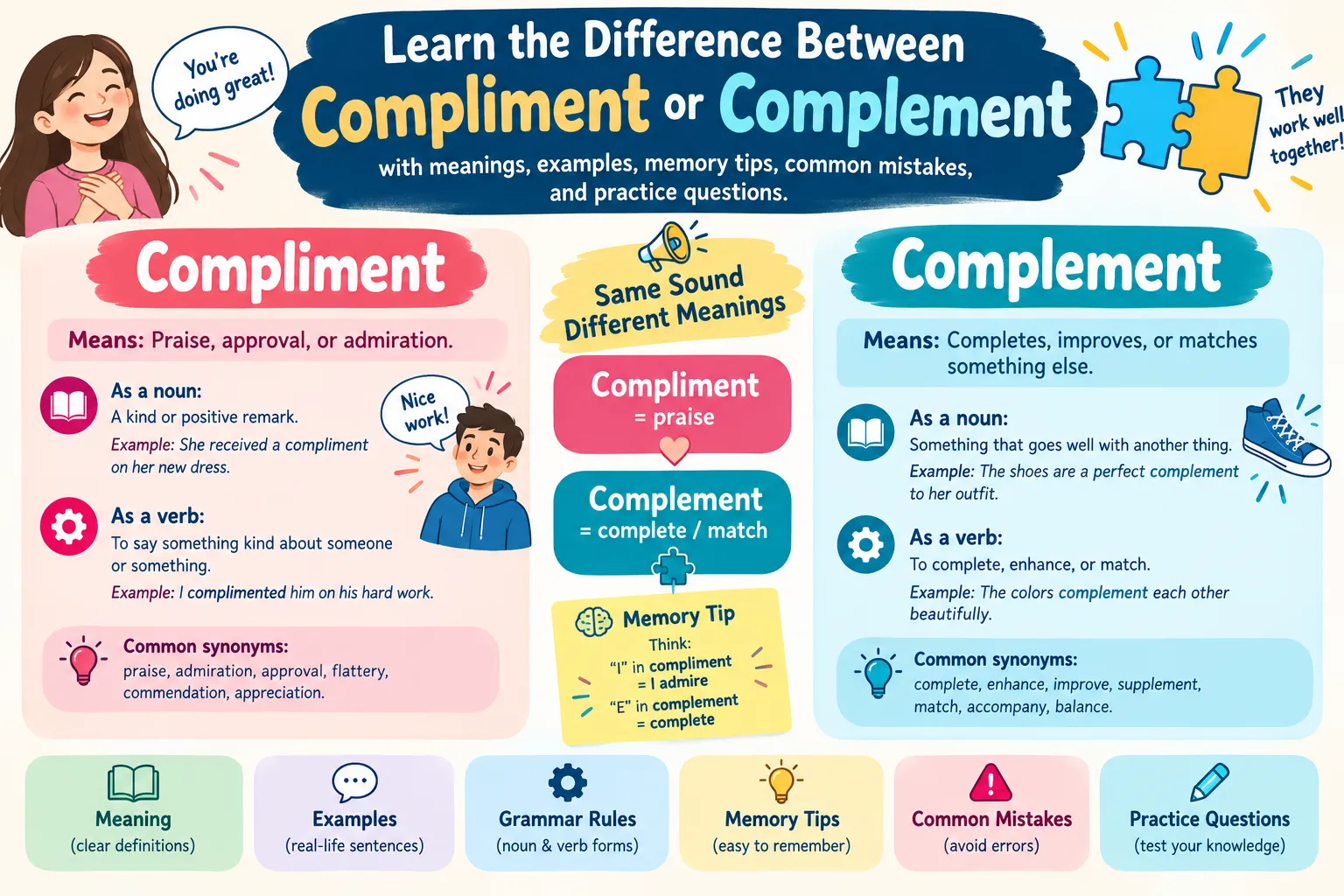
Have you ever wondered whether to write compliment or complement? These words sound the same, but they have different meanings. One word is about praise. The other is about completing or improving something.
Use compliment when you praise someone or something. For example, “My teacher gave me a compliment on my essay.” Use complement when two things work well together. For example, “This sauce complements the pasta.”
Both words can be used as nouns and verbs. This means they can name something or describe an action. Their similar sounds make them easy to mix up. However, a simple memory trick can help you choose the right word.
In this guide, you will learn their meanings, grammar rules, differences, common expressions, and examples. You will also find practice questions to test what you have learned.
What Is the Difference Between Compliment and Complement?
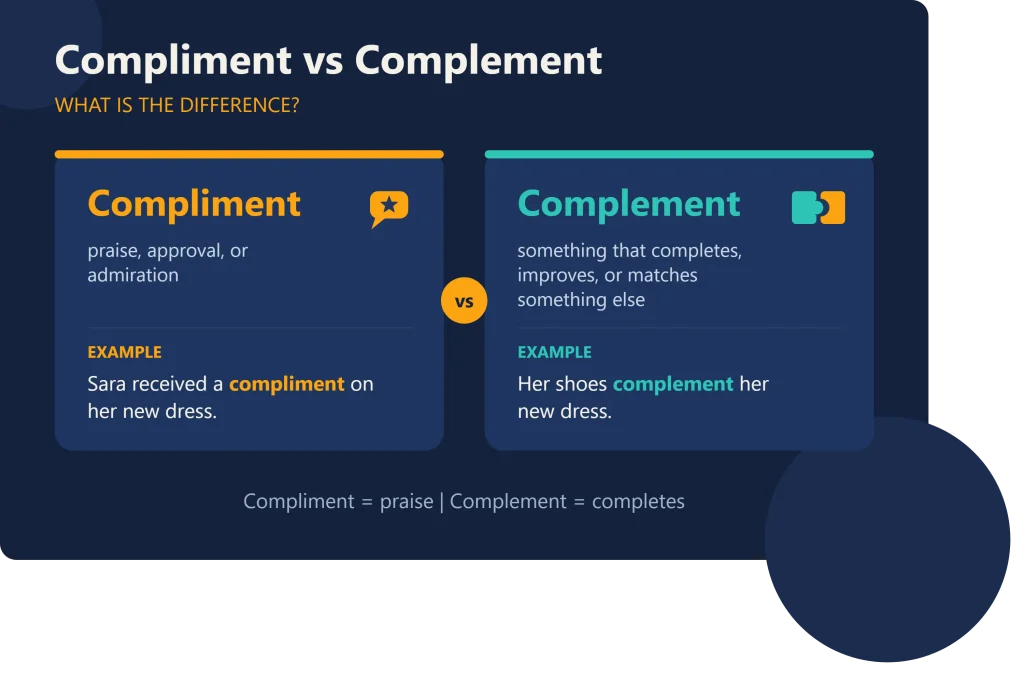
The main difference is simple:
- Compliment means praise, approval, or admiration.
- Complement means something that completes, improves, or matches something else.
Compare these examples:
- Compliment: Sara received a compliment on her new dress.
- Complement: Her shoes complement her new dress.
What Does Compliment Mean?
A compliment is a kind or positive remark about someone or something. It can show praise, respect, or admiration.
Compliment as a noun
A noun names a person, place, thing, or idea. As a noun, compliment means praise.
Examples:
- My friend gave me a compliment on my painting.
- The teacher received compliments for her helpful lesson.
- He took her kind words as a compliment.
- I enjoy receiving compliments about my work.
A common phrase is pay someone a compliment. It means to say something kind or positive to that person.
Example: I paid my brother a compliment on his new haircut.
Compliment as a verb
A verb describes an action. As a verb, compliment means to praise someone or something.
Examples:
- I complimented Mia on her beautiful drawing.
- The manager complimented the team on its hard work.
- She often compliments people on their clothes.
- We complimented the chef on the delicious meal.
A useful grammar pattern is:
Compliment someone on something.
For example: “The coach complimented Ali on his performance.”
Synonyms of compliment
Synonyms are words with similar meanings. Some common synonyms of compliment are:
- Praise: To say that someone or something is good.
- Admiration: A feeling of respect or approval.
- Approval: A sign that you think something is good or acceptable.
- Appreciation: Recognition of someone’s effort or value.
- Flattery: Praise that may be excessive or not fully sincere.
- Commendation: Formal praise for good work or behavior.
What Does Complement Mean?
A complement is something that completes, improves, or matches another thing. It may add something useful or make the result better.
Complement as a noun
As a noun, complement names something that completes or works well with something else.
Examples:
- The blue curtains are a perfect complement to the white walls.
- Rice is a good complement to this curry.
- Her skills are a useful complement to his experience.
- The team has a full complement of players.
The phrase a complement to often means something that adds value or works well with something else.
Example: This book is a useful complement to our English lessons.
The phrase a full complement of means the complete or usual number of people or things needed.
Example: The hospital now has a full complement of nurses.
Complement as a verb
As a verb, complement means to complete, improve, or match something.
Examples:
- The blue shirt complements your eyes.
- Fresh herbs complement the flavor of the soup.
- Her careful planning complements his creative ideas.
- The new lesson complements the work we did yesterday.
A useful grammar pattern is:
Something complements something else.
For example: “The green cushions complement the sofa.”
Notice that the thing doing the matching or improving is the subject of the sentence.
Synonyms of complement
Some useful synonyms of complement are:
- Complete: To make something whole or finished.
- Enhance: To improve the quality or value of something.
- Improve: To make something better.
- Supplement: To add something extra.
- Match: To look good or work well with something else.
- Accompany: To go with something.
- Balance: To create a pleasing or useful combination.
Compliment vs. Complement: 10 Key Differences
1. Main meaning
A compliment is praise. A complement completes or improves something.
- She gave me a compliment on my speech.
- The pictures complement the story.
2. Purpose
A compliment shows admiration. A complement adds something useful or suitable.
- The teacher complimented Ben on his effort.
- The pictures complement the lesson.
3. Use as a noun
A compliment is a kind remark. A complement is something that works well with another thing.
- His kind words were a compliment.
- The scarf was a perfect complement to her coat.
4. Use as a verb
To compliment means to praise. To complement means to match, complete, or improve.
- I complimented her on her work.
- Her ideas complement mine.
5. Common sentence patterns
We often say compliment someone on something. We often say a complement to something.
- He complimented me on my cooking.
- This guide is a complement to the course.
6. Feelings
A compliment often makes someone feel appreciated. A complement does not need to express a feeling.
- I was happy to receive a compliment.
- The blue frame complements the picture.
7. Clothing and appearance
Use compliment for praise about clothing. Use complement when clothing items match.
- My friend complimented my jacket.
- My jacket complements my trousers.
8. Food and flavor
Use compliment when praising food. Use complement when one food goes well with another.
- We complimented the chef on dinner.
- The sauce complements the pasta.
9. Work and skills
A compliment praises someone’s work. A complement adds a useful skill or quality.
- The boss complimented the team on its work.
- Her writing skills complement his design skills.
10. Spelling
Compliment has an i. Complement has an e.
- Remember the i in compliment for praise.
- Remember the e in complement for complete.
You May Also Like https://orchoice.com/import-or-inport/
Easy Ways to Remember the Difference
A simple memory trick can help you choose the right spelling.
Remember “I” in compliment
The word compliment has an i, just like the word admire has an i.
A compliment is something you say to show admiration.
Example: “I complimented her on her singing.”
Remember “complete” in complement
The word complement has an e, just like complete.
A complement completes, improves, or matches something else.
Example: “The shoes complement the outfit.”
Try this quick test
Ask yourself:
- Am I talking about praise? Use compliment.
- Am I talking about something that completes or matches something else? Use complement.
Complimentary vs. Complementary
The words complimentary and complementary are adjectives. They are related to compliment and complement, but their meanings differ.
What does complimentary mean?
Complimentary can mean giving praise or showing approval.
Example: She made a complimentary comment about my project.
It can also mean free of charge, especially when a business gives something to a customer.
Example: The hotel offers complimentary breakfast.
What does complementary mean?
Complementary means completing, matching, or improving something else.
Examples:
- Blue and orange are complementary colors in common color theory.
- Their skills are complementary, so they work well together.
- The teacher gave us a complementary worksheet to support the lesson.
A quick reminder:
- Complimentary: praise or something free.
- Complementary: things that work well together.
Common Expressions with Compliment and Complement
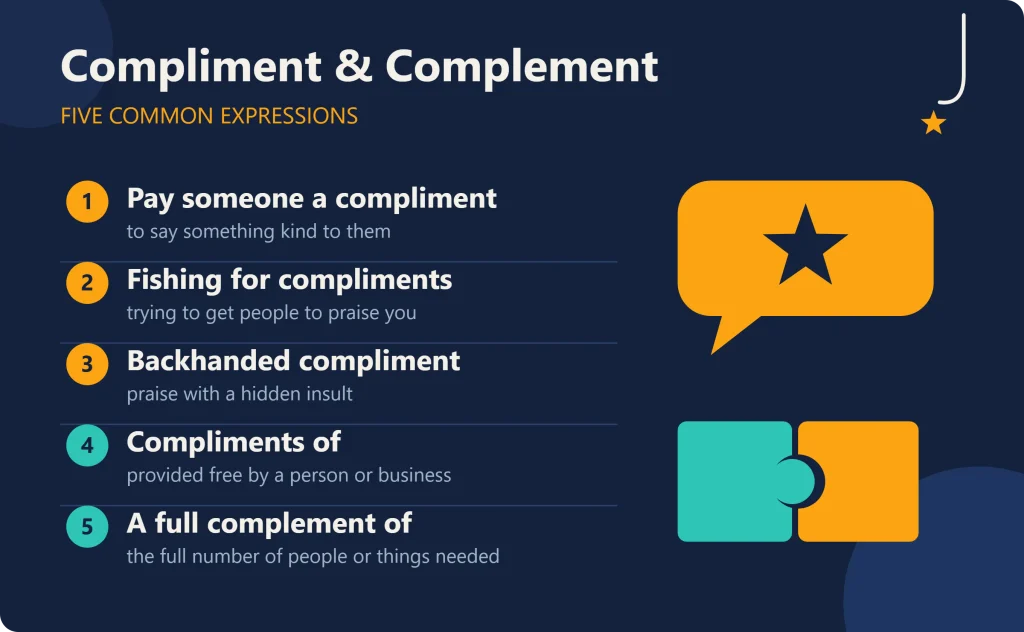
1. Pay someone a compliment
This means to say something kind or positive to someone.
Example: I paid my sister a compliment on her artwork.
2. Fishing for compliments
This means trying to get people to praise you.
Example: He kept asking if his new haircut looked good. He seemed to be fishing for compliments.
3. Backhanded compliment
A backhanded compliment sounds positive but also contains an insult or criticism.
Example: “Your presentation was good for someone with so little experience” is a backhanded compliment.
4. Compliments of
The phrase compliments of can mean that something is provided free by a person or business.
Example: The hotel gave us free drinks, compliments of the manager.
5. A full complement of
This phrase means the full number of people or things needed.
Example: The school has a full complement of teachers.
Common Mistakes to Avoid
Mistake 1: Using complement when you mean praise
Incorrect: My teacher gave me a complement on my essay.
Correct: My teacher gave me a compliment on my essay.
Why? The teacher praised the essay.
Mistake 2: Using compliment when you mean a good match
Incorrect: The green tie compliments his blue suit.
Correct: The green tie complements his blue suit.
Why? The tie and suit work well together.
Mistake 3: Confusing complementary and complimentary
Incorrect: The hotel offers complementary breakfast.
Correct: The hotel offers complimentary breakfast.
Why? The breakfast is free.
Mistake 4: Thinking the words have only one grammar role
Both words can be nouns and verbs.
- Noun: She received a compliment.
- Verb: She complimented her friend.
- Noun: The scarf is a complement to the coat.
- Verb: The scarf complements the coat.
Mistake 5: Assuming every compliment is sincere
A compliment usually expresses praise, but it can be sarcastic or insincere.
Example: “Great job arriving only an hour late!” may be sarcastic rather than real praise.
Compliment vs. Complement: Quick Comparison Table
| Feature | Compliment | Complement |
| Main meaning | Praise or admiration | Something that completes or improves |
| As a noun | A kind or admiring remark | Something that matches or adds value |
| As a verb | To praise | To complete, improve, or match |
| Common pattern | Compliment someone on something | A complement to something |
| Related adjective | Complimentary | Complementary |
| Memory tip | Think of admiration | Think of complete |
| Example | She complimented my dress. | My shoes complement my dress. |
Practice Questions: Compliment or Complement?
Choose the correct word for each sentence. Try to answer before checking the key.
- My friend gave me a ______ on my new haircut.
- The lemon sauce will ______ the fish.
- The manager ______ the team on its hard work.
- These shoes are a perfect ______ to your outfit.
- The hotel provides ______ drinks to its guests.
- The blue and orange colors look good together because they are ______.
- He was fishing for ______ when he asked if everyone liked his new car.
- Her calm nature ______ his lively personality.
Answers and explanations
- Compliment — The friend praised the haircut.
- Complement — The sauce goes well with the fish.
- Complimented — The manager praised the team.
- Complement — The shoes match or improve the outfit.
- Complimentary — The drinks are free.
- Complementary — The colors work well together.
- Compliments — He wanted people to praise his car.
- Complements — The two personalities work well together.
Possible Asked Questions
1. What is the main difference between compliment and complement?
A compliment is praise or admiration. A complement completes, improves, or matches something else.
2. Are compliment and complement pronounced the same?
Yes, they are homophones in many English accents. They sound alike but have different spellings and meanings.
3. Can compliment be a verb?
Yes. Compliment as a verb means to praise someone or something.
Example: She complimented me on my presentation.
4. Can complement be a verb?
Yes. Complement as a verb means to complete, improve, or match something.
Example: The curtains complement the furniture.
5. Is it “compliments of” or “complements of”?
Use compliments of when naming the person or business providing something as a courtesy.
Example: The dessert was compliments of the restaurant.
6. Is it complimentary or complementary breakfast?
Use complimentary breakfast when the breakfast is free. Use complementary for things that work well together.
7. How can I remember which word to use?
Remember compliment = praise and complement = complete. Ask yourself whether you mean admiration or a good match.
Conclusion
The difference between compliment and complement is easy to learn with a little practice. A compliment is praise that shows admiration or approval. A complement is something that completes, improves, or matches another thing. Both words can work as nouns and verbs, so look at the meaning of the full sentence before choosing one. Remember that compliment has an “i” and relates to admiration, while complement has an “e” and connects to “complete.” Also, do not confuse complimentary, which can mean praise or free, with complementary, which describes things that work well together. Use the examples and practice questions in this guide to build your confidence. With these simple rules, you can choose the right word in schoolwork, emails, and everyday writing.

I’m Samia Jamshaid, an English language specialist, SEO specialist, digital publisher, and researcher. I create clear, accurate, and well-researched content on English grammar, vocabulary, word meanings, and language comparisons, helping readers understand and use English with confidence.







1 thought on “Compliment or Complement: How to Choose the Correct Word”