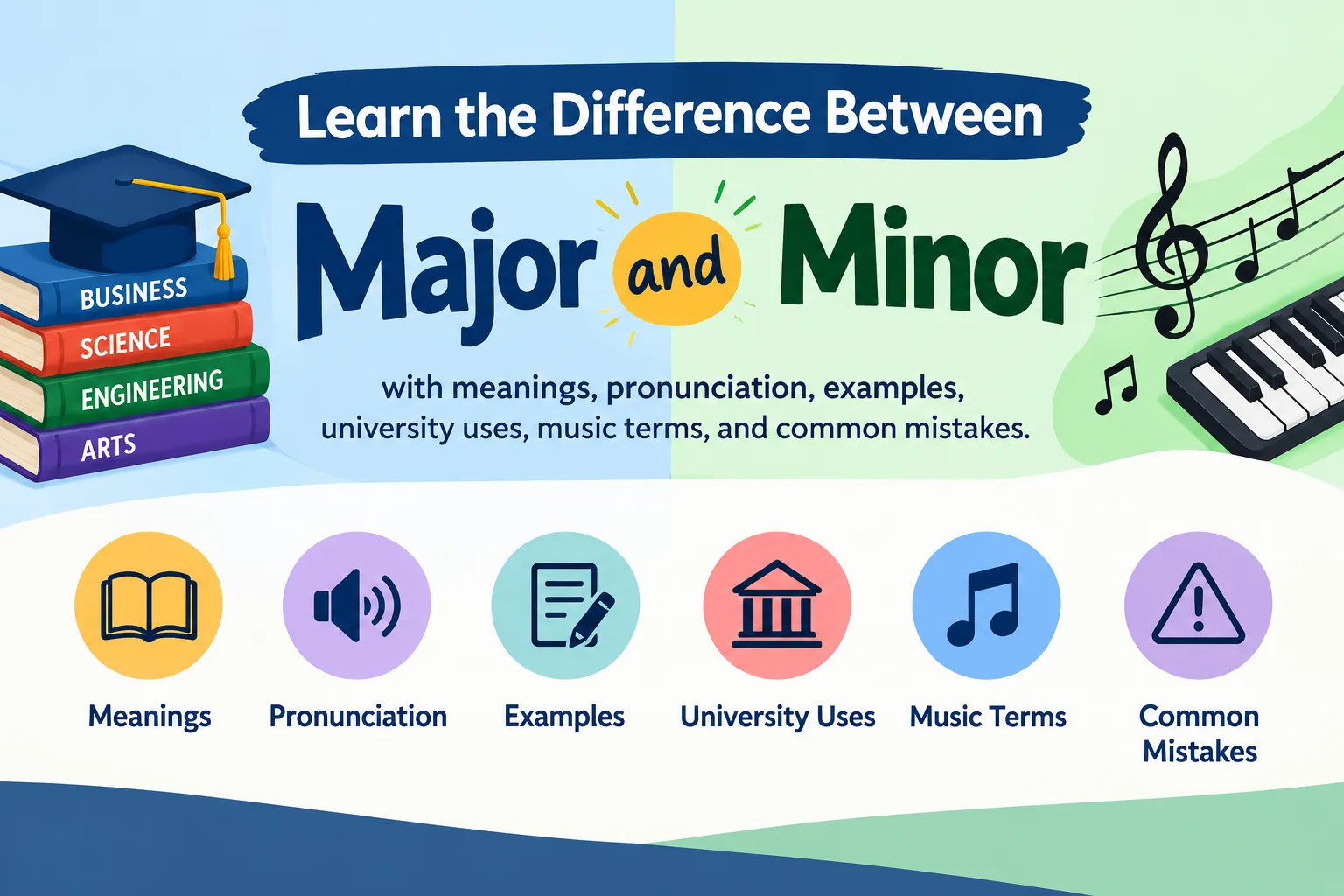
Major and minor are common English words. They often describe the size, level, or importance of something. However, their meanings can change with the situation.
Major usually means large, important, or greater in degree. Second word usually means small, less important, or lower in degree. For example, a major problem may need urgent attention, while a minor problem may need only a small fix.
These words also have special meanings. At a university, a major is the main area of study, while a minor is a secondary area. In music, both describe certain intervals, scales, chords, and keys.
Learning the difference helps you speak and write clearly. This guide explains their meanings, pronunciation, grammar, history, and common uses. It also covers university studies, music, common mistakes, and frequently asked questions.
What Does Major Mean?
Major can be an adjective, noun, or verb.
Major (adjective): Large, important, or greater in degree.
Examples:
- The storm caused major damage.
- She made a major change to her plan.
Major (noun): A main subject studied at a college or university. It can also mean a military officer’s rank.
Examples:
- Her major is biology.
- He was promoted to major.
Major (verb): To study a subject as your main field, mainly in American English.
Example:
- He plans to major in history.
What Does Minor Mean?
It can also be an adjective, noun, or verb.
Minor (adjective): Small, less important, or lower in degree.
Examples:
- The car had minor damage.
- We made a minor change to the report.
As a noun: A person who has not reached the legal age of adulthood, or a secondary university subject.
Examples:
- A minor may need an adult’s permission for some activities.
- Her minor is photography.
As a verb: To study a subject as a secondary field, mainly in American English.
Example:
- She plans to minor in business.
Pronunciation
| Word | US pronunciation | UK pronunciation |
| Major | /ˈmeɪ.dʒɚ/ | /ˈmeɪ.dʒə/ |
| Minor | /ˈmaɪ.nɚ/ | /ˈmaɪ.nə/ |
Both words have two syllables, with stress on the first syllable.
- Major: The first vowel sounds like the vowel in may.
- Minor: The first vowel sounds like the vowel in my.
10 Main Differences
1. Importance
Major describes something important. Minor describes something less important.
- Major: Safety is a major concern.
- Minor: A spelling error is a small issue.
2. Size or Amount
Major can describe something large. A small or slight thing has less size or importance.
- Major: The city began a major building project.
- Minor: The shop needed a small repair.
3. Problems
A major problem may need urgent attention. A small problem usually has a smaller effect.
- Major: The power failure caused a major problem.
- Minor: The delay was a small problem.
4. Changes
A major change can affect many things. A slight change usually affects only a small part.
- Major: The school made a major change to its rules.
- Minor: I made a slight change to the title.
5. Injuries
These words can describe how serious an injury is. The exact meaning depends on the injury and medical situation.
- Major: The accident caused serious injuries.
- Minor: He had a small cut on his hand.
6. University Subjects
A major is usually a student’s main field of study. A minor is a secondary field, where offered.
- Major: Her major is computer science.
- Minor: Her secondary subject is psychology.
Universities have different course rules, and some do not offer minors.
7. Music
In music, both words describe certain intervals, scales, chords, and keys. They are technical terms, not simple labels for importance.
- Major: The song is written in a major key.
- Minor: The piece moves into a minor key.
8. Legal Age
A minor is a person who has not reached the legal age of adulthood. Major is not the usual opposite noun for this meaning.
- Major: The officer held the rank of major.
- Minor: The law sets special rules for people below the legal age of adulthood.
9. Military Rank
Major is a military rank. Minor is not its matching lower rank.
- Major: The major spoke to the soldiers.
- Minor: The officer reported a small error.
10. Effects and Results
A major effect is large or important. A smaller effect is less important or has less impact.
- Major: The new rule had a major effect on the school.
- Minor: The change had only a small effect.
For further information https://orchoice.com/compliment-or-complement/
Major and Minor: Comparison Table
| Feature | Major | Minor |
| General meaning | Large or important | Small or less important |
| Degree | Greater | Lesser |
| Problem | Often serious or significant | Often small or less serious |
| Change | Has a greater effect | Has a smaller effect |
| University study | Main field of study | Secondary field of study |
| Music | Describes certain musical intervals, scales, chords, and keys | Describes corresponding musical forms |
| Legal meaning | Not the usual term for an adult | A person below the legal age of adulthood |
| Military use | An officer’s rank | Not a matching lower rank |
| Grammar | Adjective, noun, and verb | Adjective, noun, and verb |
Nature and Behaviour
Both often work as opposites when describing size, importance, or effect.
A major issue usually needs more attention because it may affect many people or cause a big change. A minor issue usually has a smaller effect and may be easier to fix.
However, they are not direct opposites in every situation. In music, they describe specific musical qualities. At a university, they describe different areas of study. In law, a minor is a person who has not reached the legal age of adulthood.
Why Do People Confuse Major and Minor?
People often confuse these words because they appear together and can have different meanings.
First, they are often used as opposites, such as in “major and minor problems.” This can make learners think they are opposites in every situation.
Second, their meanings change with context. A major at university is a main subject, while a major in the military is an officer’s rank.
Third, both words can be nouns and adjectives:
- Adjective: We found a major problem.
- Noun: She chose biology as her major.
- Adjective: It was a minor error.
- Noun: He chose art as his minor.
Origin and History
Both words come from Latin.
Major comes from a Latin form meaning “greater” or “larger.” Second word comes from a Latin word meaning “smaller” or “lesser.”
English adopted the words for many uses, including size, importance, rank, education, and music. Their shared history explains why they often appear together, even though their modern meanings depend on the situation.
British English vs. American English
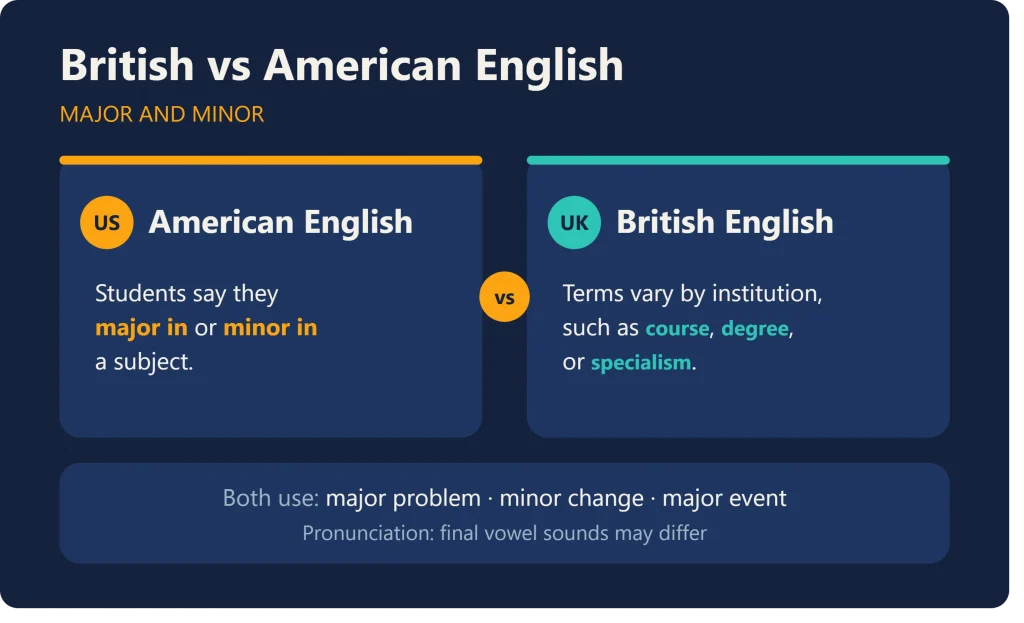
The general meanings of both are similar in British and American English. Both varieties use phrases such as major problem, minor change, and major event.
Some differences appear in education and pronunciation.
- American English: Students commonly say they major in or minor in a subject.
- British English: University terms vary by institution. Students may use words such as course, degree, or specialism.
- Pronunciation: The final vowel sounds may differ between American and British accents.
When Should You Use Major?
Use major when something is large, important, or has a strong effect.
Examples:
- The country faced a major crisis.
- She made a major decision.
- His major is engineering.
- The orchestra played a piece in a major key.
When Should You Use Minor?
Use it when something is small, less important, or secondary.
Examples:
- The car needed a minor repair.
- There was a minor delay.
- The melody uses a minor key.
Common Mistakes to Avoid
Mistake 1: Thinking major always means an important person
Correction: Major can describe importance, a university subject, or a military rank.
Mistake 2: Thinking minor is always a lower military rank
Correction: A minor is not the matching lower rank of a major.
Mistake 3: Assuming every university minor has four subjects
Correction: Requirements vary. One university may require four subjects, while another may use a different number of courses or units.
Mistake 4: Thinking every major-key song sounds happy
Correction: Major music is often heard as bright, but mood also depends on rhythm, tempo, lyrics, and performance.
Mistake 5: Thinking minor always means unimportant
Correction: In law, a minor is a person below the legal age of adulthood. In music, minor has a technical meaning.
In Everyday English
These words are useful at school, work, and home.
At work, a manager may discuss a major project or a less serious update. At home, you may need a major repair or a slight adjustment. In the news, a major storm may cause wide damage, while a minor storm may have limited effects.
Students may discuss their major and minor subjects. Music learners use the terms to talk about scales, chords, and keys.
Major and Minor in Metaphors and Common Phrases
These phrases help describe the size or importance of an event.
Phrases with major
- Major breakthrough: An important discovery or success.
- Major issue: A serious or important problem.
- Major change: A change with a large effect.
Phrases with minor
- Minor detail: A small part of something.
- Minor setback: A small problem or delay.
- Minor adjustment: A small change.
Connotations of Both
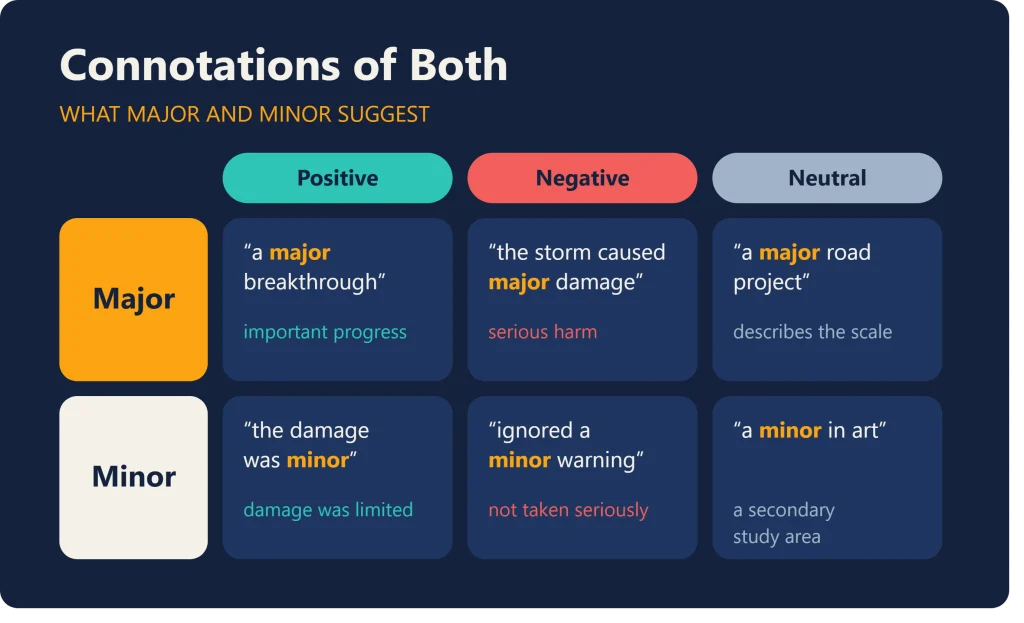
A connotation is a feeling or idea that a word may suggest.
Major
- Positive: “The team made a major breakthrough.” This suggests important progress.
- Negative: “The storm caused major damage.” This suggests serious harm.
- Neutral: “The city began a major road project.” This describes the project’s scale.
Minor
- Positive: “The damage was minor.” This suggests the damage was limited.
- Negative: “They ignored a minor warning.” This may suggest that a warning was not taken seriously.
- Neutral: “She chose a minor in art.” This describes a secondary study area.
Major and Minor in Literature and Movies
Writers and filmmakers use the ideas of both events to show how much something affects a story.
In Charles Dickens’s A Christmas Carol (1843), Scrooge’s change of heart is a major turning point. Smaller details help build the story.
In Lewis Carroll’s Alice’s Adventures in Wonderland (1865), Alice’s journey is the main action. Her smaller encounters help shape the adventure.
In The Lion King (1994), Simba’s decision to return is a major event in the plot. In Toy Story (1995), smaller disagreements help develop the characters.
Why Is the Difference Important?
Knowing the difference helps you describe how serious, large, or important something is.
At work, calling a problem major may show that it needs urgent attention. Calling it minor suggests a smaller effect. In education, understanding majors and minors helps students learn about degree options. In music, the terms help people describe scales, chords, and keys correctly.
Possible Asked Questions
1. What is the main difference between major and minor?
Major usually means large or important. Second word usually means small or less important. In education and music, the words also have special meanings.
2. Is major the opposite of minor?
They are opposites when describing size, degree, or importance. However, they are not direct opposites in every use.
3. What is a major at university?
A major is the main area of study a student chooses within a degree, where the institution offers this system.
4. What is a minor at university?
A minor is a secondary area of study. It may help students build extra skills or explore another subject. Rules vary by university.
5. Does every university require a minor?
No. Some universities offer minors as an option, while others use different course structures. Students should check their degree requirements.
6. What do major and minor mean in music?
They describe types of intervals, scales, chords, and keys. Major music is often heard as bright, while minor music is often heard as serious or sad.
7. Can major and minor be nouns?
Yes. A major can be a student’s main subject or a military officer’s rank. A minor can be a person below the legal age of adulthood or a secondary university subject.
Conclusion
Major or minor are common English words with several meanings. In general English, major means large, important, or greater in degree, while second word means small, less important, or lower in degree. They often work as opposites when describing problems, changes, risks, and effects. However, their meanings depend on the context. At a university, a major is usually the main area of study, while a second word is a secondary area. Course rules vary by institution. In music, these words describe intervals, scales, chords, and keys. In law, a minor is someone who has not reached the legal age of adulthood. You may also see these words in news reports, books, films, and everyday conversations. Always check what you are describing before choosing one. Learning their meanings through examples and practicing them in your own sentences will help you choose the correct word with confidence.

I’m Samia Jamshaid, an English language specialist, SEO specialist, digital publisher, and researcher. I create clear, accurate, and well-researched content on English grammar, vocabulary, word meanings, and language comparisons, helping readers understand and use English with confidence.






1 thought on “Major or Minor: Definitions and Key Differences 2026”