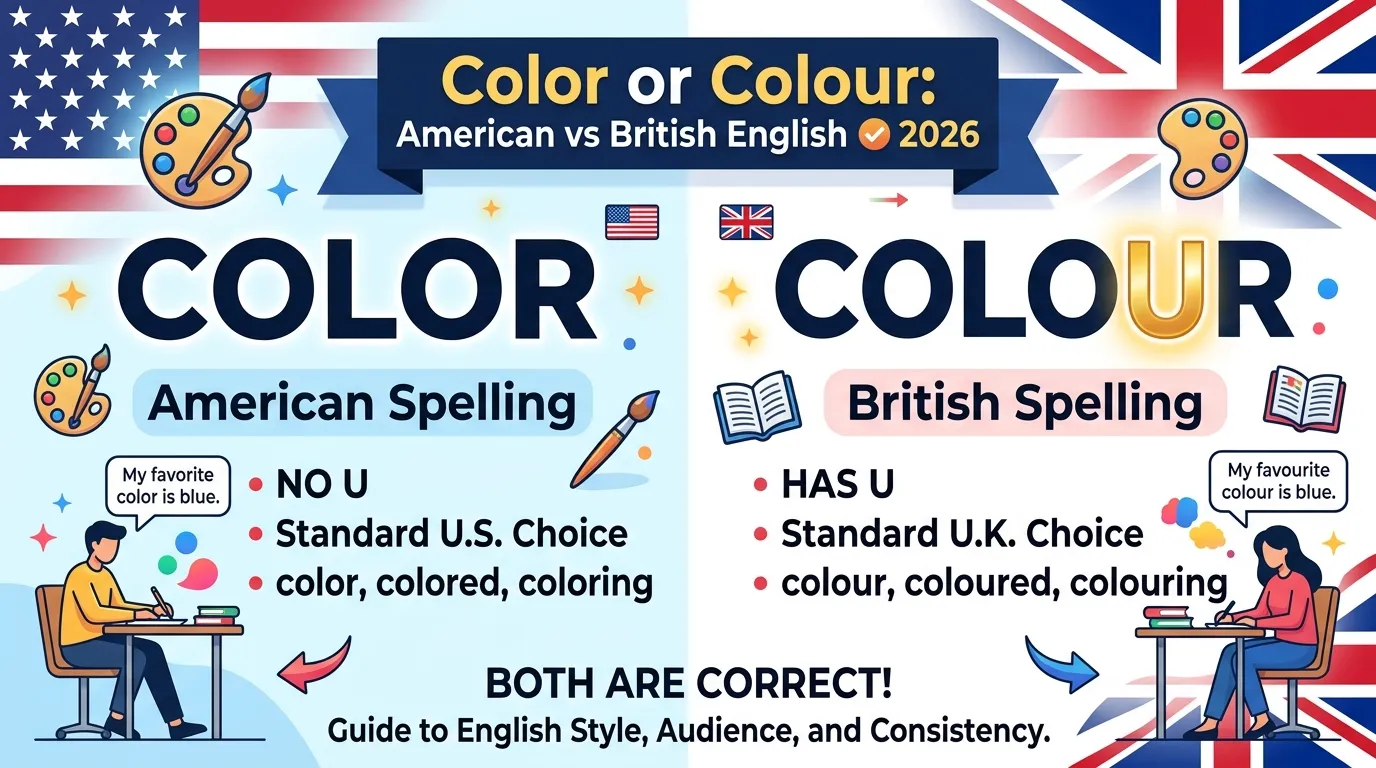
Color is the standard U.S. spelling, while colour is the standard British spelling. Both are correct.
Have you ever typed color and wondered if your teacher, editor, or reader expected colour? You are not alone. The two spellings look different, but they have the same meaning. The main difference is where the spelling is used.
For example, an American writer may say, “Blue is my favorite color.” A British writer may write, “Blue is my favourite colour.” The meaning does not change.
This can also cause confusion with words such as colored or coloured, coloring or colouring, and colorful or colourful. The same spelling pattern applies.
So, color or colour is not a question of right versus wrong. It is mainly a question of English style and audience. If you write for people in the United States, color is the usual choice. If you write in British English, colour is the usual choice.
Color or Colour: Meaning
Color and colour mean the same thing.
As a noun, the word describes the appearance of something, such as red, blue, green, or yellow.
- The color of the car is red.
- The colour of the car is red.
As a verb, it means to add or change color.
- The child will color the picture.
- The child will colour the picture.
The word can also be used in a figurative way.
For example:
- Her story colored my view of the event.
- His memories coloured the way he told the story.
Pronunciation of Color and Colour
| Word | English Variety | Pronunciation | Syllables | Simple Sound |
|---|---|---|---|---|
| Color | American English | /ˈkʌlər/ | 2 | KUL-er |
| Colour | British English | /ˈkʌlə/ | 2 | KUL-uh |
The Main Difference Between Color and Colour
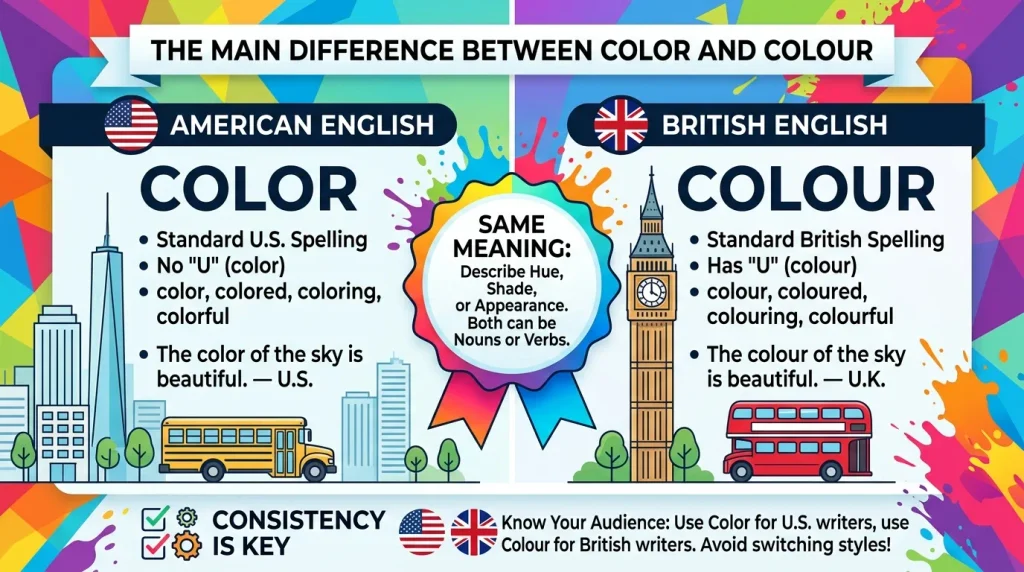
The biggest difference is spelling and English variety. The meaning does not change.
1. American vs. British Spelling
Color is the standard U.S. spelling.
Colour is the standard British spelling.
Examples:
- The color of the sky is beautiful. — U.S.
- The colour of the sky is beautiful. — U.K.
2. The Letter “U”
The easiest visual difference is the letter u.
- color → no u
- colour → has u
This small letter is the reason many learners notice the difference.
Examples:
- What is your favorite color?
- What is your favourite colour?
3. Related Words Change Too
The spelling difference does not stop with the main word.
American English usually uses:
- color
- colored
- coloring
- colorful
British English usually uses:
- colour
- coloured
- colouring
- colourful
Examples:
- She colored the picture. — U.S.
- She coloured the picture. — U.K.
4. The Meaning Is the Same
There is no special meaning for color and another meaning for colour.
Both can describe a hue, shade, or appearance.
Examples:
- Red is a bright color.
- Red is a bright colour.
Both sentences mean the same thing.
5. Both Can Be Nouns
Both forms can work as nouns.
Examples:
- Green is my favorite color.
- Green is my favourite colour.
Here, the word names a visual quality.
6. Both Can Be Verbs
Both forms can also work as verbs.
Examples:
- Please color the flower red.
- Please colour the flower red.
The meaning is the same.
7. U.S. Writing Uses Color
If your writing follows American English, use color.
This is common in U.S. schools, websites, newspapers, books, and business writing.
Examples:
- What color is your new shirt?
- Please choose a color for the logo.
8. British Writing Uses Colour
If your writing follows British English, use colour.
This spelling is common in British writing and in many places influenced by British English.
Examples:
- What colour is your new shirt?
- Please choose a colour for the logo.
9. Mixing Styles Can Look Untidy
Neither spelling is wrong. However, it is better to stay consistent.
For example, in American English, write:
- favorite color
- colored
- coloring
In British English, write:
- favourite colour
- coloured
- colouring
Avoid switching styles without a reason.
10. Your Audience Can Guide Your Choice
Think about who will read your work.
If your readers are mainly American, color is usually the better fit for that style.
If your readers use British English, colour is usually the better fit.
Examples:
- A U.S. school paper: “My favorite color is blue.”
- A British school paper: “My favourite colour is blue.”
Nature and Behaviour of Color and Colour
Nature of Color
Color is a noun and a verb in American English.
As a noun, it describes a visual quality.
As a verb, it means to add or change color.
It can also appear in many common phrases.
Nature of Colour
Colour has the same roles in British English.
It can be a noun or a verb.
The main difference is the extra u in the spelling.
Neither form is more correct by itself.
Keep Exploring https://orchoice.com/apologies-or-apologize/
Why Do People Get Confused About Color and Colour?
People often get confused because both forms appear online.
A person in the United States may see colour in a British book. A person in the United Kingdom may see color on an American website.
Both forms may also appear in international websites and products.
Another reason is that English has many spelling differences between American and British English.
For example:
- color / colour
- favorite / favourite
- honor / honour
- behavior / behaviour
- flavor / flavour
Once you understand the pattern, color or colour becomes much easier to remember.
Color vs. Colour Comparison Table
| Feature | Color | Colour |
| Main variety | American English | British English |
| Meaning | Same | Same |
| Pronunciation | /ˈkʌlər/ | /ˈkʌlə/ |
| Syllables | 2 | 2 |
| Letter “u” | No | Yes |
| Noun | Yes | Yes |
| Verb | Yes | Yes |
| Past form | colored | coloured |
| -ing form | coloring | colouring |
| Adjective | colorful | colourful |
| Common U.S. use | Yes | Less common |
| Common U.K. use | Less common | Yes |
The Origin of Color and Colour
The history of color and colour goes back a long way.
The English word came through French from the Latin word color, meaning a color or appearance.
British English kept a spelling influenced by French, giving us colour.
American English later developed its own spelling preferences. In the United States, spelling reformers such as Noah Webster helped make shorter forms more common.
This is why American English uses forms such as:
- color instead of colour
- honor instead of honour
- favor instead of favour
- flavor instead of flavour
Webster was an important part of this story, but he did not simply invent every American spelling difference. These spelling patterns had a longer history.
Noah Webster’s Spelling Ideas
Noah Webster wanted American English to have spelling that was simpler and more suited to American use.
Some of his ideas became common.
For example:
- centre → center
- colour → color
- honour → honor
- flavour → flavor
Other spelling ideas did not become standard.
He suggested unusual forms such as soop for soup and wimmin for women. These changes did not become normal English spelling.
This shows that spelling change is not always easy to control. Some ideas become popular, while others disappear.
British vs. American English
The clearest difference is:
American English: color
British English: colour
The same pattern can appear in related words.
| American English | British English |
| color | colour |
| colored | coloured |
| coloring | colouring |
| colorful | colourful |
| favorite | favourite |
| honor | honour |
| behavior | behaviour |
| flavor | flavour |
The exact spelling rules can vary across English-speaking countries, so it is best to follow the style used by your school, workplace, publisher, or target readers.
Which One Should You Use?
If You Write for a U.S. Audience
Use color.
For example:
My favorite color is green.
If You Write for a U.K. Audience
Use colour.
For example:
My favourite colour is green.
If You Write for a Global Audience
Either can work, but consistency is important.
Choose one English style and use it throughout the article.
For SEO writing, also consider the spelling your target readers normally search for.
Common Mistakes With Color and Colour
Mistake 1: Saying Colour Is Wrong
Colour is not wrong.
It is the standard British spelling.
Mistake 2: Saying Color Is Wrong
Color is not wrong.
It is the standard American spelling.
Mistake 3: Mixing the Two Styles
A sentence such as:
My favourite color is blue.
mixes common British favourite with American color.
It is better to keep one style:
My favorite color is blue. — American English
or:
My favourite colour is blue. — British English
Mistake 4: Forgetting Related Forms
The same difference appears in other words.
Incorrect for consistent U.S. style:
color, coloured, colouring
Consistent U.S. style:
color, colored, coloring
Consistent British style:
colour, coloured, colouring
Mistake 5: Thinking the Meaning Changes
The meaning does not change.
Color and colour refer to the same thing.
Everyday Usage of Color and Colour
In Emails
American English:
Please confirm the color of the product.
British English:
Please confirm the colour of the product.
On Social Media
American English:
I love this new color!
British English:
I love this new colour!
In News Writing
American English:
The team chose a new color for its logo.
British English:
The team chose a new colour for its logo.
In Formal Writing
American English:
The color of the sample changed after testing.
British English:
The colour of the sample changed after testing.
Both are correct when they match the chosen English style.
Usage Trends
The spelling people use can vary by country.
The following figures are usage estimates provided for comparison, not fixed rules. Real usage can change by source, writer, publication, and audience.
| Country | Color | Colour |
| United States | 98 | 2 |
| United Kingdom | 25 | 75 |
| India | 32 | 68 |
| Philippines | 98 | 2 |
| Canada | 64 | 36 |
| Australia | 26 | 74 |
| Liberia | 89 | 11 |
| Ireland | 29 | 71 |
| New Zealand | 30 | 70 |
| Jamaica | 63 | 37 |
| Trinidad & Tobago | 60 | 40 |
| Guyana | 63 | 37 |
The table shows a clear pattern in the reported figures. Color is much more common in the United States, while colour is more common in the United Kingdom, Australia, India, Ireland, and New Zealand.
Canada shows a more mixed pattern.
These numbers should not be treated as permanent language rules. English use can change over time.
Metaphors and Similes With Color and Colour
The word can be used beyond literal shades.
Metaphor
Her childhood colored her view of the world.
This means her childhood affected how she saw the world.
Another Metaphor
The music added color to the celebration.
This means the music made the celebration more lively or interesting.
Simile
The garden was as colorful as a painting.
This compares the garden with a bright painting.
The same ideas can be written with colour in British English.
Connotative Meaning
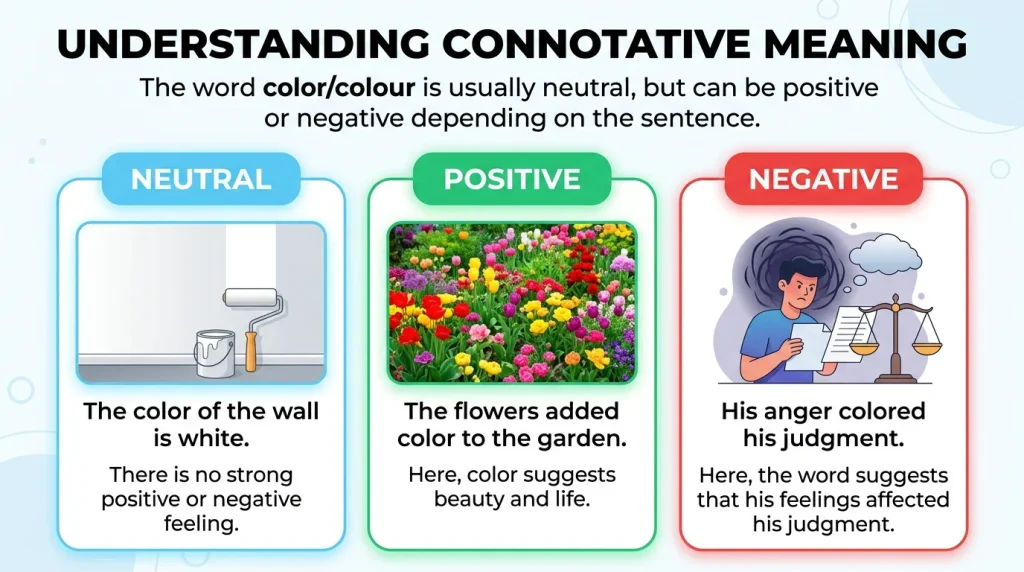
The word color/colour is usually neutral.
Positive
The flowers added color to the garden.
Here, color suggests beauty and life.
Negative
His anger colored his judgment.
Here, the word suggests that his feelings affected his judgment.
Neutral
The color of the wall is white.
There is no strong positive or negative feeling.
So, the word can be neutral, positive, or negative depending on the sentence.
Idioms and Proverbs
Several common expressions use color/colour.
True Colors
True colors means someone’s real character or feelings.
The team showed its true colors during the crisis.
British English can use true colours.
Rose-Colored Glasses
Rose-colored glasses describes seeing things in an overly positive way.
He looks at the problem through rose-colored glasses.
British English often writes rose-coloured glasses.
With Flying Colors
With flying colors means doing something very successfully.
She passed the test with flying colors.
British English often uses with flying colours.
See the Color of Someone’s Money
This expression means seeing whether someone really has the money they claim to have.
The seller wanted to see the color of his money.
Color and Colour in Literature and Movies
Different spelling styles can also appear in book and movie titles.
The Color Purple
The Color Purple is an American novel by Alice Walker, published in 1982.
The title uses the American spelling color.
The story later became a movie in 1985 in the United States.
The Colour of Magic
The Colour of Magic is a fantasy novel by British writer Terry Pratchett, published in 1983.
The title uses the British spelling colour.
These titles are a useful reminder that spelling can reflect the English variety used by the writer.
Why This Difference Matters
The difference matters when you want your writing to match a certain English style.
Using color in American English makes your writing fit common U.S. spelling.
Using colour in British English does the same for British style.
This can be useful in:
- school work
- websites
- blogs
- books
- business writing
- advertising
- editing
- SEO content
Usefulness in Daily Life
Knowing color or colour can help when you read websites, books, product labels, or school materials from different countries.
You may see color on an American website and colour in a British book. Knowing that both mean the same thing prevents confusion.
This is also helpful when writing online. If your website targets U.S. readers, color may fit your style. If it targets British readers, colour may fit better.
Learning related forms such as colored/coloured and coloring/colouring also helps you write more naturally.
Situational Preference
Choose color when your writing follows American English or targets mainly U.S. readers. Choose colour when your writing follows British English or targets readers who normally use that style. In school or work, follow the style guide you are given. For a global audience, either spelling can work, but do not switch between styles without a reason. This is especially useful in articles, websites, emails, and formal documents. The meaning stays the same in every case. The main goal is simple: match the spelling to your chosen English variety and use it consistently from beginning to end.
Common Questions About Color or Colour
1. Is color or colour correct?
Both are correct. Color is the standard American spelling, while colour is the standard British spelling.
2. Is colour British or American?
Colour is the standard British spelling. American English normally uses color.
3. Is color American or British?
Color is the standard American spelling. British English normally uses colour.
4. Do color and colour mean the same thing?
Yes. They have the same basic meaning. The difference is mainly spelling.
5. Are color and colour pronounced differently?
The pronunciation is very similar. The spelling difference does not create a major difference in the basic word sound.
6. What is the difference between colored and coloured?
Colored is the common American spelling. Coloured is the common British spelling.
7. What is the difference between coloring and colouring?
Coloring is the American spelling. Colouring is the British spelling.
Conclusion
Color or colour is a spelling difference, not a difference in meaning. Color is the standard spelling in American English, while colour is the standard spelling in British English. Both words have the same meaning and can be used as a noun or a verb. The same spelling pattern appears in related words. American English uses colored, coloring, and colorful, while British English uses coloured, colouring, and colourful. These spelling differences developed from older French and Latin forms, and American spelling reformers such as Noah Webster helped make shorter -or forms common in the United States. The easiest rule is to think about your readers. Use color for American English and colour for British English. For a global audience, either form can work, but keep your spelling style consistent. Once you learn this pattern, color or colour becomes simple to understand and use.

I’m Samia Jamshaid, an English language specialist, SEO specialist, digital publisher, and researcher. I create clear, accurate, and well-researched content on English grammar, vocabulary, word meanings, and language comparisons, helping readers understand and use English with confidence.




1 thought on “Color or Colour: American vs British English Guide 2026”