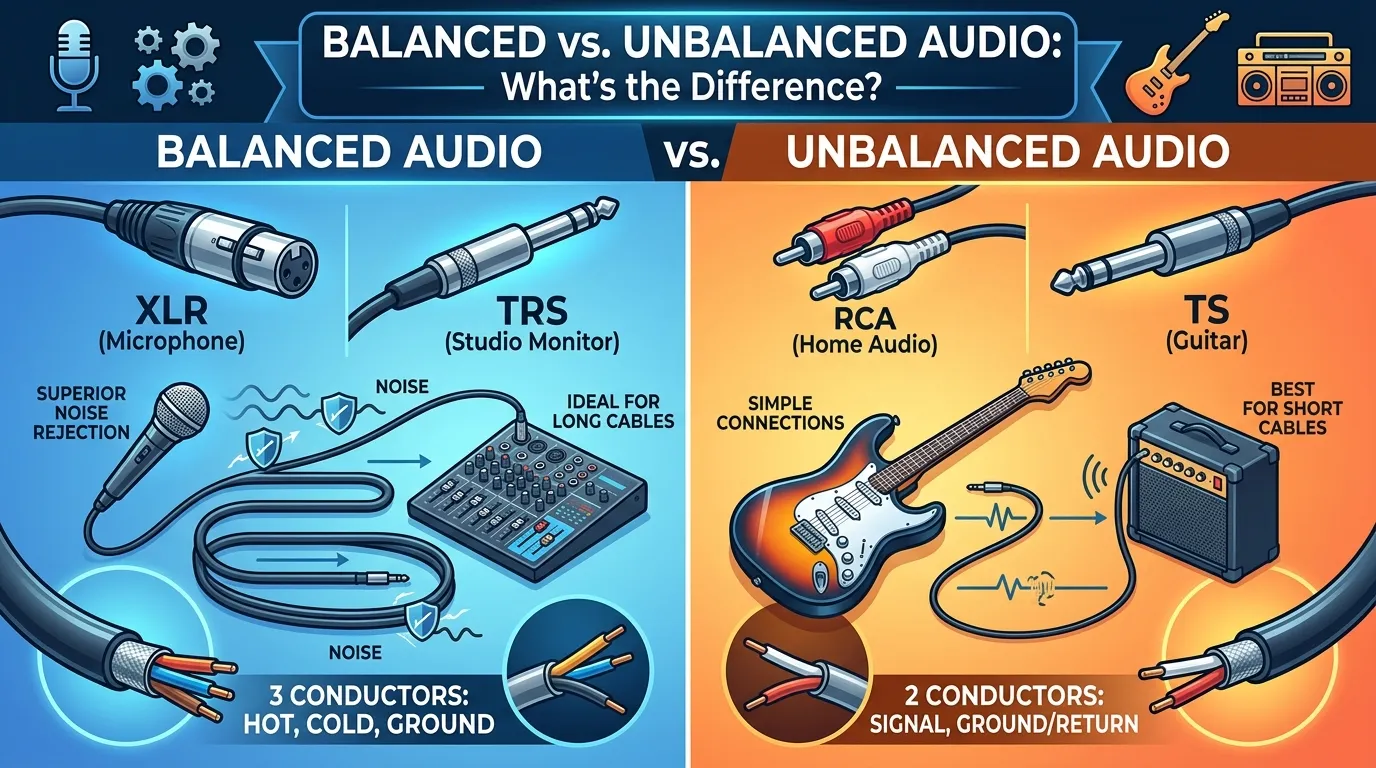
Balanced audio helps block unwanted noise, while unbalanced audio is a simple choice for many short audio connections.
Imagine you are setting up a small music room. You connect your guitar to an amp with a short cable. The sound is clear. Then you connect a microphone with a long cable. You hear a strange hum or buzz. This may make you ask, balanced or unbalanced—which one should I use?
Both types can carry audio. The main difference is how they carry the audio signal and deal with noise. A balanced connection normally uses three conductors. An unbalanced connection normally uses two.
If you are choosing between balanced or unbalanced audio, think about your equipment, cable length, and the area around the cable. Balanced connections are often better for long cables and places with a lot of electrical noise. Unbalanced connections often work well for short cables.
Pronunciation
| Word | US Pronunciation | UK Pronunciation | Syllables |
| Balanced | /ˈbælənst/ | /ˈbælənst/ | 2 |
| Unbalanced | /ʌnˈbælənst/ | /ʌnˈbælənst/ | 3 |
Balanced has two syllables. Unbalanced has three syllables.
Difference Between Balanced and Unbalanced
1. Basic Meaning
Balanced audio uses a special setup that helps reduce unwanted noise.
Unbalanced audio uses a simpler setup with fewer conductors.
Examples:
- The microphone uses a balanced connection.
- The guitar uses an unbalanced connection.
2. Number of Conductors
A normal balanced connection has three conductors:
- Hot
- Cold
- Ground
An unbalanced connection normally has two:
- Signal
- Ground or return
Examples:
- A normal XLR audio cable has three conductors.
- A normal TS guitar cable has two.
3. Noise
Balanced connections are better at reducing unwanted noise. This is helpful when audio cables are near power cables or other electronic devices.
Unbalanced connections can pick up more hum or buzz, especially when the cable is long.
Examples:
- A balanced microphone cable can help reduce noise on a stage.
- A short unbalanced guitar cable may work well in a quiet room.
4. Cable Length
Balanced connections are usually better for long cable runs.
Unbalanced connections are usually better for short runs.
There is no single distance that works for every audio system. The equipment, cable, and surroundings all matter.
Examples:
- A long microphone cable is usually balanced.
- A short guitar cable is usually unbalanced.
5. Common Connectors
Some connectors are often used with each type.
Unbalanced:
- RCA
- TS
Balanced:
- XLR
- TRS when used for balanced audio
The connector alone does not always tell you if the signal is balanced.
Examples:
- RCA is common in home audio.
- XLR is common for microphones.
6. Use With Instruments
Many musical instruments use unbalanced connections.
A guitar is a common example. It often uses a TS cable to connect to an amp.
Microphones and other professional audio gear often use balanced connections.
Examples:
- Guitar → amp = usually unbalanced.
- Microphone → audio interface = usually balanced.
7. Use in Professional Audio
Balanced connections are common in recording studios and live shows.
They are useful because audio cables may be long and may pass near many electronic devices.
Unbalanced connections are also used in professional audio. They are not always bad.
Examples:
- A stage microphone may use a balanced XLR cable.
- A guitar may use an unbalanced TS cable.
8. Cost
Unbalanced connections are often simpler and cheaper.
Balanced equipment can cost more because it needs equipment that supports the balanced signal.
Examples:
- A simple home audio setup may use RCA cables.
- A studio may use XLR or balanced TRS cables.
9. Balanced Does Not Mean Stereo
This is an important point.
Balanced tells us how an audio signal is carried.
Stereo usually means two audio channels: left and right.
These are not the same thing.
A TRS connector can carry balanced mono audio. It can also carry unbalanced stereo audio.
Examples:
- Balanced mono is not the same as stereo.
- Many headphone connections use TRS for unbalanced stereo.
10. Sound Quality
Balanced audio does not always sound better.
Its main benefit is better noise rejection.
If a short unbalanced connection is already clear, changing to balanced may not make a clear difference.
Examples:
- A short RCA cable can give clear sound.
- A balanced cable can help when a long cable picks up noise.
Explore related topics https://orchoice.com/color-or-colour/
Nature and Behaviour
The word balanced often means even or steady.
The word unbalanced often means uneven or not steady.
But in audio, these words have a special meaning.
Balanced audio means the connection is made to help reject noise.
Unbalanced audio means the connection uses a simpler design.
Unbalanced does not mean poor quality.
How Balanced Audio Works
Balanced audio normally uses three conductors.
One carries the main signal. Another carries an opposite version of the signal. The third is the ground.
If unwanted noise reaches both signal wires, the receiving equipment can reject much of that noise.
This is called common-mode rejection.
You do not need to remember the technical name. The simple idea is:
Balanced audio is designed to help keep unwanted noise out of the sound.
How Unbalanced Audio Works
Unbalanced audio uses a simpler design.
One conductor carries the audio signal. The other works as the return path and ground reference.
Because the ground path can also pick up interference, long unbalanced cables may collect more noise.
For short cables, this may not cause any problem.
Why Are Balanced and Unbalanced Confused?
The word balanced sounds better than unbalanced.
This can make people think balanced audio is always better.
That is not true.
Both types can work well. The right choice depends on the equipment and setup.
A short guitar cable can work well as an unbalanced connection. A long microphone cable will often work better as a balanced connection.
People also confuse balanced audio with stereo balance. These are different ideas.
Comparison Table
| Feature | Balanced | Unbalanced |
| Main goal | Reduce unwanted noise | Simple audio connection |
| Conductors | Usually 3 | Usually 2 |
| Noise protection | Better | Lower |
| Long cables | Usually better | More likely to pick up noise |
| Short cables | Works well | Works well |
| Common connectors | XLR, TRS | RCA, TS |
| Common use | Microphones, studio gear | Guitars, home audio |
| Cost | Often higher | Often lower |
| Design | More complex | Simpler |
| Main benefit | Noise rejection | Simple and common |
Origin of the Words
Balanced comes from the idea of being even or equal.
In audio, the word describes a connection that uses two signal paths in a balanced way.
Unbalanced starts with un-, which means “not.”
So, in simple terms, unbalanced audio does not use the same balanced signal design.
British vs. American English
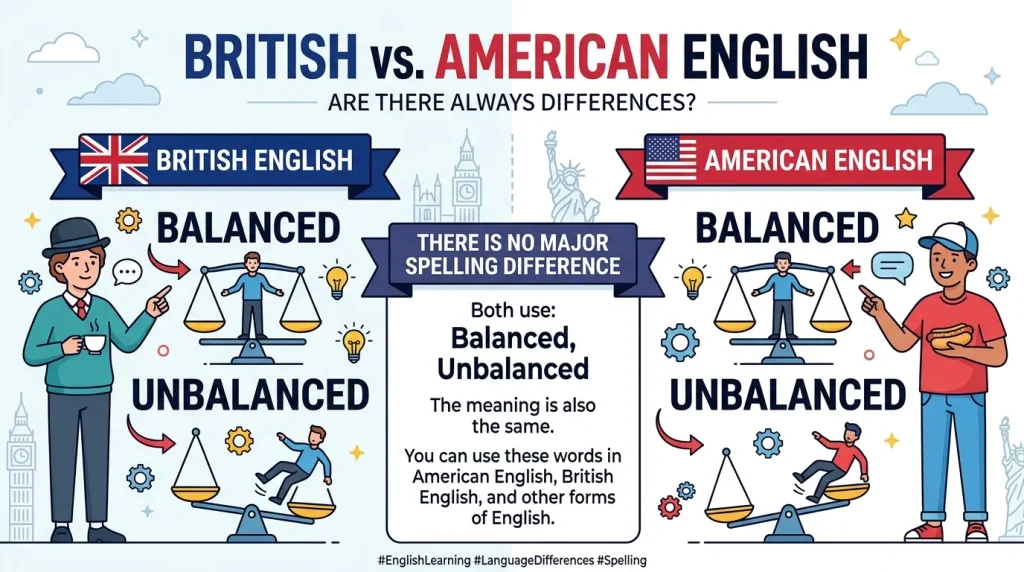
There is no major spelling difference between American and British English.
Both use:
- Balanced
- Unbalanced
The meaning is also the same.
You can use these words in American English, British English, and other forms of English.
Which One Should You Use?
The best choice depends on your equipment.
Use Balanced When:
- The cable is long.
- There is a lot of electrical noise.
- You are connecting a microphone.
- Your equipment supports balanced audio.
- You are working in a studio or live sound setup.
Use Unbalanced When:
- The cable is short.
- Your equipment uses an unbalanced connection.
- You are connecting a guitar to an amp.
- You are using RCA home audio equipment.
- Your current setup is clear and quiet.
Always check your equipment before buying a cable.
Common Mistakes
Mistake 1: Thinking Unbalanced Means Bad
It does not.
Unbalanced audio is used every day in many home and music setups.
Mistake 2: Thinking Balanced Always Sounds Better
Balanced audio mainly helps reduce noise.
It does not automatically make all audio sound better.
Mistake 3: Thinking Every XLR Cable Is Always Balanced
XLR is commonly used for balanced audio, but the equipment and wiring still matter.
Mistake 4: Thinking TRS Is Always Balanced
TRS can carry balanced mono audio. It can also carry unbalanced stereo audio.
Mistake 5: Confusing Balanced With Stereo
Balanced and stereo mean different things.
Balanced describes the way the signal is carried. Stereo usually means left and right channels.
Mistake 6: Confusing +4 dBu With Balanced
+4 dBu and −10 dBV are audio signal levels.
They do not simply mean balanced and unbalanced.
Mistake 7: Blaming the Cable for All Noise
A bad cable is not the only possible cause of noise.
Electrical problems, poor gain settings, grounding issues, and nearby devices can also cause hum or buzz.
Everyday Usage Examples
Home Audio
Many home audio systems use RCA cables.
RCA is normally an unbalanced connection.
For short connections, it can work very well.
Guitar Setup
A guitar often connects to an amp with a TS cable.
This is normally an unbalanced connection.
Recording Studio
A microphone often connects to an audio interface with an XLR cable.
This is normally a balanced connection.
Studio Monitors
Studio monitors may use balanced XLR or TRS connections.
This can help reduce unwanted noise.
Live Shows
Live shows often need long cable runs.
Balanced connections are common because they help reduce noise from nearby electrical equipment.
Usage Trends
Balanced and unbalanced connections are both still common.
Professional studios often use balanced connections for microphones, audio interfaces, mixers, and studio monitors.
Unbalanced connections remain common in home audio and musical instruments.
The choice is not about which type is newer.
It is about which type works best with your equipment.
Metaphors and Similes
Think of a balanced connection as a team working together to spot unwanted noise.
The two signal paths help the system tell the real audio apart from shared noise.
An unbalanced connection is like a simpler road. It works well, but it may be more open to noise when the road is long or the area is busy.
This is only a simple way to understand the idea.
Connotative Meaning
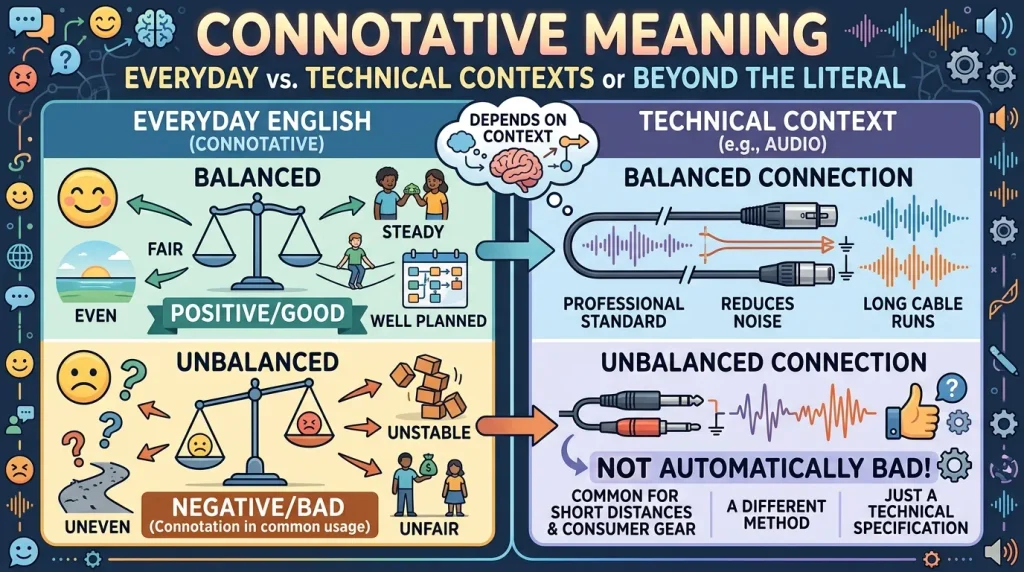
In everyday English, balanced usually has a good meaning.
It can mean:
- even
- fair
- steady
- well planned
Unbalanced can suggest:
- uneven
- unstable
- unfair
But in audio, these words are technical terms.
An unbalanced connection is not automatically bad.
Idioms and Proverbs
The words balanced and unbalanced are also used in everyday English.
“A balanced approach”
This means a fair or careful way of doing something.
Example:
She took a balanced approach to the problem.
“Keep your life balanced”
This means giving enough time to different parts of life.
Example:
He tries to keep work and family life balanced.
“Throw something off balance”
This means to make something less stable.
Example:
The sudden change threw the plan off balance.
These meanings are different from the audio meaning.
Literature and Movies
In books and movies, balance often means fairness, control, or peace.
A character may try to balance work and family. A story may show two sides trying to keep a balance.
Unbalanced can describe a person or situation that has lost control or stability.
In audio, however, these words have a technical meaning.
Why This Difference Matters
Knowing the difference between balanced and unbalanced audio can help you choose the right cable.
An unbalanced connection can work well for a short cable.
A balanced connection can be a better choice for a long cable or a noisy area.
Using the right connection can help prevent unwanted hum and buzz.
But balanced is not always needed. The most important thing is to check what your audio equipment supports.
Usefulness in Daily Life
You may see these terms when:
- connecting a guitar
- setting up a microphone
- using an audio interface
- setting up studio monitors
- building a home theater
- working with live sound
- connecting DJ equipment
- buying audio cables
Situational Preference
For a short connection in a quiet room, unbalanced audio is often enough. It is simple, common, and usually costs less. A guitar connected to a nearby amp is a good example.
For a long cable run, microphone, studio setup, or noisy area, balanced audio is often the better choice. It helps reduce unwanted noise and hum.
The best choice always depends on the equipment. Both types have a useful place in audio.
What People Ask About Balanced or unbalanced
1. Is balanced audio better than unbalanced audio?
Not always. Balanced audio is mainly better at rejecting unwanted noise. Unbalanced audio can work very well for short connections.
2. Is XLR balanced or unbalanced?
XLR is commonly used for balanced audio, especially with microphones.
3. Is RCA balanced or unbalanced?
RCA is normally unbalanced.
4. Is TRS balanced or unbalanced?
It can be either. TRS can carry balanced mono audio or unbalanced stereo audio.
5. Can unbalanced audio sound good?
Yes. Unbalanced audio can sound clear and clean, especially with short cables.
6. When should I use a balanced cable?
Use a balanced cable when your equipment supports it and you have a long cable run or want better protection from electrical noise.
7. Does balanced audio improve sound quality?
Not by itself. Its main benefit is better noise rejection. If your unbalanced connection is already clean, you may not notice a big sound difference.
Conclusion
Balanced or unbalanced audio connections both have useful roles. Balanced audio uses three conductors and helps reduce unwanted noise, so it is often a better choice for microphones, studios, live shows, and longer cable runs. Unbalanced audio uses a simpler two-conductor setup and works well for guitars, home audio, and short cable runs. Balanced does not always mean better sound, and unbalanced does not mean poor sound. The best choice depends on your equipment, cable length, and surroundings. Always check what your audio devices support before buying a cable. In simple terms, choose balanced when noise protection matters, and use unbalanced when a short, simple connection works well.

I’m Samia Jamshaid, an English language specialist, SEO specialist, digital publisher, and researcher. I create clear, accurate, and well-researched content on English grammar, vocabulary, word meanings, and language comparisons, helping readers understand and use English with confidence.










1 thought on “Balanced or Unbalanced: Complete Audio Guide 2026”