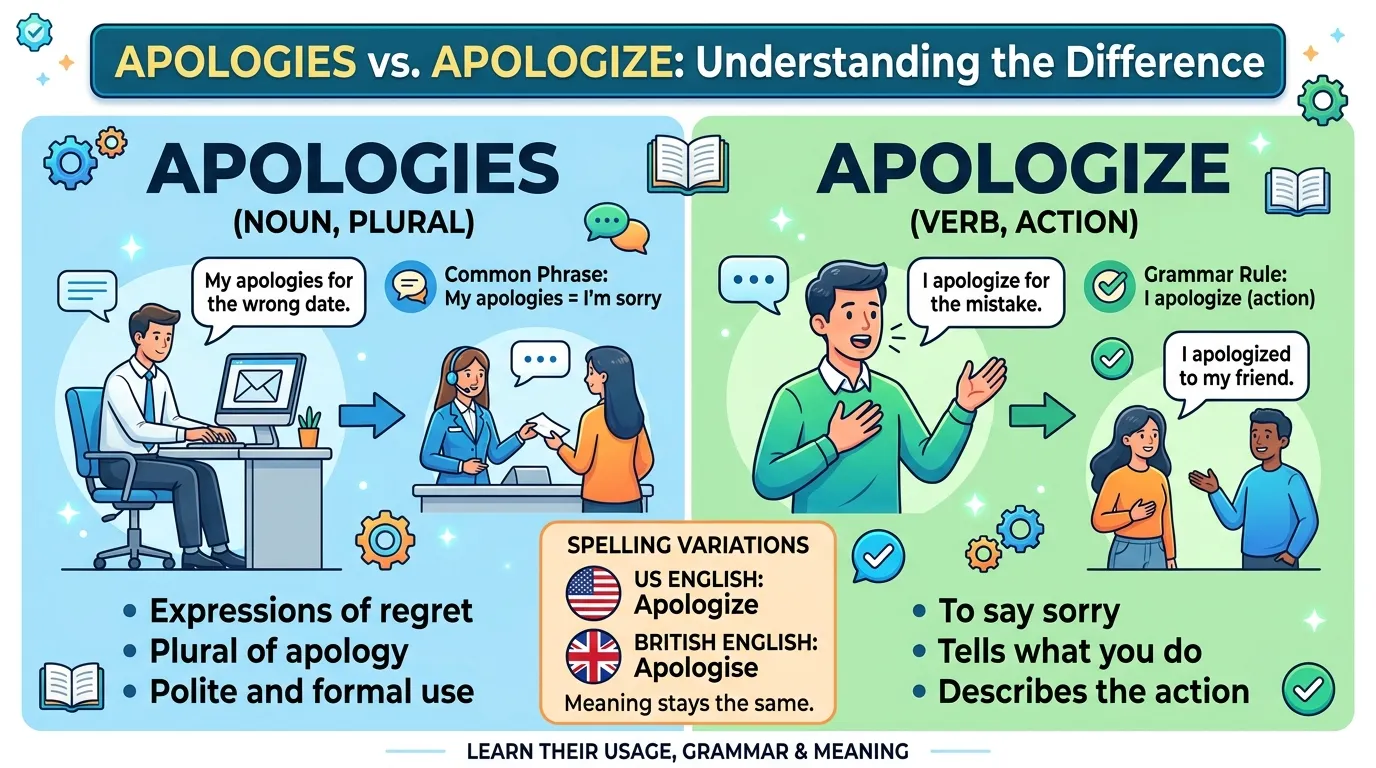
Apologies is a noun, while apologize is a verb. They are related, but you cannot use them in the same way.
Imagine you sent an email with the wrong date. Want to say sorry to your team. You could write, “I apologize for the mistake.” You could also write, “My apologies for the mistake.” Both are correct, but they work differently.
This is why apologies or apologize can confuse English learners. Apologize tells what you do when you say sorry. Apologies can mean expressions of regret, and my apologies is a common polite way to say “I’m sorry.”
There is also another spelling to know. American English uses apologize, while British English usually uses apologise. The meaning stays the same.
In this guide, we will explain apologies or apologize in simple words. You will learn their meanings, grammar, spelling, examples, common mistakes, and everyday use.
Apologies or Apologize: Difference
The easiest way to remember the difference is:
- Apologize = a verb meaning “to say sorry.”
- Apologies = a noun, usually the plural of “apology.”
- My apologies = a common polite way to say “I’m sorry.”
- Apology = the singular noun.
- Apologise = the British spelling of apologize.
Examples
- “I apologize for being late.”
- “My apologies for being late.”
- “She accepted my apology.”
- “We apologise for the delay.” (UK English)
Pronunciation
| Word | US Pronunciation | UK Pronunciation | Simple Sound |
|---|---|---|---|
| Apologies | /əˈpɑːlədʒiz/ | /əˈpɒlədʒiːz/ | uh-POL-uh-jeez |
| Apologize | /əˈpɑːlədʒaɪz/ | /əˈpɒlədʒaɪz/ | uh-POL-uh-jize |
| Apologise | — | /əˈpɒlədʒaɪz/ | uh-POL-uh-jize |
Apologise has the same basic pronunciation as apologize.
Difference Between Apologies and Apologize
1. Part of Speech
Apologize is a verb.
It tells us about an action.
- “I apologize for my mistake.”
- “She apologized to her friend.”
Apologies is a noun.
- “My apologies for the mistake.”
- “He sent his apologies.”
2. Meaning
Apologize means to say that you are sorry.
Apologies means expressions of regret. It is also used in the phrase my apologies.
- “I apologize for being late.”
- “My apologies for being late.”
3. Singular and Plural
The singular noun is apology.
The plural noun is apologies.
- “She gave me an apology.”
- “She sent her apologies.”
4. Verb vs. Noun
Use apologize when you need a verb.
- “I apologize for the error.”
- “They apologized to the customer.”
Use apology or apologies when you need a noun.
- “Please accept my apology.”
- “Please accept my apologies.”
5. “My Apology” vs. “My Apologies”
Both are correct.
My apology usually means one specific apology.
- “She did not accept my apology.”
- “I hope you accept my apology.”
My apologies is a common polite way to say “I’m sorry.”
- “My apologies for the late reply.”
- “My apologies for missing the meeting.”
6. Apologize to vs. Apologize for
Use apologize to before the person.
- “I apologized to my teacher.”
- “She apologized to her friend.”
Use apologize for before the reason.
- “I apologized for being late.”
- “He apologized for the mistake.”
You can use both together:
- “I apologized to my teacher for being late.”
- “She apologized to her friend for the mistake.”
7. American and British Spelling
American English uses:
apologize
British English usually uses:
apologise
The meaning does not change.
- US: “I apologize for the delay.”
- UK: “I apologise for the delay.”
8. Related Word Forms
Here are the main forms:
| Word | Type | Example |
| apology | noun | “I gave an apology.” |
| apologies | plural noun | “My apologies.” |
| apologize | verb | “I apologize.” |
| apologised | UK past verb | “She apologised.” |
| apologized | US past verb | “She apologized.” |
| apologising | UK -ing form | “He is apologising.” |
| apologizing | US -ing form | “He is apologizing.” |
9. Formal and Polite Use
Both forms can appear in polite or formal communication.
I apologize is direct:
- “I apologize for the error.”
My apologies is also polite:
- “My apologies for the late response.”
You may see both in emails, work messages, customer service, and official notices.
10. Sentence Structure
Apologize normally works as an action.
- “I apologize.”
- “We apologize for the delay.”
Apologies often works as a noun.
- “My apologies.”
- “Please accept my apologies.”
You may also like https://orchoice.com/reset-or-resetted/
Nature and Behaviour of Apologies and Apologize
Apologize
Apologize describes an action.
When you apologize, you say that you are sorry about something.
For example:
“I apologize for breaking your cup.”
Apologies
Apologies is a noun.
It can refer to expressions of regret.
The phrase my apologies is especially common when someone wants to say sorry in a polite way.
“My apologies for the confusion.”
Why Do People Get Confused?
People often confuse these words because they come from the same word family.
They also appear in similar sentences.
For example:
- “I apologize for the delay.”
- “My apologies for the delay.”
Both sentences have the same general message. However, apologize is a verb, while apologies is a noun.
Another problem is the spelling apologise. British English uses this spelling, while American English uses apologize.
Remember:
I apologize.
My apologies.
Comparison Table
| Feature | Apologies | Apologize |
| Part of speech | Noun | Verb |
| Basic form | Apology | Apologize |
| Meaning | Expressions of regret | Say sorry |
| Common phrase | My apologies | I apologize |
| US spelling | Apologies | Apologize |
| UK spelling | Apologies | Apologise |
| Example | “My apologies for the delay.” | “I apologize for the delay.” |
| Can refer to one situation? | Yes | Yes |
What Is the Origin of Apology and Apologize?
The word apology has a long history.
It comes from the Greek word apologia, which meant a speech or statement made in defense. It did not originally mean “I am sorry.”
Over time, the word developed a newer meaning: an expression of regret.
The verb apologize was later formed from apology with the ending -ize.
This gives us the modern words:
apology → apologies → apologize
The words have changed over time, but they are still closely connected.
British vs. American English
The main difference is spelling.
| Meaning | American English | British English |
| Present verb | apologize | apologise |
| Past verb | apologized | apologised |
| -ing form | apologizing | apologising |
| Noun | apology | apology |
| Plural noun | apologies | apologies |
For example:
US: “We apologize for the inconvenience.”
UK: “We apologise for the inconvenience.”
Both sentences are correct.
The spelling apologies does not change between these two forms.
Which One Should You Use?
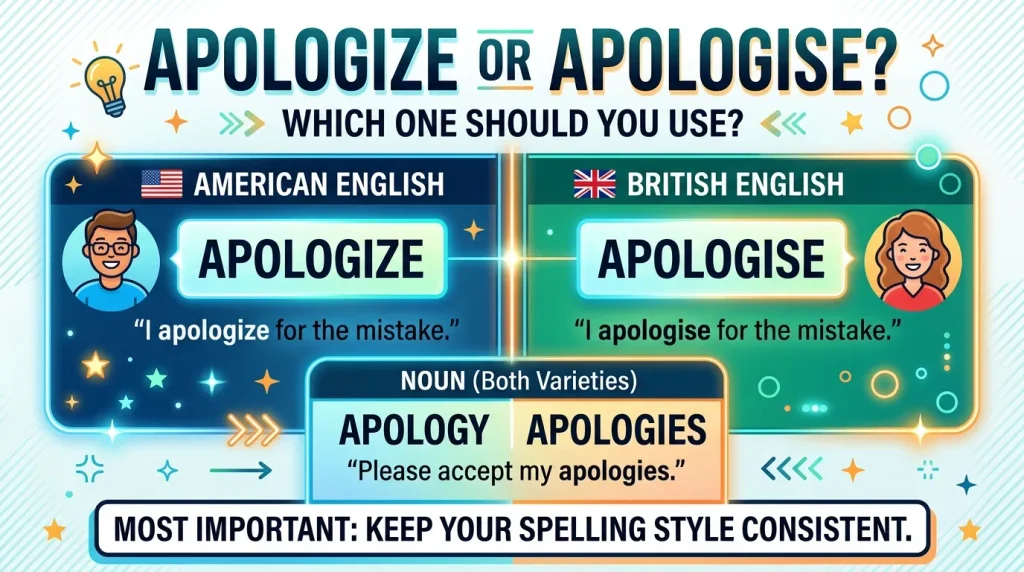
If you are writing in American English, use apologize.
“I apologize for the mistake.”
If you are writing in British English, use apologise.
“I apologise for the mistake.”
If you are writing the noun, use apology or apologies in both varieties.
“Please accept my apologies.”
The most important thing is to keep your spelling style consistent.
Common Mistakes
Mistake 1: Using “apologies” as a verb
Incorrect: “I apologies for the mistake.”
Correct: “I apologize for the mistake.”
Mistake 2: Using “apologize” as a noun
Incorrect: “Please accept my apologize.”
Correct: “Please accept my apologies.”
Mistake 3: Using “apologise” in American English
Incorrect: “I apologise for the delay.”
Correct: “I apologize for the delay.”
Note: “Apologise” is correct in British English.
Mistake 4: Using “apology” as a verb
Incorrect: “I apology for being late.”
Correct: “I apologize for being late.”
Mistake 5: Using the wrong preposition
Incorrect: “I apologize to the delay.”
Correct: “I apologize for the delay.”
Mistake 6: Thinking “my apology” is always wrong
Incorrect: “My apology is always wrong.”
Correct: “My apology was accepted.”
My apology is correct when it refers to one specific apology.
Everyday Usage
In Emails
My apologies works well in a polite email.
“My apologies for the late reply.”
You can also use I apologize.
“I apologize for the delay in sending the report.”
On Social Media
A short form can sound natural:
“My apologies for the confusion.”
Or:
“I apologize for the mistake.”
In News
News reports may use apology or apologies when discussing a public statement.
“The company issued an apology.”
“The company offered its apologies.”
In Formal Writing
Apology is often used as a noun.
“The letter included an apology for the error.”
Usage Trends
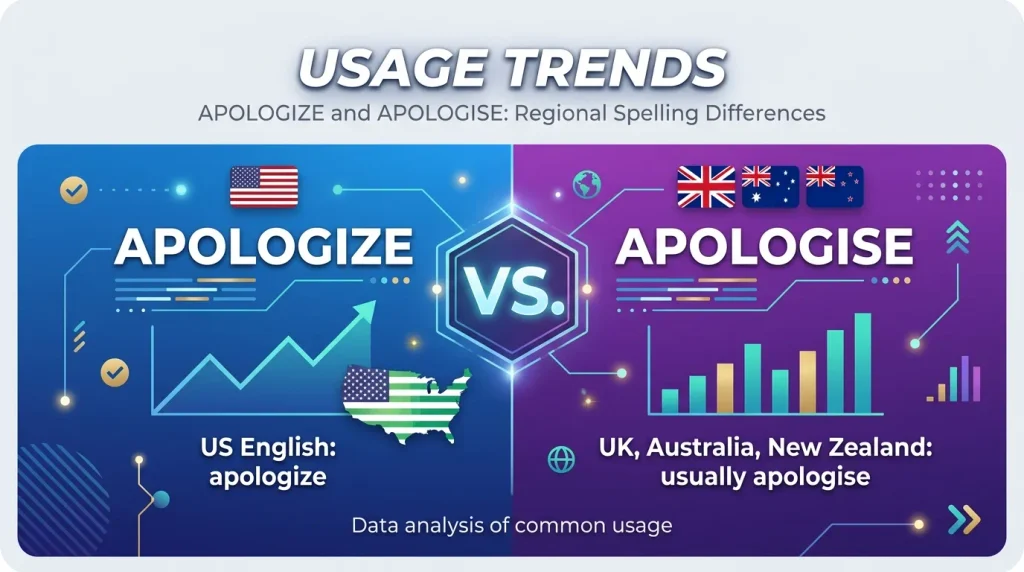
Apologize and apologise are both widely used.
The choice usually depends on the English variety.
- US English: apologize
- UK English: apologise
- Australia: usually apologise
- New Zealand: usually apologise
Metaphors and Similes
An apology is often described with simple images.
Metaphor
“An apology is a bridge.”
This means an apology can help repair a damaged relationship.
Simile
“His apology was like a first step toward peace.”
This compares an apology with taking the first step toward fixing a problem.
These examples show that an apology can help people move forward after a mistake.
Connotative Meaning
Positive
An apology can show honesty, respect, and responsibility.
“Her sincere apology helped repair the friendship.”
Negative
An apology can sometimes seem forced or insincere.
“His apology sounded forced.”
Neutral
The word can simply state that someone is sorry.
“My apologies for the late reply.”
So, apology and apologize do not have one fixed positive or negative feeling. The context matters.
Idioms and Common Expressions
There are several common expressions with these words.
“My apologies”
This means “I’m sorry.”
“My apologies for the delay.”
“Please accept my apologies”
This is a polite and often formal way to say sorry.
“Please accept my apologies for missing the meeting.”
“Without apology”
This means doing or saying something without feeling sorry about it.
“She spoke her opinion without apology.”
“Letter of apology”
This means a letter that expresses regret.
“He wrote a letter of apology.”
Literature and Movies
The word apology also appears in titles and older works.
Literature
The Apology is a famous work by the Greek philosopher Plato. It presents a version of the defense made by Socrates at his trial in ancient Athens.
This is an important historical example because the older meaning of apology was connected with a defense or explanation.
Music and Popular Culture
The word Apologize is also well known as the title of a song by OneRepublic, released in 2006 and later widely known through a 2007 version with Timbaland.
Why This Difference Matters
Knowing the difference helps you write clear English.
If you need a verb, use apologize or apologise.
“I apologize for the mistake.”
If you need a noun, use apology or apologies.
“Please accept my apologies.”
This small grammar difference can make emails, school work, and work messages sound more natural.
It also helps you avoid common mistakes such as “I apologies” and “my apologize.”
Usefulness in Daily Life
These words are useful in many everyday situations.
You may need them when:
- writing an email
- replying to a customer
- missing a meeting
- making a mistake
- arriving late
- hurting someone’s feelings
- correcting an error
- writing a formal letter
- speaking to a teacher
- talking to a friend
For a casual situation, you may simply say “Sorry.”
For a more formal situation, you can say:
“I apologize for the inconvenience.”
Or:
“Please accept my apologies.”
Situational Preference
Choose apologize when you want to describe the action of saying sorry. Use apologise if you follow British spelling. Choose my apologies when you want a polite way to say sorry, especially in emails or work messages. Use my apology when you mean one specific apology. Use apology when you need the singular noun. For example, “I apologize for being late” describes the action, while “My apologies for being late” is a polite expression. The choice depends on grammar, meaning, and the English style you are using.
Common Questions and Answers
1. Is “my apology” correct?
Yes. My apology is correct when you mean one specific apology.
“She accepted my apology.”
2. Is “my apologies” correct?
Yes. My apologies is a common polite way to say “I’m sorry.”
“My apologies for the delay.”
3. Which is more natural: “my apology” or “my apologies”?
Both are correct, but they are used differently. My apologies is the common fixed expression used directly to say sorry. My apology often refers to one particular apology.
4. Is “apologize” American or British?
Apologize is the standard spelling in American English. British English usually uses apologise.
5. Is “apologise” the British spelling?
Yes. Apologise is the usual British spelling of apologize.
6. Should I say “apologize to” or “apologize for”?
Use apologize to for the person and apologize for for the reason.
“I apologized to my teacher for being late.”
7. What is the plural of “apology”?
The plural is apologies.
“She offered her apologies.”
Conclusion
Apologies or apologize are related words, but they have different jobs in a sentence. Apologize is a verb that means to say sorry, while apologise is the usual British spelling of the same verb. Apology is a noun, and apologies is its plural form. The phrase my apologies is also a common polite way to say “I’m sorry,” even when you are sorry about only one situation. My apology is correct when you mean one specific apology. For example, “She accepted my apology.” In American English, use apologize, while British English usually uses apologise. Remembering these simple differences can help you choose the right word and avoid common grammar and spelling mistakes. Whether you are writing an email, sending a message, or speaking with someone, using the correct form makes your English clear and natural.”

I’m Samia Jamshaid, an English language specialist, SEO specialist, digital publisher, and researcher. I create clear, accurate, and well-researched content on English grammar, vocabulary, word meanings, and language comparisons, helping readers understand and use English with confidence.





1 thought on “Apologies or Apologize: Mistakes and Correct Usage 2026”