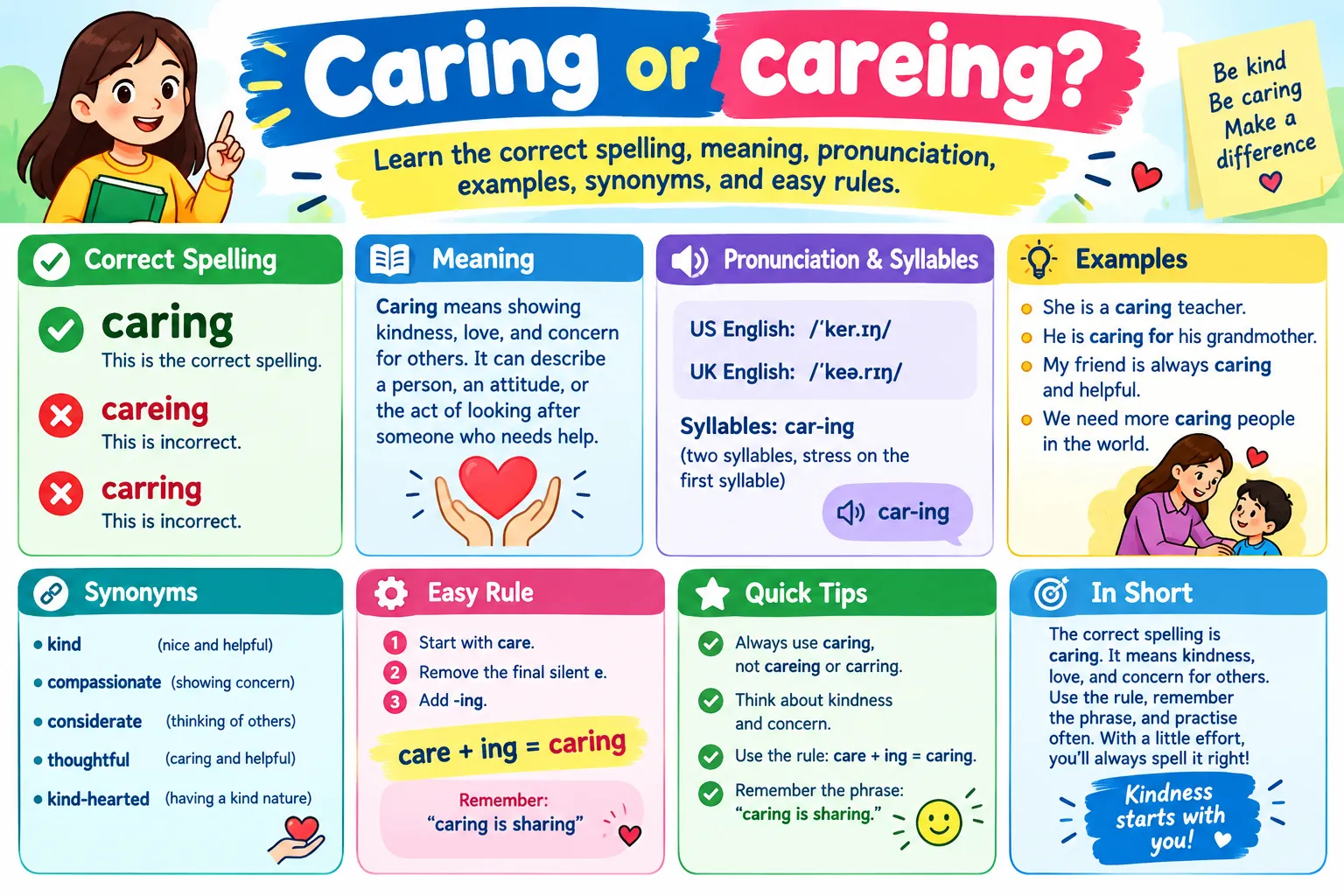
Have you ever wondered whether to write caring or careing? Many people make this spelling mistake. But the answer is simple. Caring is correct, while careing is incorrect.
The word caring means showing kindness, love, and concern for others. A caring person helps people when they need support. For example, a caring teacher helps students learn, and a caring friend listens when you have a problem.
Why do we spell it caring instead of careing? The answer is a simple spelling rule. When we add -ing to a word that ends in a silent e, we usually remove the e first. So, care becomes caring.
In this guide, you will learn the correct spelling, meaning, pronunciation, and use of caring. You will also see easy examples, common mistakes, synonyms, and answers to popular questions.
1. Caring vs. Careing: Which Is Correct?
Caring is the correct spelling. Careing is wrong.
The word caring comes from the verb care. When we add -ing, we remove the final e.
| Word | Correct or Incorrect | Explanation |
| Caring | Correct | The final e is removed before adding -ing. |
| Careing | Incorrect | The final e should be removed. |
| Carring | Incorrect | This word has the wrong spelling. |
Examples
Incorrect: She is a careing friend.
Correct: She is a caring friend.
Incorrect: He is always careing for his grandmother.
Correct: He is always caring for his grandmother.
Incorrect: We need more carring people.
Correct: We need more caring people.
2. What Does Caring Mean?
Caring means showing kindness and concern for other people. It can describe a person who helps others or an action that gives support.
Caring as an adjective
An adjective describes a person, place, or thing. Caring describes someone who is kind and helpful.
Examples:
- My mother is a caring person.
- She is a caring teacher.
- He has a caring heart.
- We live in a caring community.
Caring as a noun
Caring can also mean looking after people who need help.
Examples:
- Caring for older people takes patience.
- Caring for children is an important job.
- The caring professions help people who need support.
Caring as a verb form
Caring can also show that someone is looking after a person or animal.
Examples:
- She is caring for her sick father.
- He is caring for a small puppy.
- They are caring for the injured bird.
3. Why Is Caring the Correct Spelling?
English has a useful spelling rule.
When a verb ends in a silent e, we usually drop the e before adding -ing.
The rule is:
Care + ing = Caring
Here are some more examples:
| Base Word | Correct Spelling |
| Make | Making |
| Hope | Hoping |
| Write | Writing |
| Dance | Dancing |
| Smile | Smiling |
| Take | Taking |
| Care | Caring |
For example, we write making, not makeing. In the same way, we write caring, not careing.
This rule works for many common English words, although some words follow different spelling patterns.
4. Easy Ways to Remember Caring
These simple tricks can help you remember the correct spelling.
Trick 1: Remember the rule
Start with care. Remove the final e and add -ing.
- Care
- Remove e
- Add ing
- Caring
Trick 2: Remember “Caring is sharing”
The phrase “Caring is sharing” connects kindness with sharing. It can help you remember the word caring.
Example: He shared his lunch with a friend because he believed that caring is sharing.
Trick 3: Think about kindness
Imagine a friend who helps you when you feel sad. That friend is caring.
Connect the word with kindness to help you remember its meaning and spelling.
Trick 4: Say the word slowly
Say car-ing. The word has two syllables. Remember that caring does not keep the final e from care.
Keep exploring https://orchoice.com/prise-or-prize/
5. Caring Pronunciation and Syllables
Learning how to say a word can help you use it correctly.
Pronunciation:
- US English: /ˈker.ɪŋ/
- UK English: /ˈkeə.rɪŋ/
The sound may change a little from one accent to another.
Syllables: Caring has two syllables: car-ing.
The first syllable is stressed when you say the word.
6. Synonyms of Caring
Synonyms are words that have the same or a similar meaning.
Here are some useful synonyms for caring.
| Synonym | Simple Meaning | Example |
| Kind | Nice and helpful | She is kind to everyone. |
| Caring | Showing concern for others | He is a caring friend. |
| Compassionate | Wanting to help people who suffer | The compassionate nurse helped the patient. |
| Considerate | Thinking about other people’s needs | He was considerate of his friends. |
| Kind-hearted | Having a kind nature | My kind-hearted neighbor helped me. |
| Warm-hearted | Friendly and loving | She is a warm-hearted person. |
| Thoughtful | Thinking about others | His thoughtful gift made me smile. |
| Supportive | Giving help or encouragement | My family is supportive. |
| Empathetic | Understanding how others feel | An empathetic teacher listens carefully. |
| Attentive | Paying close attention | The attentive nurse checked on the patient. |
7. Antonyms of Caring
Antonyms are words with opposite meanings.
| Antonym | Simple Meaning | Example |
| Uncaring | Not showing concern | His uncaring words hurt her. |
| Indifferent | Not interested or concerned | He seemed indifferent to the problem. |
| Unkind | Not nice or helpful | It was unkind to laugh at him. |
| Insensitive | Not thinking about others’ feelings | Her insensitive words made him sad. |
| Thoughtless | Not thinking about how actions affect others | His thoughtless joke upset his friend. |
| Cold-hearted | Not showing kindness or sympathy | The cold-hearted reply shocked everyone. |
| Careless | Not taking enough care | It was a careless mistake. |
8. Caring in Everyday Sentences
Reading examples can help you understand how to use caring.
Caring at home
- My mother is a caring person.
- My father has a caring nature.
- My sister is always caring for our little brother.
- My family gives me caring support.
At school
- A caring teacher helps every student.
- Our school has a caring environment.
- A caring friend shares and helps.
- Caring classmates make school more enjoyable.
Caring for animals
- She is caring for a stray cat.
- He has a caring attitude toward animals.
- The children are caring for a small puppy.
- A caring person treats animals kindly.
In the community
- A caring neighbor helped us when we were sick.
- Volunteers showed their caring side at the shelter.
- A caring community helps people in need.
- Their caring actions made everyone smile.
9. Common Mistakes With Caring
Many people make small mistakes when writing caring. Here are some mistakes to avoid.
Mistake 1: Writing careing
Incorrect: She is a careing mother.
Correct: She is a caring mother.
Why? Remove the final e before adding -ing.
Mistake 2: Writing carring
Incorrect: He is a carring teacher.
Correct: He is a caring teacher.
Why? The correct spelling is caring, with one r after the letter a.
Mistake 3: Confusing caring with careful
Caring and careful come from the same root word, but they have different meanings.
- Caring means showing kindness.
- Careful means taking care to avoid mistakes or danger.
Examples:
- She is a caring teacher who helps her students.
- She is a careful teacher who checks her work.
Mistake 4: Forgetting the meaning of caring for
Caring for often means looking after someone or something.
Examples:
- She is caring for her grandmother.
- He is caring for a sick dog.
10. Caring vs. Careful vs. Carelessly
These words look similar, but their meanings are different.
| Word | Meaning | Example |
| Caring | Showing kindness | She is a caring friend. |
| Careful | Trying to avoid mistakes or danger | Be careful near the road. |
| Carefully | Doing something with care | He carefully opened the box. |
| Careless | Not taking enough care | It was a careless mistake. |
| Carelessly | Doing something without enough care | She carelessly dropped the cup. |
11. Where Does the Word Caring Come From?
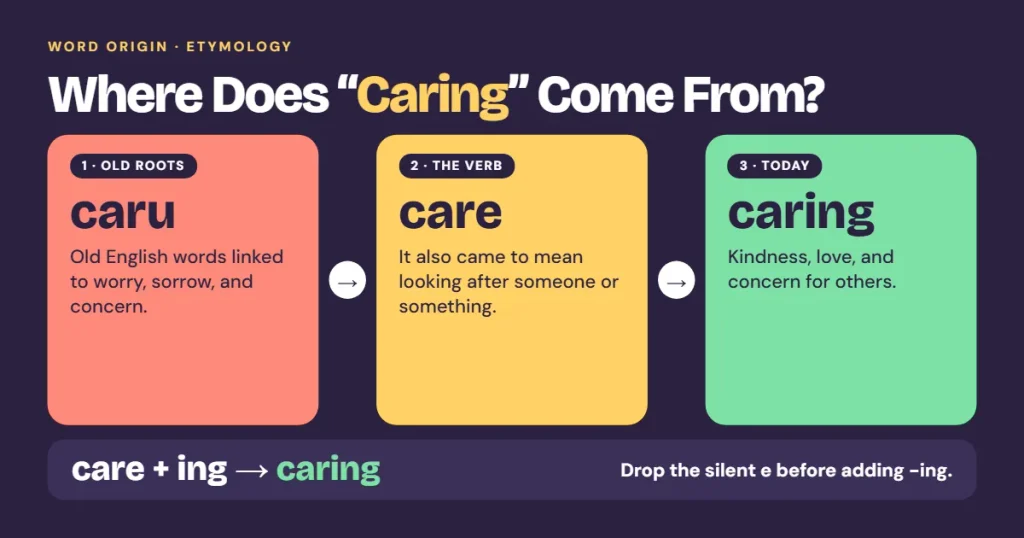
The word caring comes from the verb care. The word care has roots in Old English words linked to worry, sorrow, and concern.
Over time, care also came to mean looking after someone or something. Today, caring often describes kindness, love, and concern for others.
The word is formed by adding -ing to care. We remove the final silent e before adding the suffix.
That is why the correct spelling is caring.
12. Caring in British and American English
The spelling of caring is the same in British and American English.
| Feature | British English | American English |
| Correct spelling | Caring | Caring |
| Incorrect spelling | Careing | Careing |
| Meaning | Showing kindness or concern | Showing kindness or concern |
| Example | She is a caring teacher. | She is a caring teacher. |
13. Common Phrases With Caring
Some common phrases use the word caring to talk about kindness and support.
Caring is sharing
This phrase means that sharing can be a way to show kindness.
Example: He shared his food with a friend. Caring is sharing!
A caring heart
This phrase describes someone who is kind and thoughtful.
Example: She has a caring heart and always helps others.
A caring environment
This phrase describes a place where people feel safe and supported.
Example: The teacher created a caring environment for her students.
These phrases can help you use caring in everyday writing.
14. Why Is Caring Important?
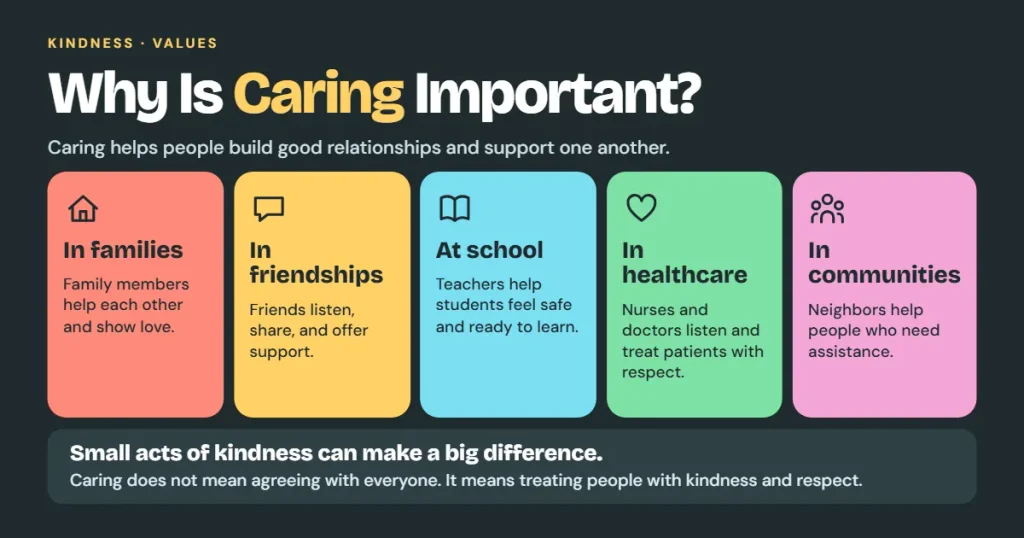
Caring helps people build good relationships and support one another.
In families
Caring family members help each other and show love.
In friendships
Caring friends listen, share, and offer support when someone has a problem.
At school
Caring teachers help students feel safe and ready to learn.
In healthcare
Caring nurses and doctors listen to patients and treat them with respect.
In communities
Caring people help their neighbors and support people who need assistance.
Small acts of kindness can make a big difference. Caring does not mean agreeing with everyone. It means treating people with kindness and respect.
15. Questions About Caring or Careing
1. Is it caring or careing?
Caring is correct. Careing is incorrect because the final silent e is removed before adding -ing.
2. Is carring correct?
No. The correct spelling is caring.
3. What does caring mean?
Caring means showing kindness, love, and concern for others.
4. How do you pronounce caring?
In common US English, it is pronounced /ˈker.ɪŋ/. In many UK accents, it is pronounced /ˈkeə.rɪŋ/.
5. How many syllables are in caring?
Caring has two syllables: car-ing.
6. What is the root word of caring?
The root word is care.
7. Is caring a noun or an adjective?
It can be both. In “a caring person,” it is an adjective. In “caring for others takes time,” it is a noun-like form of the verb.
8. What are synonyms for caring?
Some synonyms are kind, compassionate, considerate, and kind-hearted.
9. What is the opposite of caring?
Common opposites include uncaring, indifferent, and unkind.
10. Is caring spelled the same in British and American English?
Yes. Both use the spelling caring.
Conclusion
The correct spelling is caring, not careing or carring. The spelling rule is simple: start with the word care, remove the final silent e, and add -ing to make caring. Caring means showing kindness, love, and concern for others. It can describe a person who is kind and thoughtful or the act of looking after someone who needs help. For example, you can say, “She is a caring teacher” or “He is caring for his grandmother.” Remember this easy spelling rule: care + ing = caring. You can also use the phrase “caring is sharing” to help you remember the correct spelling. Learning this rule will improve your English writing and help you avoid common spelling mistakes. Whenever you want to describe kindness, support, or concern for others, use caring. With regular practice, you will find it easier to spell and use this word correctly in everyday writing.

I’m Samia Jamshaid, an English language specialist, SEO specialist, digital publisher, and researcher. I create clear, accurate, and well-researched content on English grammar, vocabulary, word meanings, and language comparisons, helping readers understand and use English with confidence.






1 thought on “Caring or Careing? Which Spelling Is Correct? 2026”