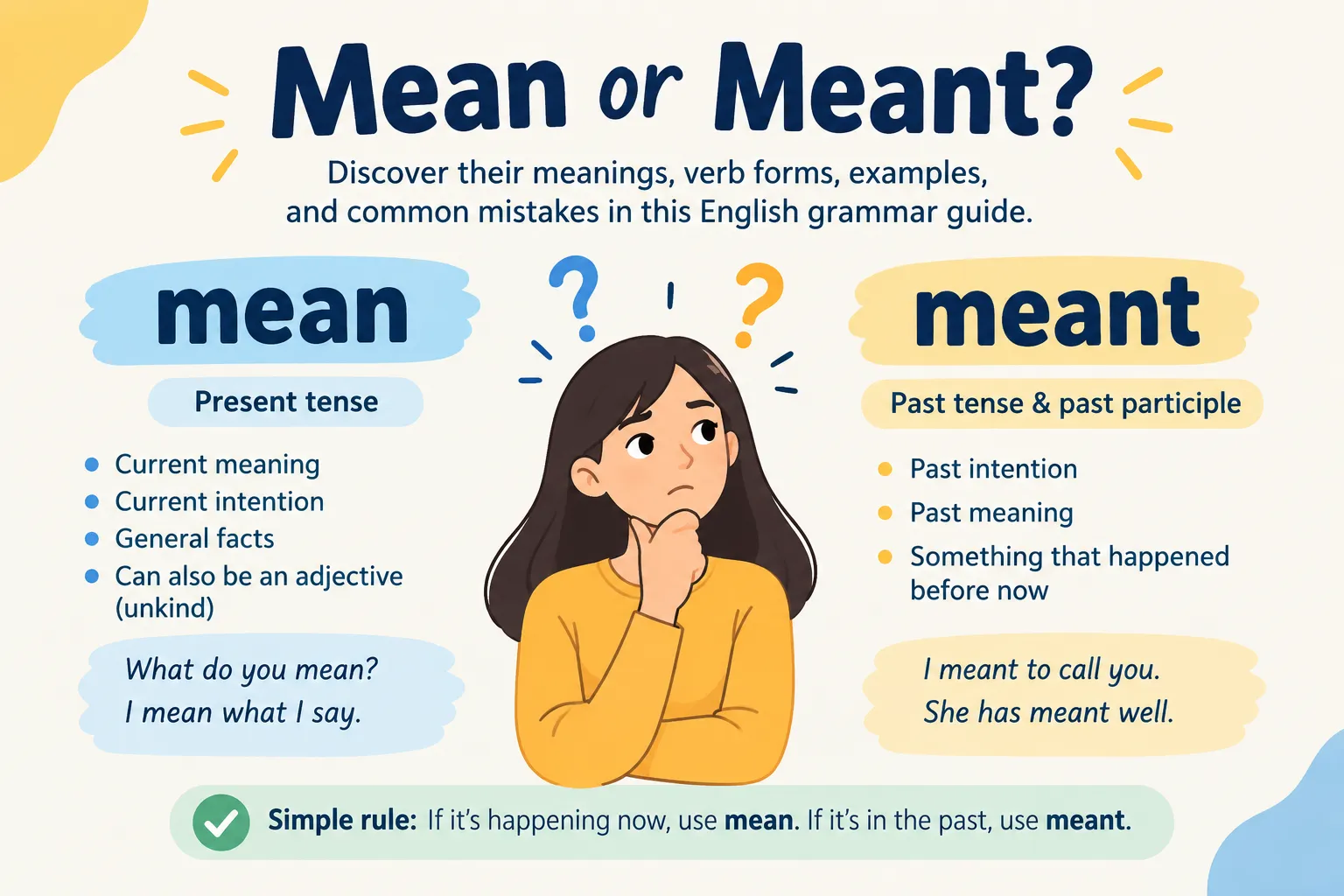
Have you ever wondered whether to write mean or meant? These words look alike, but they are used in different ways. For example, you might say, “I mean what I say” when you speak about your present thoughts. But you would say, “I meant to call you yesterday” when talking about a past plan.
The main difference between mean or meant is simple: mean is the base form of the verb, while meant is its simple past form and past participle. The word mean can also be an adjective that describes someone or something unkind.
In this guide, you will learn when to use each word, how to avoid common mistakes, and how to use both words in daily English. You will also find clear examples, grammar tips, and a short quiz to test your knowledge.
Answer: Mean vs. Meant
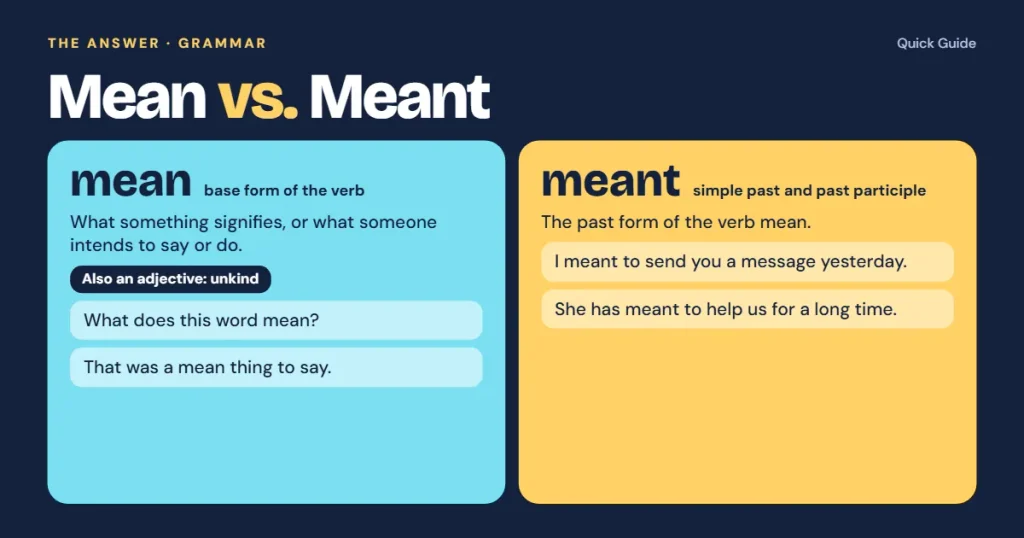
- Mean: The base form of a verb. It can describe what something signifies or what someone intends to say or do.
- Meant: The simple past form and past participle of mean.
- Mean (adjective): Can describe someone who is unkind or a person who acts badly toward others.
Examples:
- What does this word mean?
- I meant to send you a message yesterday.
- She has meant to help us for a long time.
- That was a mean thing to say.
What Does Mean Mean?
Mean (verb): To express, signify, or intend something.
We use mean when asking about a word’s meaning, explaining an idea, or sharing an intention.
Examples:
- What does this sign mean?
- I mean every word I say.
- This gift means a lot to me.
- What do you mean by that question?
The verb changes with the subject. We use mean with I, you, we, and they. We usually add -s to make means when the subject is he, she, or it.
- I mean what I say.
- They mean well.
- She means no harm.
- This word means something different here.
Mean as an Adjective
Mean (adjective): Unkind, hurtful, or not generous.
In this use, mean does not describe the act of expressing an idea. It describes a person, action, or behavior.
Examples:
- He was mean to his little brother.
- It was mean to laugh at her mistake.
- The man is mean with his money.
Compare these two sentences:
- “What do you mean?” asks someone to explain an idea.
- “That was mean” says that an action was unkind.
What Does Meant Mean?
Meant (verb): The simple past form and past participle of mean.
Use meant to talk about an earlier meaning, intention, or plan. It is also used with helping verbs such as has, have, and had.
Examples:
- I meant to call you last night.
- She meant no harm.
- We meant to arrive early.
- I have meant to ask you that question for weeks.
- They had meant to surprise their mother.
Mean vs. Meant: Main Differences
| Feature | Mean | Meant |
| Verb form | Base form | Simple past and past participle |
| Main use | Present or general meaning and intention | Past meaning and intention; perfect verb forms |
| Example | I mean what I say. | I meant what I said. |
| With do | What do you mean? | What did you mean? |
| With have | I have to mean it is not the usual construction for this meaning. | I have meant to ask you. |
| Adjective use | Can mean unkind | Not normally used as an adjective in this sense |
Verb Forms of Mean
The verb mean is irregular. Its past form does not end in -ed. The correct form is meant, not meaned.
| Verb form | Correct word | Example |
| Base form | mean | I mean what I say. |
| Third-person singular | means | This sign means danger. |
| Simple past | meant | I meant to help. |
| Past participle | meant | She has meant well. |
| Future form | will mean | This will mean a change. |
The base form is also used after do, does, and did in questions and negatives.
- What do you mean?
- What does she mean?
- What did you mean?
- I did not mean to upset you.
Keep exploring https://orchoice.com/caring-or-careing/
When Should You Use Mean?
Use mean in these common situations.
1. To Ask About a Word or Idea
Use mean when you want someone to explain something.
- What does this word mean?
- What do you mean by “soon”?
- This symbol means peace.
2. To Explain Your Current Intention
Use mean when you are explaining what you intend or believe now.
- I mean to finish my work today.
- I mean no harm.
- I mean what I say.
3. To State a General Fact
Use mean or means to explain what something stands for or leads to.
- A red light means stop.
- More practice can mean better results.
- These marks mean the test is complete.
4. To Describe Unkind Behavior
Use mean as an adjective when someone acts in an unkind way.
- Do not be mean to your friends.
- That was a mean joke.
- She was not trying to be mean.
When Should You Use Meant?
Use meant when the sentence calls for the past form or past participle.
1. To Talk About a Past Intention
- I meant to reply yesterday.
- He meant to bring his notebook.
- We meant to visit you last week.
2. To Explain an Earlier Message
- I meant that as a joke.
- What meant the most to you during the trip?
- She meant that she would return soon.
The second example is grammatical, but a more natural question in many situations is, “What mattered most to you during the trip?” Use meant the most when you want to focus on the importance or significance of something.
3. To Use the Past Participle
Use meant after has, have, or had when the sentence needs the perfect form.
- I have meant to call you.
- She has meant well from the start.
- We had meant to leave before dark.
4. To Talk About a Purpose
The phrase was meant to often describes a plan, purpose, or expected result.
- This note was meant to help you.
- The room was meant to be a study area.
- The message was meant to make everyone laugh.
10 Differences Between Mean and Meant
1. Present Meaning vs. Past Meaning
- Mean: What does this word mean?
- Meant: What did this word mean in the old book?
2. Current Intention vs. Past Intention
- Mean: I mean to finish this today.
- Meant: I meant to finish it yesterday.
3. Questions With Do vs. Did
- Mean: What do you mean?
- Meant: What did you mean?
4. General Fact vs. Earlier Fact
- Mean: These signs mean danger.
- Meant: The old signs meant danger to travelers.
5. Base Form vs. Past Participle
- Mean: I want to mean what I say.
- Meant: I have meant to speak to you.
6. Correct Form vs. Incorrect Form
- Mean: I do not mean to complain.
- Meant: I did not mean to complain yesterday.
Do not write “I did not meant.” After did not, use mean.
7. Present Description vs. Past Description
- Mean: This word means something kind.
- Meant: That word meant something different in the old text.
8. Present Plan vs. Past Plan
- Mean: We mean to start soon.
- Meant: We meant to start earlier.
9. Current Message vs. Earlier Message
- Mean: I mean this message to be helpful.
- Meant: I meant that message to be helpful.
10. Adjective vs. Verb Form
- Mean: He is mean to his classmates. (Adjective: unkind)
- Meant: He meant to speak to his classmates. (Verb: intended)
Common Mistakes With Mean and Meant
Mistake 1: Using Meant for a Present Statement
Incorrect: I meant what I say.
Correct: I mean what I say.
Use mean because the speaker is talking about what they say now or as a general statement.
Mistake 2: Using Mean With a Past Time
Incorrect: I mean to call you yesterday.
Correct: I meant to call you yesterday.
The sentence describes an earlier intention, so meant is the correct choice.
Mistake 3: Adding -ed to Mean
Incorrect: I meaned no harm.
Correct: I meant no harm.
Mean is an irregular verb. Its past form is meant, not meaned.
Mistake 4: Using Meant After Did
Incorrect: What did you meant?
Correct: What did you mean?
After did, use the base form of the main verb.
Mistake 5: Using Mean After Has
Incorrect: She has mean well.
Correct: She has meant well.
After has in this perfect-tense construction, use the past participle meant.
Mistake 6: Confusing the Verb With the Adjective
Incorrect: He meant to his sister.
Correct: He was mean to his sister.
Use was mean to describe unkind behavior. Use meant when talking about the past form of the verb.
Mistake 7: Using Meant After Does
Incorrect: What does this word meant?
Correct: What does this word mean?
After does, use the base form mean.
Mean or Meant in Everyday English
Here are natural examples from common situations.
In Daily Conversation
- Present: What do you mean?
- Past: I meant to tell you earlier.
At School
- Present: What does this sentence mean?
- Past: The teacher meant that we should read the whole chapter.
At Work
- Present: I mean to finish the report today.
- Past: I meant to send the report yesterday.
In Messages
- Present: I mean every word in this message.
- Past: I meant that as a joke.
In News and Public Information
- Present: The new rule means higher costs for some families.
- Past: The announcement meant major changes for the team.
Common Phrases With Mean and Meant
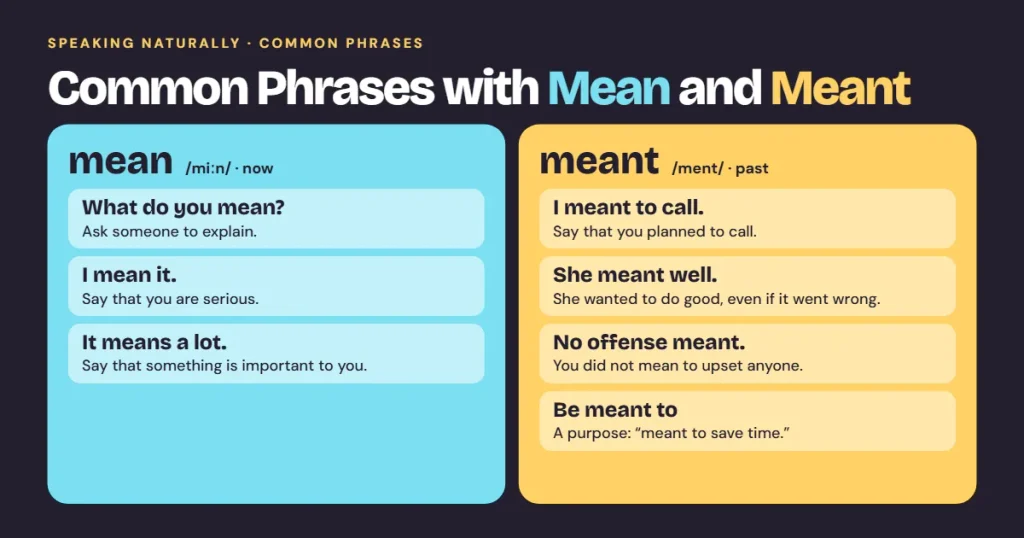
Learning common phrases can help you use these words naturally.
- What do you mean? — Ask someone to explain.
- I mean it. — Say that you are serious.
- It means a lot. — Say that something is important to you.
- I meant to call. — Explain that you planned to call.
- She meant well. — Say that she wanted to do something good, even if the result was not perfect.
- No offense meant. — Say that you did not intend to insult or upset someone.
- Be meant to — Describe a purpose or expectation, as in “This tool is meant to save time.”
Pronunciation of Mean and Meant
The two words sound different at the end.
| Word | US pronunciation | UK pronunciation |
| Mean | /miːn/ | /miːn/ |
| Meant | /mɛnt/ | /mɛnt/ |
Mean rhymes with green. Meant rhymes with sent. Both have one syllable.
Origin of Mean and Meant
The verb mean has roots in Old English and other early Germanic forms. It has long been used to express an idea, intention, or meaning.
English often changes irregular verbs instead of adding -ed. For example:
- go → went
- teach → taught
- keep → kept
- mean → meant
What People Ask About Mean or Meant
Is mean or meant correct?
Both are correct. Use mean for the base verb and present statements. Use meant for the simple past and past participle.
What is the past tense of mean?
The past tense of mean is meant.
Example: “I meant to help you.”
Is meaned a word?
In standard modern English, meaned is not the correct past form of this verb. Use meant.
Should I say “What do you mean?” or “What do you meant?”
Say “What do you mean?” After do, use the base verb.
Can I say “I have meant”?
Yes. Meant is the past participle of mean.
Example: “I have meant to ask you this for weeks.”
Does mean have more than one meaning?
Yes. As a verb, it can express meaning or intention. As an adjective, it can describe someone or something unkind.
What does “I meant to” mean?
It means you intended or planned to do something.
Example: “I meant to call you” means you planned to call, but the call may not have happened.
How can I remember mean and meant?
Think about the verb form. Mean is the base form; meant is the past form and past participle. Also remember that did takes the base form: “Did you mean?”
Practice Quiz: Mean or Meant?
Choose the correct word to complete each sentence.
- What does this sign ___?
- I ___ to call you last night.
- What did she ___ by that?
- He has ___ well from the start.
- That was a ___ thing to say.
Answers
- mean
- meant
- mean
- meant
- mean
Conclusion
The difference between mean or meant is easy to learn when you understand their grammar. Use mean as the base form of the verb, as in “What do you mean?” Use meant for the simple past and past participle, as in “I meant to call” and “I have meant to ask.” Remember that mean can also be an adjective meaning unkind. For example, “I mean what I say,” “I meant what I said,” “What did you mean?” and “She has meant well.” With a little practice, you can choose the right word and use mean or meant with confidence.

I’m Samia Jamshaid, an English language specialist, SEO specialist, digital publisher, and researcher. I create clear, accurate, and well-researched content on English grammar, vocabulary, word meanings, and language comparisons, helping readers understand and use English with confidence.


1 thought on “Mean or Meant: Grammar Guide With Examples 2026”