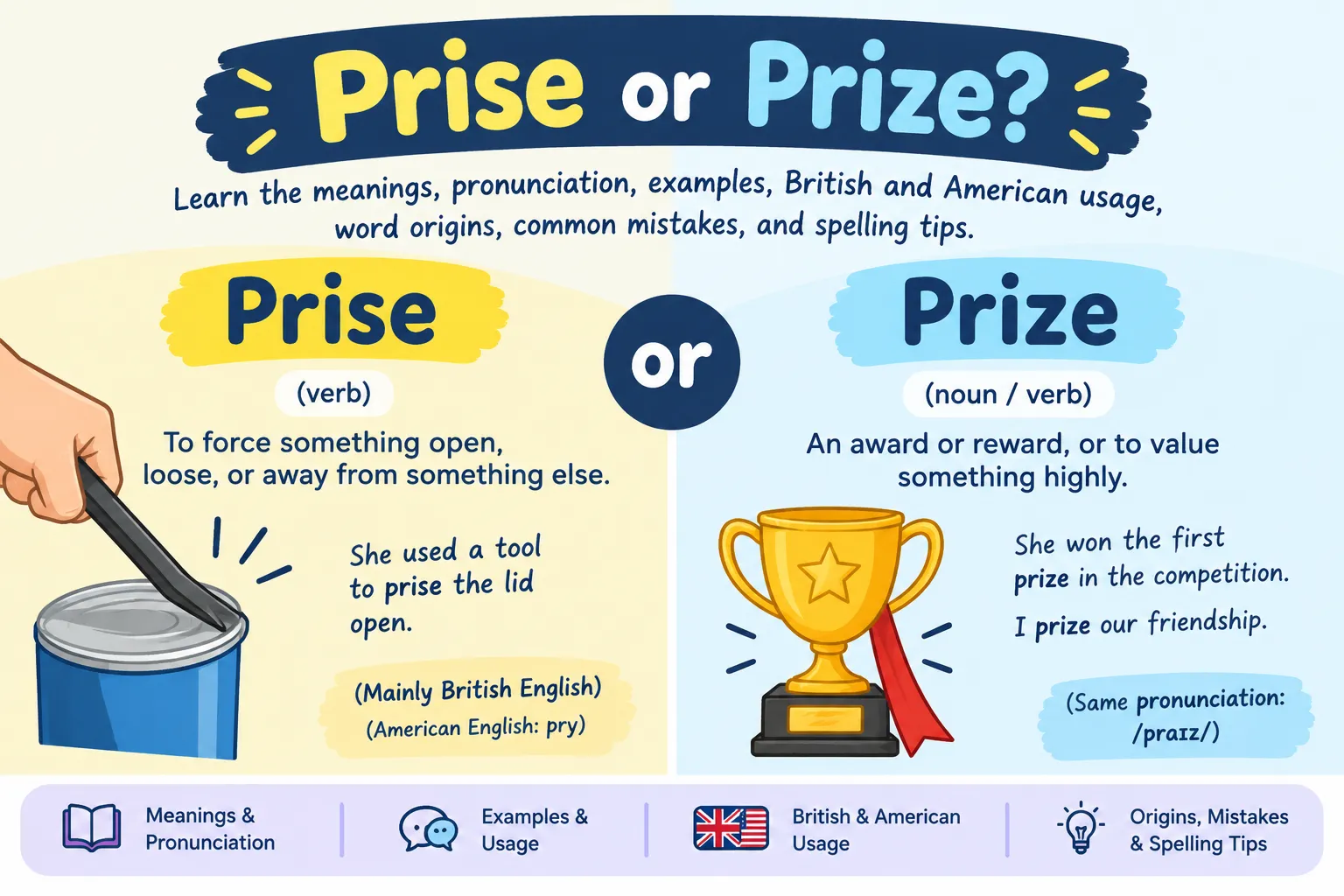
Have you ever wondered whether to write prise or prize? These two words can confuse English learners because they sound the same. However, they have different meanings and uses.
The good news is that the difference is easy to learn. Prize is most often a noun that means an award won in a competition. It can also be a verb that means to value something highly. Prise is mainly used as a verb in British English. It means to force something open, loose, or away from something else.
For example, you can win a prize in a school competition. You can also prise open a stuck lid with a suitable tool.
Both words are generally pronounced /praɪz/. They sound alike, but their spelling and meaning depend on the sentence. In American English, pry is the more usual spelling for the action of forcing something open.
In this guide, you will learn the meanings, examples, pronunciation, word origins, common mistakes, and British and American usage of prise and prize.
1. What Is the Difference Between Prise and Prize?
The main difference is their meaning and use.
- Prize (noun): An award or reward given to a winner.
- Prize (verb): To value or treasure something highly.
- Prise (verb): To use force or leverage to open, loosen, or separate something. This spelling is especially common in British English.
Examples of prize
- Maya won first prize in the spelling contest.
- I prize the time I spend with my family.
Examples of prise
- He used a tool to prise the lid open.
- She tried to prise the stuck window away from its frame.
2. Prise or Prize: Pronunciation
One reason these words cause confusion is that they are generally pronounced the same way.
| Word | US pronunciation | UK pronunciation | Syllables |
| Prize | /praɪz/ | /praɪz/ | 1 |
| Prise | /praɪz/ | /praɪz/ | 1 |
Are prise and prize homophones?
Yes. In their standard pronunciations, prise and prize are homophones. Homophones are words that sound alike but have different meanings or spellings.
Remember that price is different. It is pronounced /praɪs/, with an /s/ sound at the end. Price means the amount of money something costs.
Do not confuse these two pairs:
- Prise and prize: Same pronunciation, different meanings and uses.
- Price and prize: Different final consonant sounds and different meanings.
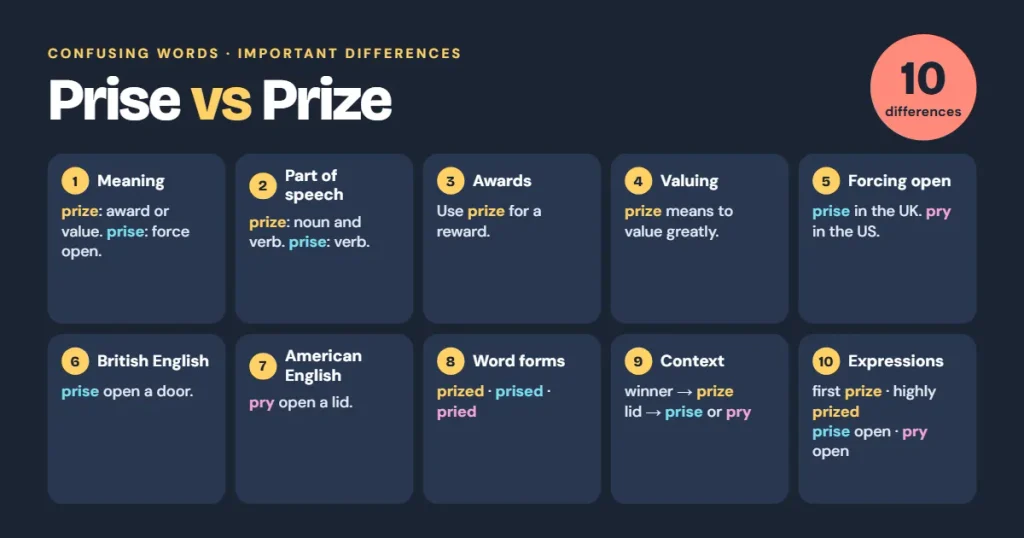
3. Ten Important Differences Between Prise and Prize
Difference 1: Meaning
Prize usually means an award or something valued highly. Prise usually means to force something open or away.
- She received a prize for her artwork.
- He used a screwdriver to prise the cover loose.
Difference 2: Part of speech
Prize can be both a noun and a verb. Prise is mainly used as a verb in the meaning discussed here.
- The prize was a new bicycle. (Noun)
- I prize your friendship. (Verb)
- They prised the board away from the wall. (Verb)
Difference 3: Awards and rewards
Use prize when you mean an award or reward.
- The winner received a cash prize.
- The school offered a prize for the best science project.
Do not use prise for an award.
Difference 4: Valuing something
The verb prize can mean to value something greatly.
- She prizes honesty above wealth.
- He prized the old watch because it belonged to his grandfather.
In this sense, prise is not the correct choice.
Difference 5: Forcing something open
Use prise in British English when force or leverage is used to open or separate something.
- He prised open the wooden box.
- She carefully prised the lid off the jar.
In American English, pry is generally the more natural choice for this meaning.
Difference 6: British English
British writers commonly use prise for the action of forcing something open.
- The mechanic prised the panel away.
- She tried to prise the door open.
The spelling prize is also recorded for this action, but prise clearly signals the British usage to many readers.
Difference 7: American English
American writers usually choose pry for the action of forcing something open.
- He used a bar to pry the lid off.
- She tried to pry the board loose.
American English still uses prize for an award and for the verb meaning to value highly.
Difference 8: Word forms
The usual forms differ in spelling.
| Base word | Past tense | -ing form |
| Prize (value highly) | Prized | Prizing |
| Prise (force apart) | Prised | Prising |
| Pry (American usage) | Pried | Prying |
Examples:
- She prized the gift.
- He prised the lid open.
- They pried the board loose.
Difference 9: Context
The words around the target word help you choose the right spelling.
- Words such as winner, award, and competition often point to prize.
- Words such as lid, door, loose, and open may point to prise in British English or pry in American English.
Difference 10: Common expressions
Some expressions make the difference easy to remember.
- First prize: The top award in a competition.
- Highly prized: Greatly valued or admired.
- Prise open: To force something open.
- Pry open: The common American equivalent of prise open.
You may also like https://orchoice.com/liaison-or-liason/
4. Comparison Table: Prise vs. Prize
| Feature | Prise | Prize |
| Main meaning | Force something open or apart | An award or something valued |
| Common part of speech | Verb | Noun and verb |
| Pronunciation | /praɪz/ | /praɪz/ |
| Syllables | One | One |
| British usage | Common for forcing something apart | Common for awards and valuing |
| American usage | Less usual than pry for forcing apart | Common for awards and valuing |
| Example | She prised the lid open. | He won a prize. |
| Memory clue | Think of a tool separating two things | Think of an award or something precious |
5. Origin and History of Prise and Prize
The histories of these words overlap, which helps explain their similar spelling and sound.
The noun prize, meaning an award or reward, developed from Middle English prise and is linked to Old French pris, meaning value, worth, or reward. The spelling with z became established later.
The verb prize, meaning to value something highly, also has a history linked to older English forms and the Old French verb preisier, meaning to value or appraise.
The verb prise, meaning to force something open or apart, comes from a different historical sense connected with taking hold or grasping. Its history is linked to Old French prise, meaning a taking or a grasp.
Although the words have overlapping histories, their modern meanings are different. You should choose the spelling based on what you want to say, not just on the words’ origins.
6. British English vs. American English
The most useful regional difference concerns the action of forcing something open.
In British English
Prise is a common spelling for this action.
- He prised the window open.
- They prised the old tiles from the floor.
Prize is used for awards and for valuing something highly.
- She won a prize.
- He prizes his independence.
In American English
Pry is generally preferred when something is forced open or separated.
- He pried the window open.
- They pried the old tiles from the floor.
Prize keeps its usual meanings.
- She won a prize.
- He prizes his independence.
7. Why Do People Confuse Prise and Prize?
There are three main reasons.
1. They sound the same.
Both are generally pronounced /praɪz/. You cannot hear the spelling difference in ordinary speech.
2. Their spellings differ by only one letter.
The letters s and z can be confusing, especially for learners who are still building English vocabulary.
3. Both spellings are connected to recognized English words.
Neither spelling is simply a typo. The right choice depends on the meaning and the variety of English being used.
How to avoid confusion
Ask yourself one question: What do I mean?
- If you mean an award, write prize.
- If you mean to value something highly, write prize.
- If you mean to force something open in British English, write prise.
- If you mean the same physical action in American English, pry is usually the best choice.
8. Common Mistakes to Avoid
Mistake 1: Using prise for an award
Incorrect: She won first prise in the contest.
Correct: She won first prize in the contest.
An award is a prize, not a prise.
Mistake 2: Using prize when you mean to value something
Correct: I prize my family’s support.
The verb prize means to value or treasure something. It does not need to refer to a competition.
Mistake 3: Assuming prise is always wrong
Incorrect advice: Prise is never a real English word.
Correct explanation: Prise is a recognized verb, especially in British English, for forcing something open or apart.
Mistake 4: Assuming prise and prize sound different
They are generally homophones. Do not rely on pronunciation to choose between them.
Mistake 5: Confusing prize with price
- The price of the book is ten dollars.
- The prize for the winner is ten dollars.
Mistake 6: Ignoring regional usage
A British writer may write prise open the lid. An American writer would usually write pry open the lid. Both communicate the same action.
9. Everyday Examples of Prise and Prize
Here are more examples to help you understand the words in everyday situations.
Prize as a noun
- The child won a prize for reading ten books.
- First prize went to the youngest singer.
- The prize included a medal and a certificate.
- Everyone hoped to win the main prize.
- The team celebrated its prize after the final match.
Prize as a verb
- I prize your honest advice.
- She prizes the letters her mother wrote.
- They prized the painting for its history.
- He prizes trust more than fame.
- The collector prized the rare coin.
Prise as a verb
- He used a tool to prise the lid open.
- She tried to prise the stuck drawer loose.
- They prised the board from the frame.
- The worker carefully prised the old tile away.
- He managed to prise the window open.
10. Connotation and Figurative Meaning
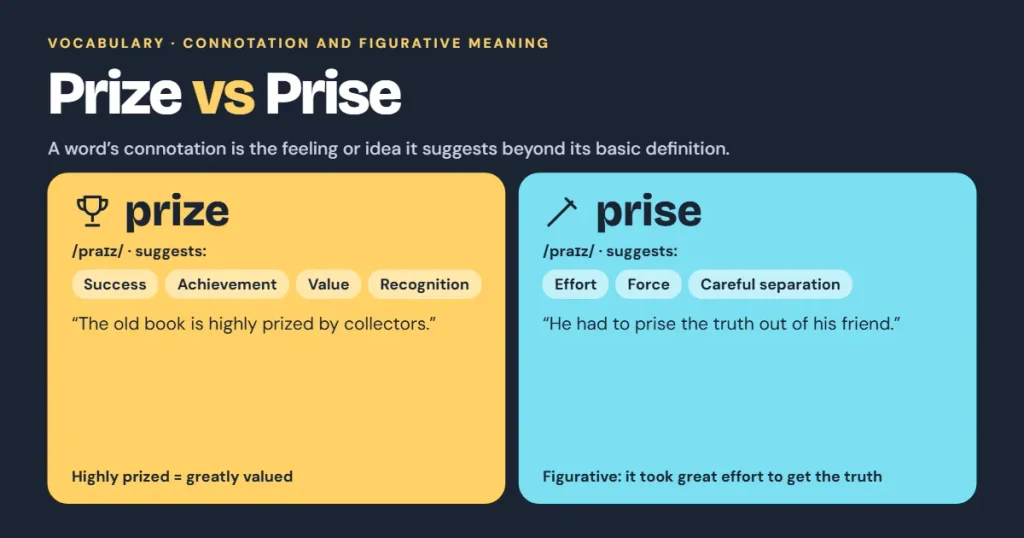
A word’s connotation is the feeling or idea it suggests beyond its basic definition.
Prize
The word prize often suggests success, achievement, value, or recognition.
For example, “She is the prize of the team” may suggest that she is especially valuable, although the wording can sound unusual or context-dependent.
The phrase highly prized is a natural way to say that something is greatly valued.
Example: “The old book is highly prized by collectors.”
Prise
The word prise often suggests effort, force, or careful separation.
Example: “He had to prise the truth out of his friend.”
This figurative use means he had difficulty getting the friend to reveal the truth. It does not refer to physically opening an object.
11. Idioms and Common Expressions
Neither prise nor prize appears in a large number of everyday idioms, but several useful expressions can help you learn their meanings.
- First prize: The top award in a contest.
- Consolation prize: An award given to someone who did not win the main award.
- Highly prized: Greatly valued or admired.
- Prize possession: Something a person values greatly.
- Prise open: To force something open, especially in British English.
- Prise something out of someone: To get information from someone with difficulty.
Examples:
- The runner won first prize.
- Her grandmother’s ring is her prize possession.
- The mechanic had to prise open the panel.
- The reporter tried to prise a comment out of the official.
12. Which Word Should You Use?
Choose the word that matches your meaning.
| If you want to say… | Use… | Example |
| An award won in a contest | Prize | He won a prize. |
| To value something highly | Prize | I prize our friendship. |
| To force something open in British English | Prise | She prised open the lid. |
| To force something open in American English | Pry | She pried open the lid. |
| The amount paid for an item | Price | The price is too high. |
A simple rule is to remember prize = award or value, prise = force apart in British English, and pry = force apart in American English.
13. Why Does This Difference Matter?
Choosing the right word makes your writing clear and accurate. If you write prise when you mean an award, readers may stop to work out what you intended. If you use prize when you mean to force something open, the sentence may be confusing unless the context makes the meaning clear.
Regional spelling matters too. British readers commonly recognize prise open, while American readers usually expect pry open. Using the form that fits your audience can make your writing sound more natural.
The same care helps with price and prize. They differ by one consonant sound, but one means cost and the other means an award. Paying attention to meaning, spelling, and context helps you avoid errors in emails, schoolwork, articles, and everyday conversations.
14. Possible Asked Questions
1. Is it prise or prize?
Both are correct words, but they have different uses. Prize means an award or to value something highly. Prise usually means to force something open or apart, especially in British English.
2. Are prise and prize pronounced the same?
Yes. Both are generally pronounced /praɪz/ and have one syllable.
3. Is prise British or American English?
Prise is especially common in British English for the action of forcing something open. American English usually uses pry for that meaning.
4. Can prize be used as a verb?
Yes. Prize can mean to value or treasure something highly. For example: “She prizes her independence.”
5. What is the past tense of prise?
The past tense is prised. For example: “He prised the lid open.” In American English, the usual equivalent is pried, from pry.
6. What is the difference between price and prize?
Price means the amount of money something costs. Prize means an award or something won. Price ends in /s/, while prize ends in /z/.
7. How can I remember prise and prize?
Think of prize as an award or something precious. Think of prise as using force to separate two things in British English. If you are writing for an American audience, remember pry for that physical action.
Conclusion
The difference between prise and prize becomes simple when you understand their meanings. Prize is a noun that means an award or reward, and it can also be a verb meaning to value something highly. Prise is mainly used in British English as a verb meaning to force something open, loose, or away from another object. If you win a competition, you receive a prize. If you value a friendship, you prize that friendship. Whether you force a lid open, you can use prise in British English, while pry is more common in American English. Also, do not confuse prize with price. A price is the amount of money you pay for something, while a prize is an award or reward. Remember these simple differences, practic with examples, and you will become more confident in using the correct word.

I’m Samia Jamshaid, an English language specialist, SEO specialist, digital publisher, and researcher. I create clear, accurate, and well-researched content on English grammar, vocabulary, word meanings, and language comparisons, helping readers understand and use English with confidence.



1 thought on “Prise or Prize? Spelling Rules and Easy Examples 2026”